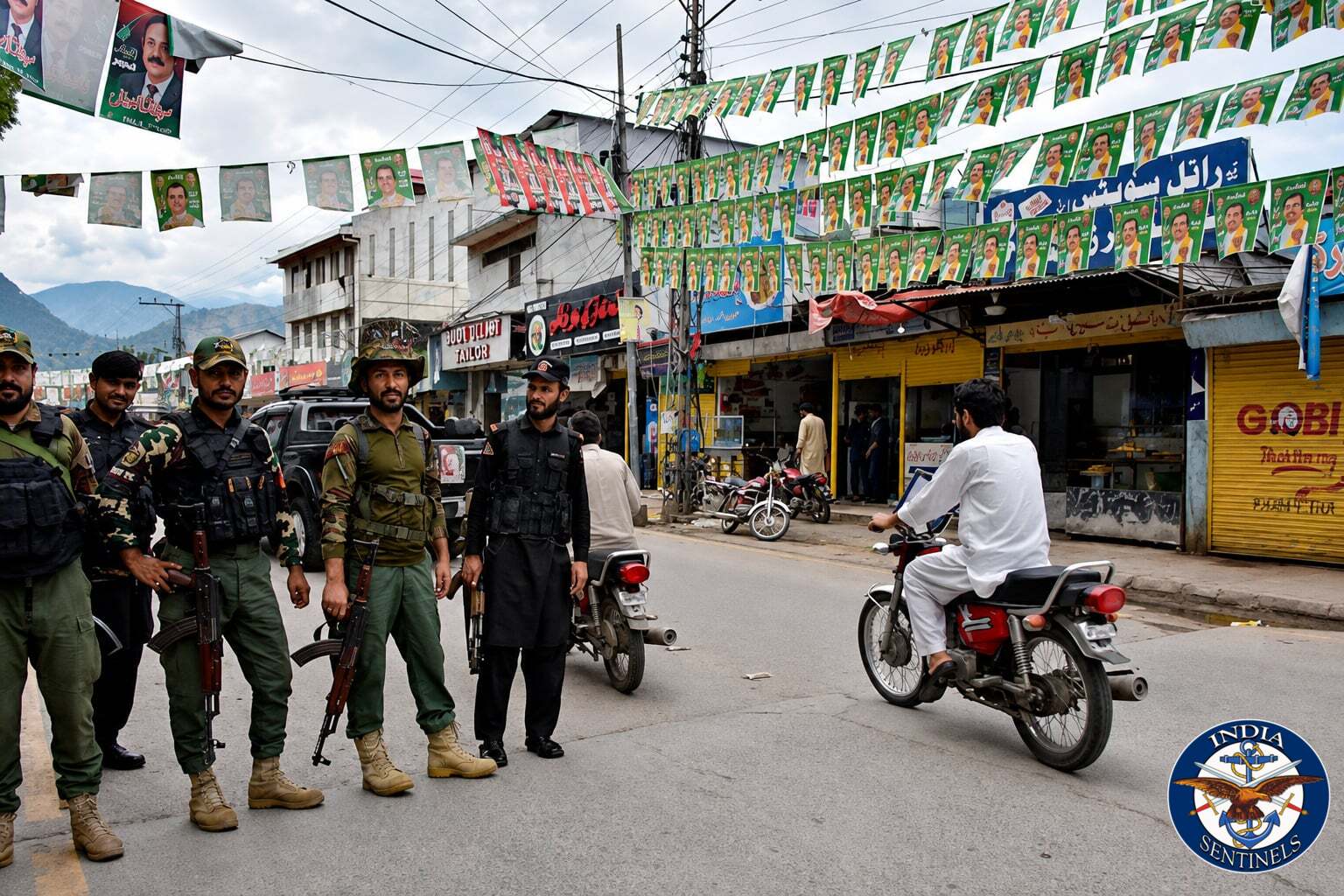
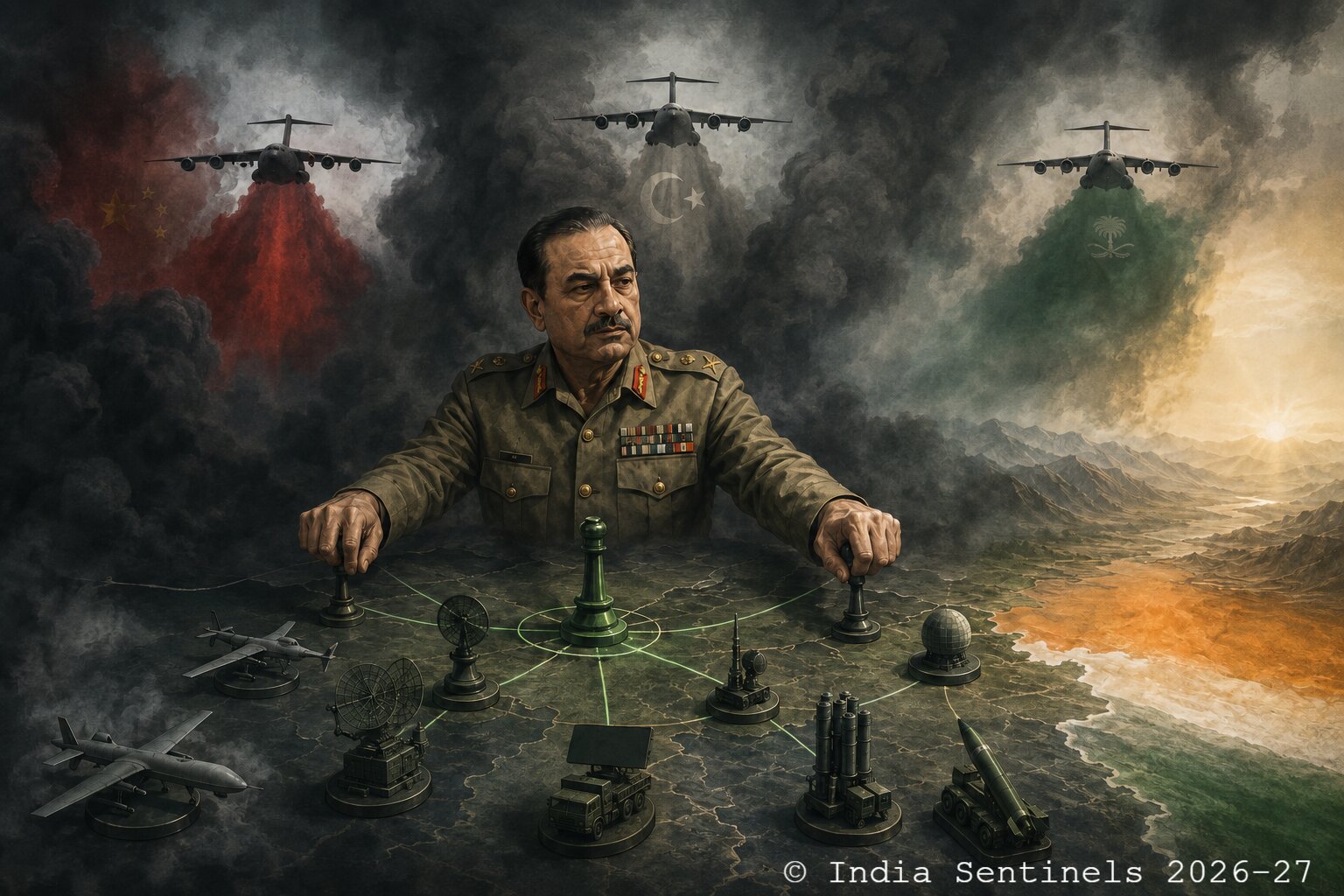
 India Sentinels illustration for representation. (© India Sentinels)
A series of significant administrative, military and diplomatic developments in Pakistan has created an unmistakable sense of unease. Considered together, the centralization of military authority, a new trilateral defence pact and reports of intensified foreign military air traffic suggest a deliberate effort to prepare the country for an uncertain strategic contingency.
At the centre of this transformation is the country’s army chief, Field Marshal Asim Munir, whose authority now extends across Pakistan’s armed forces and into its strategic command structure. The breadth and timing of these changes raise an important question for India: is Pakistan merely reorganizing its military establishment, or is it preparing for a more assertive posture?
Pakistan’s civil-military balance was fundamentally altered by the country’s 27th constitutional amendment, passed in November 2025. The amendment created the position of chief of defence forces (CDF), to be held concurrently by the chief of the army staff and placed the Pakistani navy and air force under a unified command headed by Munir.
Munir was appointed Pakistan’s first CDF on December 4, 2025, beginning a five-year tenure that could keep him in office until 2030. The constitutional changes also granted extensive legal protections to officers holding five-star rank and strengthened Munir’s position against possible institutional or political challenges.
The new arrangement replaced the country’s office of chairman joint chiefs of staff committee after its last incumbent, General Sahir Shamshad Mirza, retired in November 2025. Pakistan consequently moved away from a coordinating joint-services structure towards a command system in which the army chief exercises primacy over all three services.
The process was taken further on August 20 when Pakistan’s parliament passed the Defence Forces of Pakistan Bill, 2026, and the National Command Authority (Amendment) Bill, 2026. These measures provided the legal and administrative framework for the CDF headquarters and formally defined Munir’s operational authority over the armed forces.
Under the legislation, the CDF can retire, release, dismiss or retain military personnel, except officers appointed under Article 243 of Pakistan’s constitution. He can also approve or reject resignations, alter prescribed service limits and issue directions concerning the implementation of the unified command structure.
The CDF remains formally accountable to Pakistan’s federal government, and the prime minister retains an important role in appointments connected with the strategic command. Nevertheless, the replacement of several institutional layers with a single military chain of command gives Munir unprecedented influence over conventional operations and structures associated with Pakistan’s nuclear arsenal.
Supporters may argue that the system permits faster decisions, closer inter-service coordination and more effective multi-domain operations. Critics, however, will see it as another stage in the concentration of military power and the further erosion of meaningful civilian oversight.
Such extensive centralization is unusual during peacetime, particularly when undertaken through legislation passed with limited debate and in the face of an opposition boycott. It may streamline decision-making, but it also reduces the safeguards that might otherwise restrain a rapid escalation during a crisis.
Read also: As ties thaw, can India, China move from rivalry to defence partnership?
New external security framework
This domestic consolidation has been accompanied by Pakistan’s efforts to strengthen its external defence partnerships. The Mecca Joint Defence Agreement, signed by Saudi Arabia, Turkey and Pakistan at Al-Safa Palace on August 7 provides that an armed attack on one signatory will be regarded as an attack on all three.
The agreement envisages high-level political and military coordination, joint exercises and expanded cooperation in air defence, unmanned systems, electronic warfare and artificial intelligence. It also promotes joint development, production, technology transfer and long-term logistical support among the three countries.
For Pakistan, the arrangement could combine Saudi financial strength, Turkish defence technology and its own substantial military manpower. It does not automatically guarantee that Riyadh and Ankara would support Islamabad in every confrontation with India, but it gives Pakistan greater diplomatic and material depth than it possessed previously.
The timing of the agreement is particularly significant because Pakistan is simultaneously reorganizing its domestic command system. A more centralized military establishment, supported by closer defence-industrial relationships with China and Turkey, could respond to crises more quickly and with fewer internal constraints.
Read also: How India checkmated Pakistan COAS Gen Munir’s dream project
Questions over foreign military flights
Reports citing Indian security sources have also pointed to repeated Chinese and Turkish military transport flights into Pakistan over a period of roughly 60 hours. Chinese aircraft were reportedly tracked at Nur Khan airbase near Rawalpindi and Masroor airbase in Karachi, with Turkish military transports also said to have participated in the activity.
The precise contents of the aircraft have not been independently established, and Pakistan, China and Turkey have not publicly confirmed that the flights carried weapons. The reported frequency of the movements has nevertheless fuelled speculation that Pakistan may be replenishing drones, air-defence equipment or other military stores.
Turkey has separately been reported to have delivered two additional NGMMCCs (next-generation mobile mission control centres) to the Pakistan Air Force. The systems were reportedly intended to replace Turkish-origin command-and-control units believed to have been destroyed during Indian strikes on Nur Khan airbase under Operation Sindoor.
These reports must be treated with caution because open-source flight tracking cannot establish the nature or quantity of military cargo. Even so, the concentration of military flights over a short period deserves attention, particularly when viewed alongside Pakistan’s command restructuring and expanding defence partnerships.
The calendar further magnifies Indian concern because New Delhi is preparing to host the BRICS Summit on September 12–13 this year. The Russian president, Vladimir Putin, is expected to participate, and the Chinese president, Xi Jinping, is also likely to attend, although temporal proximity alone does not establish any link between the summit and Pakistan’s military activity.
Read also: Will recent Bangladesh-China pact pose new challenge to Siliguri Corridor?
Shadow of Operation Sindoor
The core driver behind this comprehensive defence build-up seems to be rooted in the lingering military fallout from Operation Sindoor, launched by India following the Pahalgam terror attack. The operation highlighted serious gaps in Pakistan’s air-defence networks. While India demonstrated in front of the world, its deep strategic strikes with clear evidence, Pakistan’s counterclaims, shorn of credible evidence, struggled to find acceptance globally. Its narrative of downing Indian fighter jets fell flat in absence of facts.
There would be no bigger humiliation for the Pakistani army and Asim Munir to go down in history as the ones who could not cause even a minor damage to India, while India struck at will, unchallenged, deep inside Pakistan and destroyed its assets and bases right next to its military headquarters.
Pakistan’s only strategic missile launched towards Delhi to generate sensationalism too failed when it was easily intercepted enroute at a much safer distance from Delhi. Moreover, a recent docuseries has the Indian director general of military operations (DGMO) narrating verbatim how Pakistan’s DGMO picked up the phone and requested his Indian counterpart for a ceasefire.
Therefore, it stands to logic that Field Marshal Asim Munir would look to settle the scores in the currency of his tenure, and all this preparation seem to be headed in one direction.
Read also: How Trump’s tariff plans could reshape US-India defence ties
India cannot afford complacency
The concentration of conventional and strategic authority under one military commander, reinforced by new foreign partnerships and reported equipment movements, has altered the security equation in South Asia. Munir now possesses formidable legal authority, the backing of Pakistan’s civilian government and considerable influence over the country’s strategic decision-making machinery.
This may not mean that every military flight into Pakistan is evidence of an imminent operation against India. Nevertheless, India needs to keep its guard up.
A highly centralized command structure may allow Pakistan to react more coherently during a crisis, but it can also accelerate escalation by narrowing the number of institutions involved in critical decisions. When conventional military authority and nuclear oversight converge within a single chain of command, the consequences of misjudgement become considerably more dangerous.
India must consequently maintain close intelligence surveillance, strengthen air and missile defence and assess Pakistan’s activities without either alarmism or complacency. Smoke does not invariably mean fire, but there is now enough of it for New Delhi to watch the horizon with exceptional care.
Disclaimer: The views expressed in the article are the author’s own and don’t necessarily reflect the views of India Sentinels.
Follow us on social media for quick updates, new photos, videos, and more.
X: https://x.com/indiasentinels
Facebook: https://facebook.com/indiasentinels
Instagram: https://instagram.com/indiasentinels
YouTube: https://youtube.com/indiasentinels
© India Sentinels 2026-27