 Illustration for representation. (© India Sentinels 2026–27)
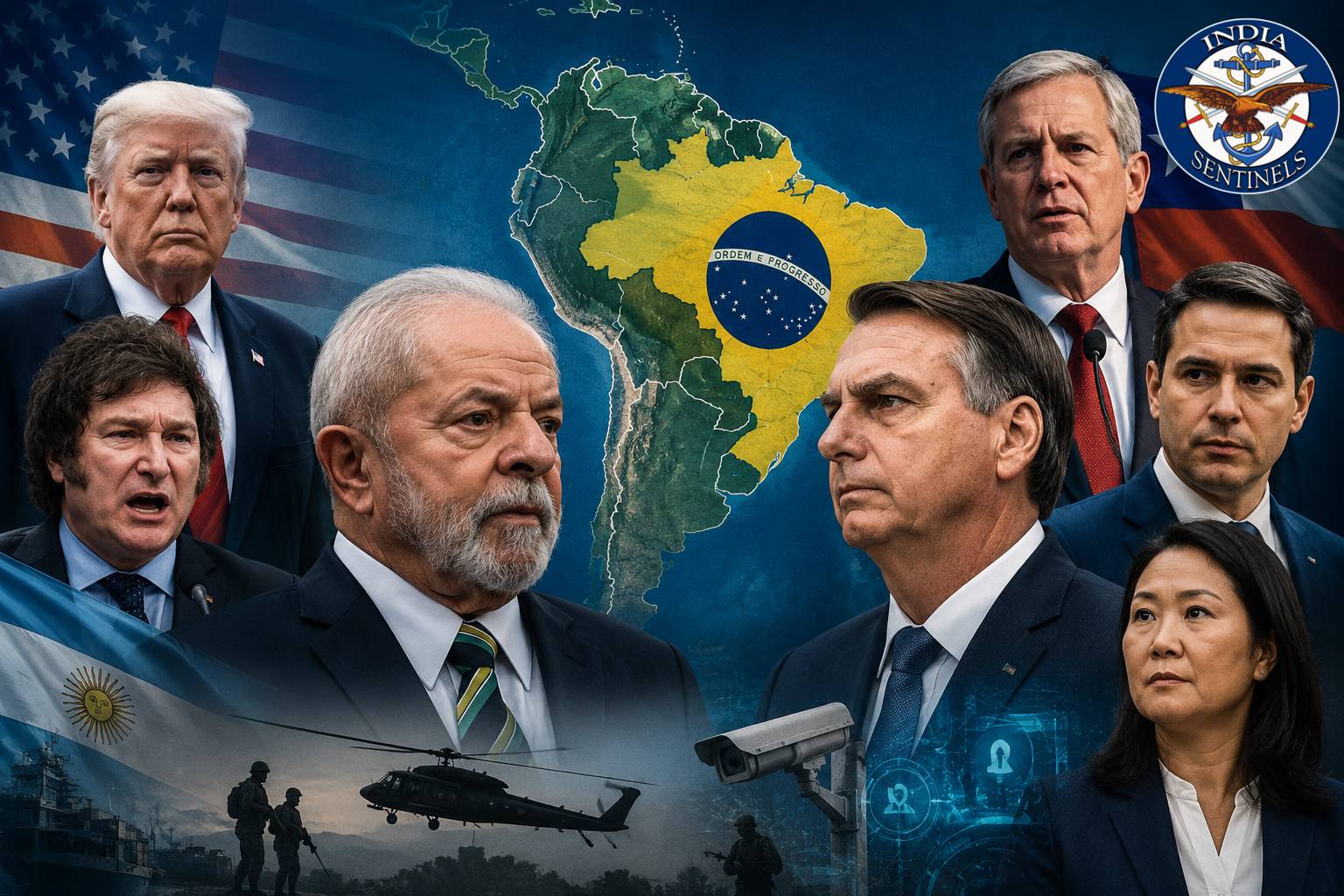
Latin America is in the middle of another political turn, with conservative leaders gaining ground after the leftward momentum commonly described as the pink tide. Argentina under Javier Milei, Chile under José Antonio Kast, Ecuador under Daniel Noboa, Peru under Keiko Fujimori and Colombia under Abelardo de la Espriella now form a powerful, though far from uniform, current on the right.
The immediate causes are largely domestic: fear of violent crime, frustration over the cost of living, weak growth, migration pressures and distrust of political establishments. Voters have often chosen candidates who promise order, leaner government and faster economic reform, but that does not mean the region has acquired a single ideology or become automatically pro-American.
The geopolitical consequences are nevertheless substantial because several of these governments are more receptive to Washington on security, counter-narcotics, migration and defence. Israel also sees an opening through its long-standing strengths in intelligence, cybersecurity, surveillance, drones and other security technologies, although the war in Gaza and the question of Palestine continue to divide Latin American governments and societies.
Read also: Brazil-Argentina rift signals new polarization phase in South America
Argentina has moved furthest in this direction, with Milei cultivating close political ties with the US president, Donald Trump, and the Israeli prime minister, Benjamin Netanyahu. Colombia’s new president has similarly promised to restore relations with Israel and deepen security cooperation with Washington after years of tension under his predecessor, Gustavo Petro.
The rightward movement is therefore real, but its strategic meaning will depend heavily on Brazil. As the region’s largest economy and most influential diplomatic power prepares for its October election, the choice before Brazilian voters could determine whether the political swing develops into a broader geopolitical realignment or remains a collection of nationally driven changes.
Washington’s renewed hemispheric assertiveness
The regional shift has coincided with a more coercive US approach to the Western Hemisphere, most dramatically displayed in Venezuela. On January 3, 2026, US forces captured the Venezuelan president, Nicolás Maduro, in a military operation and took him to New York to face drug-trafficking charges, to which he has pleaded not guilty.
Trump then said the US would oversee Venezuela until a safe transition could be arranged and declared that he was not afraid to put troops on the ground. Whatever one’s judgment of the operation’s legality or wisdom, its psychological effect across a region with a long and painful memory of US interventions is difficult to dismiss.
Read also: From Sierra Leone to Gaza – A former peacekeeper’s reckoning with silence
For decades, most Latin American governments expected pressure from Washington to arrive through sanctions, financial restrictions, diplomatic isolation or support for domestic opponents. Venezuela showed that the Trump administration was also prepared, in exceptional circumstances, to cross the threshold into direct military action.
That does not make further interventions inevitable, and countries across the region will draw different lessons from the episode. Governments seeking closer relations with Washington may see stronger security guarantees in alignment, while those that value autonomy have a greater incentive to diversify partnerships and reduce their exposure to US pressure.
Smaller states face an even narrower margin for manoeuvre because they must weigh the domestic benefits of defiance against the economic and security costs of antagonizing Washington. The result is not a simple return to an old sphere of influence, but a sharper contest over how much freedom Latin American governments can retain within an increasingly assertive hemispheric order.
Why Brazil is different
This is what makes Brazil’s position so consequential: it is not Venezuela, nor is it merely another state adjusting to a regional trend. Brazil is Latin America’s largest economy and most populous country, a major agricultural and energy producer, a leading member of Brics, the central power in Mercosur and the only regional state with the scale to pursue sustained strategic autonomy.
That autonomy does not amount to hostility towards the US, with which Brazil retains deep commercial, diplomatic and institutional ties. It reflects a long-standing preference for avoiding permanent alignment, preserving room for independent action and maintaining relations across competing centres of power.
The foreign policy of the Brazilian president, Luiz Inácio Lula da Silva, follows this tradition by combining engagement with Washington and Europe with closer ties to China, Brics and the wider Global South. This makes Brazil an awkward fit within any exclusively US-centred political and security architecture, even when Brasília and Washington share practical interests.
Read also: Now, a crypto chokehold shadows over Strait of Hormuz
Brazil’s importance also comes from its ability to give regional institutions political weight. Without Brazilian participation, schemes for South American autonomy are weakened; with it, even ideologically diverse governments have an alternative to choosing between Washington and Beijing.
The Brazil-US dispute
The deterioration in Brazil-US relations during 2026 has therefore acquired significance beyond the immediate dispute over trade. Washington imposed new tariffs on Brazilian goods, with levies on some affected products reaching 37.5 per cent, and Brasília responded by opening a process under its economic reciprocity law while continuing to seek negotiations.
The confrontation then moved into diplomacy after Brazil withheld approval for Trump’s nominee as US ambassador and denied visas to two American diplomats. Washington retaliated on August 4 by revoking the visa of Brazil’s ambassador to the US, Maria Luiza Ribeiro Viotti, turning an already serious disagreement into a public test of political will.
These disputes have become entangled with Brazil’s election and the legacy of Jair Bolsonaro, the former president whose family maintains close relations with the US conservative movement. Milei has openly associated himself with the Bolsonaro camp, while Lula has framed the contest around national sovereignty and resistance to foreign interference.
Read also: Petrodollar’s last rites, yuan’s quiet rise, and India’s self-inflicted wounds
The disagreement is not simply a clash between left and right, because the two countries still have strong incentives to preserve trade and official contact. It is better understood as a contest over the terms of the relationship: Washington wants greater political and strategic convergence, while Lula’s government insists that cooperation cannot require subordination.
Brazil’s election becomes a regional test
Brazil will hold the first round of its presidential election on October 4, with a run-off scheduled for October 25 if no candidate secures the required majority. The campaign is increasingly polarized between Lula and the senator, Flávio Bolsonaro, Jair Bolsonaro’s son, although smaller candidates and Brazil’s fragmented party system could still shape the final result.
An August 11 CNT/MDA poll placed Lula on 42.4 per cent and Flávio Bolsonaro on 28.7 per cent in a first-round scenario, with the president leading by 48 per cent to 39.1 per cent in a run-off. A Genial/Quaest survey published on August 14 produced a much tighter second-round contest, putting Lula ahead by 43 per cent to 40 per cent, within the poll’s margin of error.
The variation between surveys underlines the danger of treating the election as settled before the formal campaign has run its course. Lula remains the front-runner, but Flávio Bolsonaro has narrowed the gap, and high rejection levels for both men leave the contest vulnerable to economic shocks, diplomatic crises and changes in turnout.
A Lula victory would broadly preserve Brazil’s existing course: engagement with Brics, strong economic relations with China, emphasis on the Global South and resistance to excessive US influence. It would not end cooperation with Washington, but it would keep Brazil as the principal regional advocate of a multipolar foreign policy.
A Flávio Bolsonaro victory would make a substantial foreign-policy realignment more likely, although institutions, Congress and commercial interests would limit the speed and scope of any change. Brazil could be expected to move closer to Washington, rebuild political ties with Israel and align more readily with Milei and other conservative governments on security and regional diplomacy.
Argentina and a fractured South America
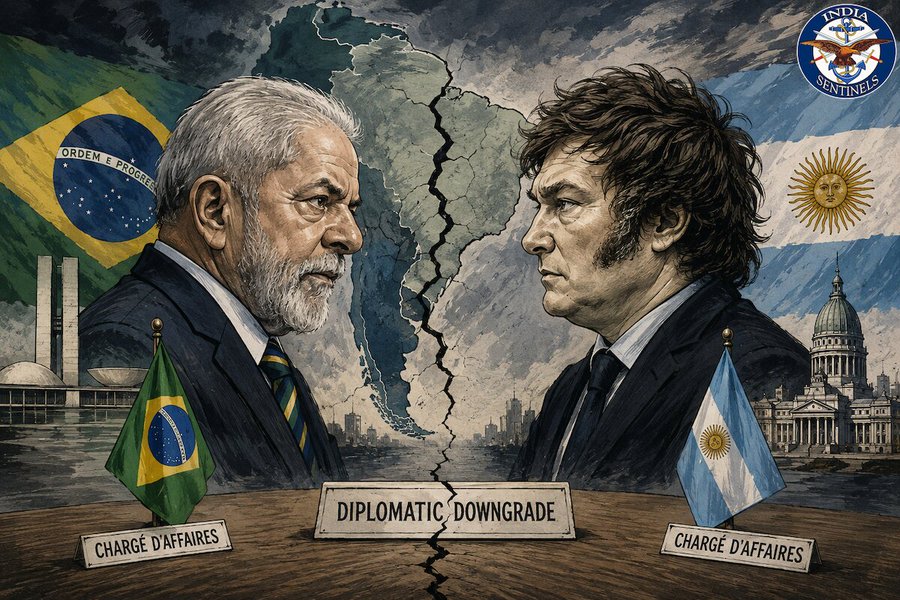
The relationship between Brazil and Argentina matters because the two countries have historically formed South America’s political and economic core. They now represent competing visions, with Milei emphasizing alignment with Trump and Netanyahu while Lula stresses autonomy, multipolarity and the Global South.
The personal hostility between the two presidents has spilled into formal diplomacy, and Brazil downgraded relations with Argentina to the chargé d’affaires level on August 5 after renewed insults by Milei. Trade, consular work and practical cooperation continue, but the dispute has pushed bilateral political relations to their lowest point in decades.
Read also: Thank you, Trump, for making India understand America like never before
This division places additional strain on Mercosur, which is already debating how much freedom members should have to conclude bilateral commercial agreements. A prolonged rupture between Brasília and Buenos Aires would weaken the bloc’s capacity to negotiate collectively and to act as an instrument of regional influence.
A Bolsonaro-led Brazil, by contrast, would bring South America’s two largest economies closer to a common conservative and US-friendly orientation. That alignment could give Washington more influence without requiring direct control, but it would not erase differences over trade, industrial policy or national interest.
Israel’s opening – and its limits
Israel’s role in Latin America should be examined within this wider realignment, but not reduced to ideology alone. Its defence and security companies have built relationships in the region over decades, and demand for intelligence, border monitoring, cyber defence, drones and counter-terrorism systems is likely to grow as governments give greater priority to organized crime and public security.
Conservative leaders often present cooperation with Israel as part of a broader political identity centred on security, Western alignment and opposition to left-wing governments. Milei has pledged to move Argentina’s embassy to Jerusalem, while de la Espriella has promised to restore Colombia’s ties with Israel after Petro severed diplomatic relations in 2024.
Yet Israel’s opportunities are constrained by strong regional opposition to its conduct in Gaza and its policies towards the Palestinians and the West Bank. Brazil under Lula has been sharply critical of Israel, and public opinion, coalition politics and legal scrutiny will continue to limit how far some governments can expand political or military ties.
The most plausible outcome is selective growth rather than a uniform diplomatic embrace. Governments may purchase Israeli technology or resume intelligence cooperation while maintaining different positions at the United Nations and on the recognition of Palestinian rights.
A new hemispheric order?
Latin America’s changing political landscape is best understood as a contest among three broad approaches rather than a clean ideological wave. The first is a conservative order aligned more closely with the US, built around security cooperation, market-oriented reform, tougher migration policies and warmer relations with Israel.
The second is strategic autonomy, under which governments maintain working relations with Washington while deepening ties with China, Brics and other partners in the Global South. The third is a transactional model in which states move between these poles according to domestic pressures, commodity cycles and immediate political advantage.
Most countries will probably combine elements of all three because electoral labels do not remove economic dependence, institutional constraints or public resistance. Even leaders who admire Trump or Netanyahu must manage relations with China, while left-leaning governments cannot ignore the US market, financial system and security reach.
Brazil will nevertheless exert disproportionate influence over which model gains momentum. A Lula victory would preserve a powerful counterweight to an exclusively US-centred hemisphere, whereas a Flávio Bolsonaro victory could create a conservative axis linking Brasília and Buenos Aires with several governments along the Pacific coast.
Washington would then gain something more durable than overt dominance: a network of governments whose domestic priorities increasingly converge with US strategic interests. Israel, in turn, would find a larger market for security cooperation and a more receptive diplomatic environment, even though neither development would be uniform or uncontested.
The October election is consequently about more than Lula’s political survival or the Bolsonaro family’s return to power. It may decide whether Brazil remains the principal anchor of Latin American strategic autonomy or becomes the decisive weight behind a conservative realignment of the Western Hemisphere.
Disclaimer: The views expressed in the article are the author's own and don’t necessarily reflect the views of India Sentinels.
Follow us on social media for quick updates, new photos, videos, and more.
X: https://x.com/indiasentinels
Facebook: https://facebook.com/indiasentinels
Instagram: https://instagram.com/indiasentinels
YouTube: https://youtube.com/indiasentinels
© India Sentinels 2026-27