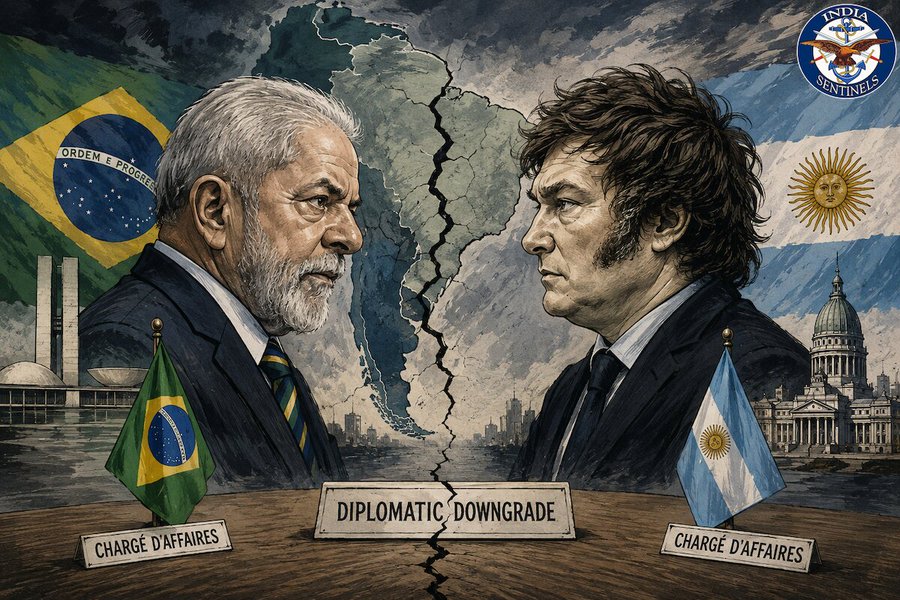
 Illustration for representation. (© India Sentinels 2026–27)
When writing about political ideologies in South America, it is tempting to interpret developments through the familiar cycle of the arrival or retreat of the “pink tide”. The latest dispute between Brazil and Argentina, however, deserves to be examined on its own terms, even though its roots lie unmistakably in the ideological divisions reshaping the region.
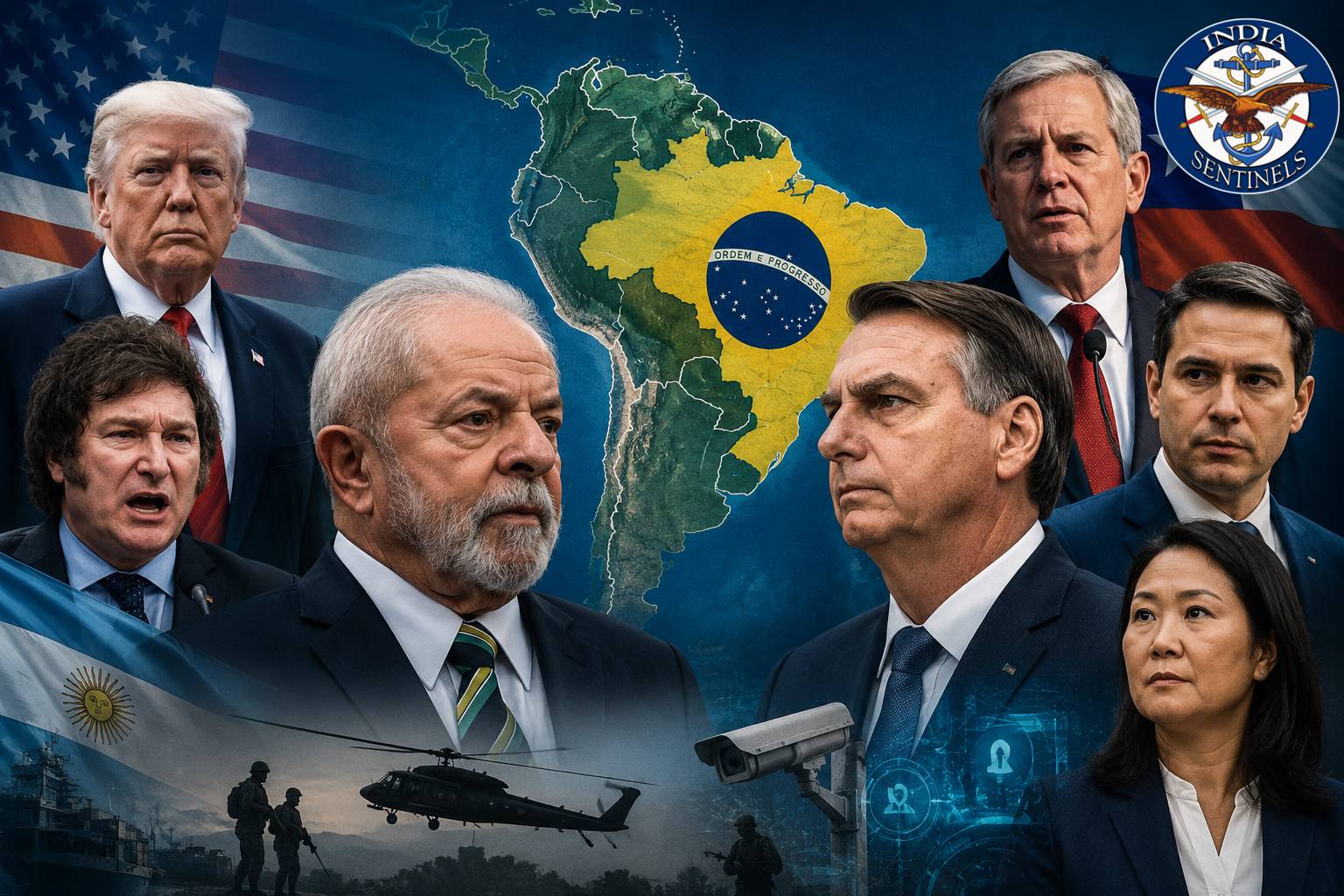
Argentina’s president, Javier Milei, has repeatedly made disparaging remarks about his Brazilian counterpart, Luiz Inácio Lula da Silva, commonly known as Lula. Milei’s descriptions of Lula as a “corrupt” and “convicted” politician have emerged as the immediate trigger for Brazil’s decision to downgrade diplomatic relations with Argentina to the level of chargé d’affaires.
Yet the deterioration represents more than a quarrel between two presidents. It points to a deeper fault line in South American politics, where ideological contestation, domestic political polarization and competing geopolitical alignments are increasingly influencing relations between states.
Relations between Brazil and Argentina have historically remained resilient despite ideological differences. The restoration of democracy in both countries during the 1980s transformed a relationship once characterized by strategic rivalry into one centred on economic integration, culminating in the establishment of Mercosur in 1991.
Successive governments largely recognized that political differences should not undermine the institutional foundations of regional cooperation. Even administrations with sharply different ideological orientations generally sustained high-level diplomatic engagement.
That consensus, however, has progressively eroded since Milei took office in December 2023. Personal hostility between the two presidents has become increasingly difficult to separate from official diplomacy. Lula did not attend Milei’s inauguration, while the Argentine president has repeatedly used belittling language against his Brazilian counterpart, questioning not only his government but also his political legitimacy.
Unlike previous ideological disagreements, which were managed through institutional dialogue, the present relationship has lacked sustained political engagement almost from the outset. This vacuum has allowed personal antagonism to increasingly shape bilateral diplomacy.
But attributing the dispute solely to personality politics would overlook the structural changes under way in South America. At its core, the conflict reflects two competing visions of the regional and international order.
Under Lula, Brazil has sought to restore its traditional role as South America’s principal diplomatic actor. Brasília has prioritized the revival of Mercosur, reinforced its commitment to BRICS, expanded South-South cooperation and maintained engagement with both Western and non-Western powers, particularly China.
Brazilian foreign policy continues to emphasize strategic autonomy, multilateralism and regional leadership through consensus-building rather than rigid bloc politics.
Argentina under Milei has moved in a markedly different direction. His government has rejected many of the foreign-policy assumptions that guided Buenos Aires over the previous two decades. Argentina declined to join BRICS, while Milei has cultivated particularly close ties with the United States and Israel and increasingly framed foreign policy through ideological alignment rather than strategic balancing.
The divergence, therefore, goes beyond differences in diplomatic priorities. It reflects fundamentally different conceptions of South America’s place in an evolving international order.
The deterioration has also been accelerated by the growing overlap between domestic politics and foreign policy. Milei’s repeated expressions of support for former Brazilian president Jair Bolsonaro, coupled with his criticism of Brazil’s judiciary and political institutions, have been viewed in Brasília as interference in the country’s domestic affairs.
Such interventions are particularly sensitive in Brazil, where political and judicial controversies surrounding Bolsonaro remain deeply contentious. From Brasília’s perspective, the disagreement has consequently moved beyond foreign-policy differences and entered the terrain of Brazil’s internal political contestation.
The timing of the diplomatic downgrade is equally significant. It comes against the backdrop of a sharp deterioration in Brazil’s relations with the United States.
In recent weeks, Brasília deferred granting agrément to US president Donald Trump’s nominee for ambassador, citing concerns over diplomatic protocol, while the United States rescinded the visa of Brazil’s ambassador in Washington following disagreements over diplomatic appointments and visa restrictions imposed by Brazil on two US officials.
Although these developments are separate from Brazil’s dispute with Argentina, Brasília appears to see a common thread: a growing tendency among ideologically aligned foreign actors to engage with Brazil’s domestic political controversies, particularly as the country approaches elections.
This wider context is important in understanding how Brazil interprets Milei’s rhetoric. His continued support for Bolsonaro and criticism of Brazilian institutions are no longer regarded merely as expressions of ideological affinity. Instead, they feed a broader concern in Brasília that Brazil’s domestic political divisions are becoming increasingly internationalized.
There is, however, no publicly available evidence that Argentina’s actions have been coordinated with those of the United States or any other foreign government. The available facts point instead to parallel political alignments rather than coordinated diplomatic action.
Nevertheless, the convergence of political messaging has heightened Brazilian concerns about sovereignty, non-interference and the increasing willingness of foreign leaders to involve themselves in one another’s domestic political debates.
The Venezuela question further illustrates the widening gulf between the diplomatic approaches of Brazil and Argentina. After Argentina severed relations with Nicolás Maduro’s government, Brazil assumed responsibility for protecting Argentine diplomatic interests in Caracas under established diplomatic arrangements.
When Venezuela revoked Brazil’s custodianship of the Argentine embassy in 2024, Brasília sought to preserve established diplomatic practice while maintaining channels of communication. Argentina, by contrast, has adopted an increasingly confrontational posture towards Caracas, reflecting a broader foreign policy that privileges ideological clarity over diplomatic flexibility.
Although Venezuela is not the direct cause of the present dispute, the episode illustrates the growing divergence between Brazilian pragmatism and Argentine ideological activism.
The implications extend well beyond bilateral relations. Brazil and Argentina constitute the political and economic centre of gravity within Mercosur. Persistent diplomatic friction between them risks weakening the bloc’s cohesion at a time when regional institutions are already under strain.
It could complicate trade negotiations, reduce policy coordination and further fragment South America’s collective voice in global forums.
More significantly, the episode reflects a broader regional trend. Across Latin America, foreign policy is increasingly becoming an extension of domestic political competition. Governments are defining external partnerships through ideological affinity rather than traditional calculations of regional stability, national interest or economic interdependence.
This tendency has contributed to sharper political divisions across the region while diminishing the capacity of regional institutions to mediate differences between member states.
Brazil’s response, nevertheless, remains measured. Rather than severing diplomatic relations, Brasília has opted to lower its representation to the level of chargé d’affaires while preserving institutional channels of communication.
This calibrated approach is consistent with Brazil’s longstanding diplomatic tradition, which has generally favoured gradual escalation over symbolic confrontation. It also reflects Brasília’s recognition that economic interdependence and regional stability require continued engagement with Argentina, regardless of political differences between their governments.
The current episode therefore represents more than another diplomatic disagreement. It signals the growing difficulty of insulating interstate relations from ideological competition in an increasingly polarized Latin America.
As domestic political divisions become more closely intertwined with foreign-policy choices, the region risks replacing pragmatic regionalism with personalized diplomacy. For Mercosur, and for South America’s broader strategic coherence, that could prove to be the more enduring consequence of the Brazil-Argentina rift.
What the Rift Means for India
For India, these developments warrant close attention. New Delhi has steadily expanded its engagement with Latin America through trade, energy partnerships and cooperation in forums such as BRICS and the G20.
A more divided South America, characterized by ideological differences among its principal powers, could complicate efforts to build regional consensus on issues ranging from trade negotiations to Global South coordination. While India maintains strong bilateral relations with both Brazil and Argentina, greater political polarization in the region could make bilateral partnerships increasingly important where regional mechanisms prove less effective.
The Brazil-Argentina rift also illustrates a wider transformation in contemporary geopolitics. Domestic political polarization is no longer confined within national borders; it is increasingly influencing diplomatic relationships and, in turn, the regional order itself.
Disclaimer: The views expressed in the article are the author’s own and don’t necessarily reflect the views of India Sentinels.
Follow us on social media for quick updates, new photos, videos, and more.
X: https://x.com/indiasentinels
Facebook: https://facebook.com/indiasentinels
Instagram: https://instagram.com/indiasentinels
YouTube: https://youtube.com/indiasentinels
© India Sentinels 2026-27