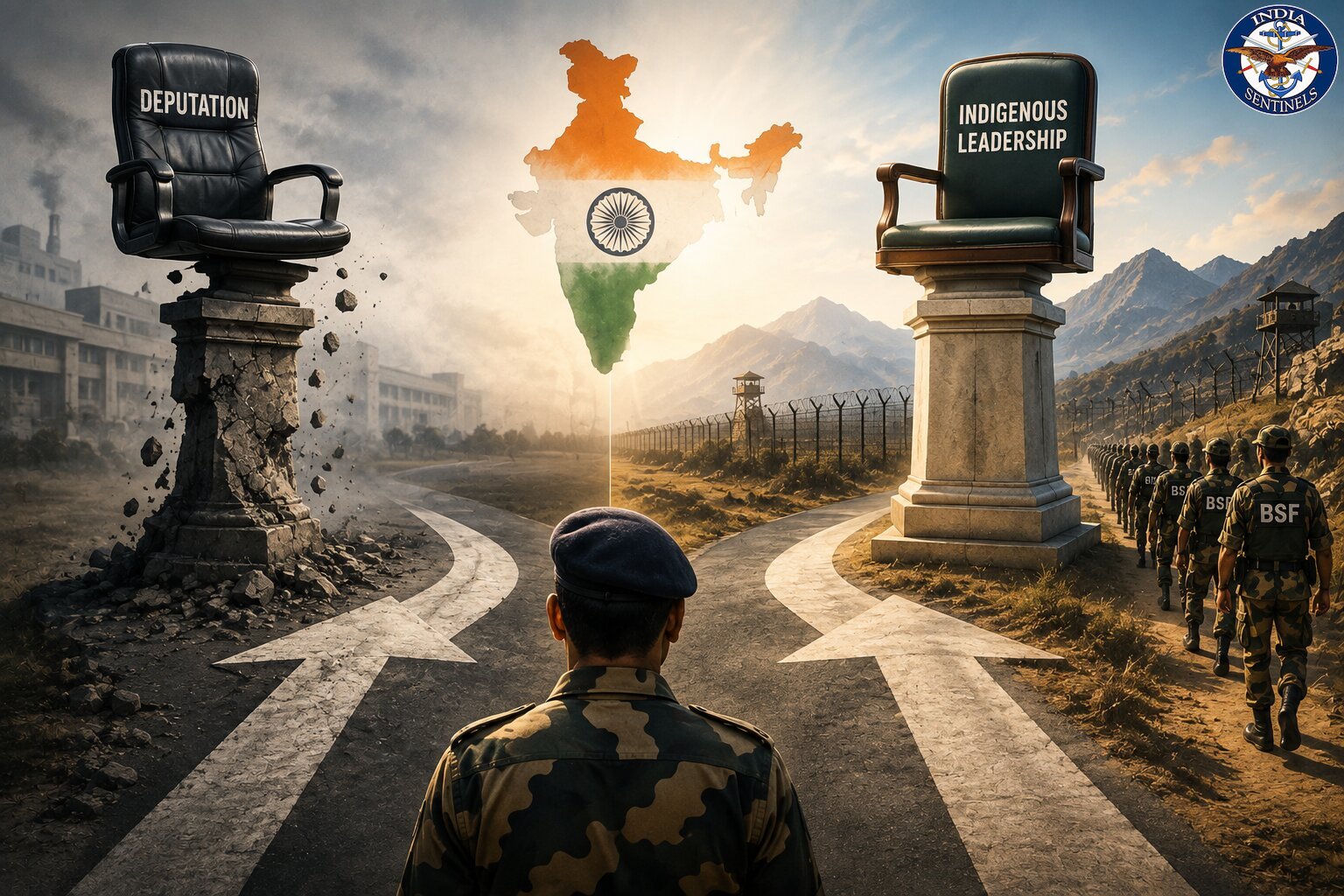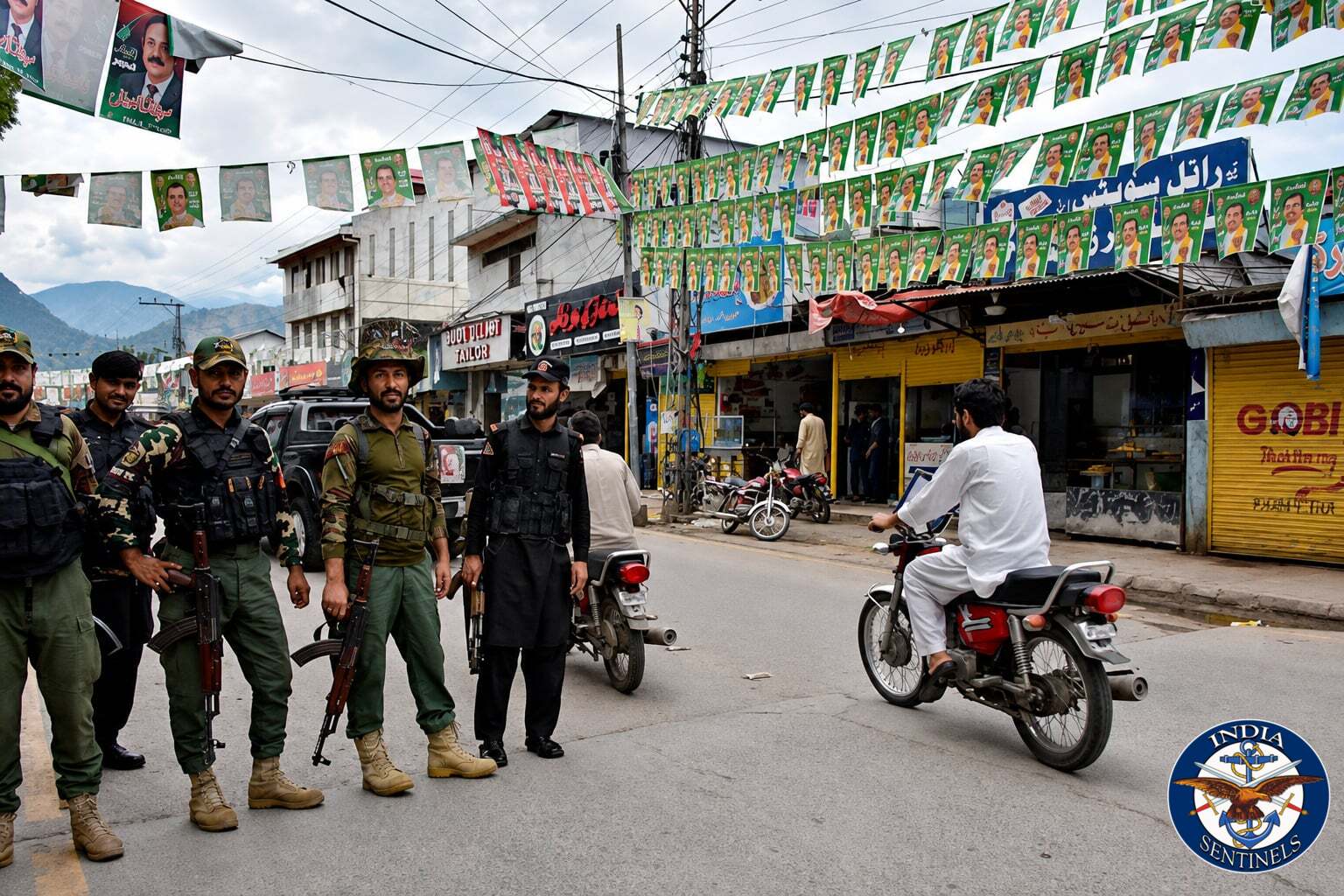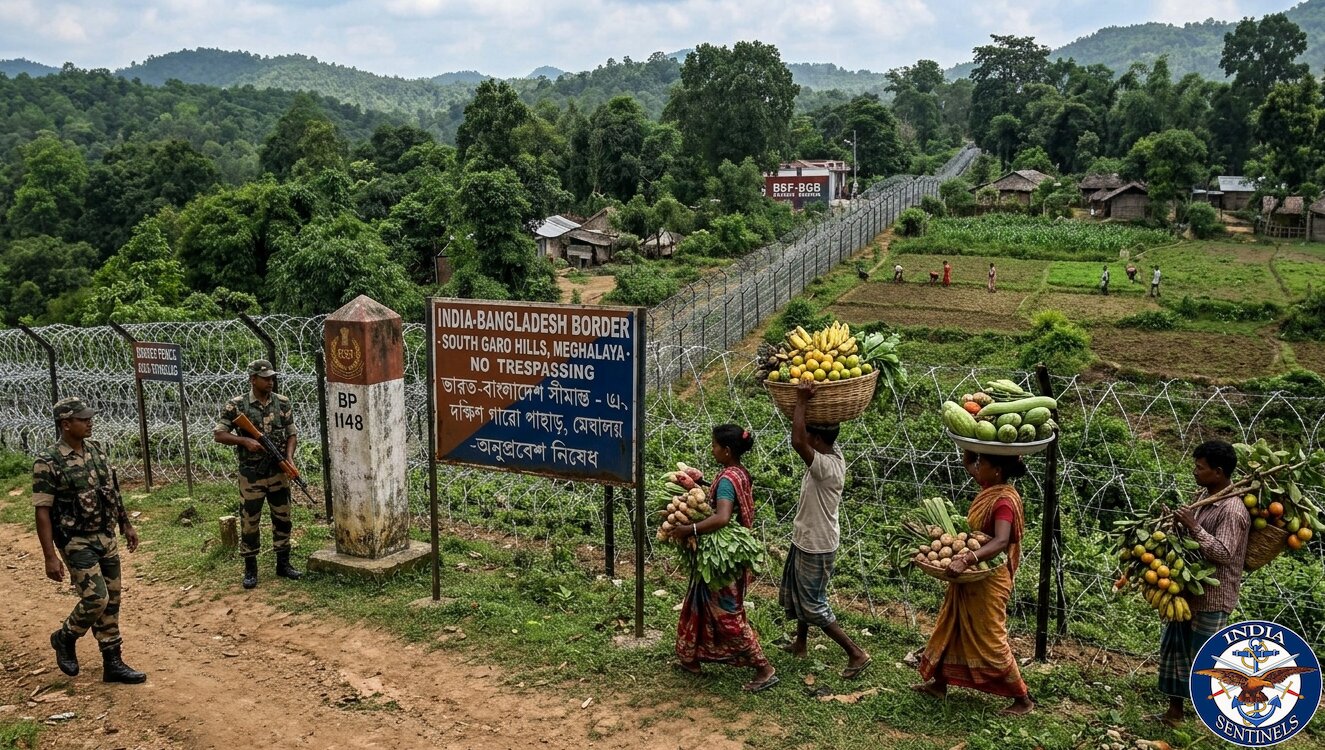
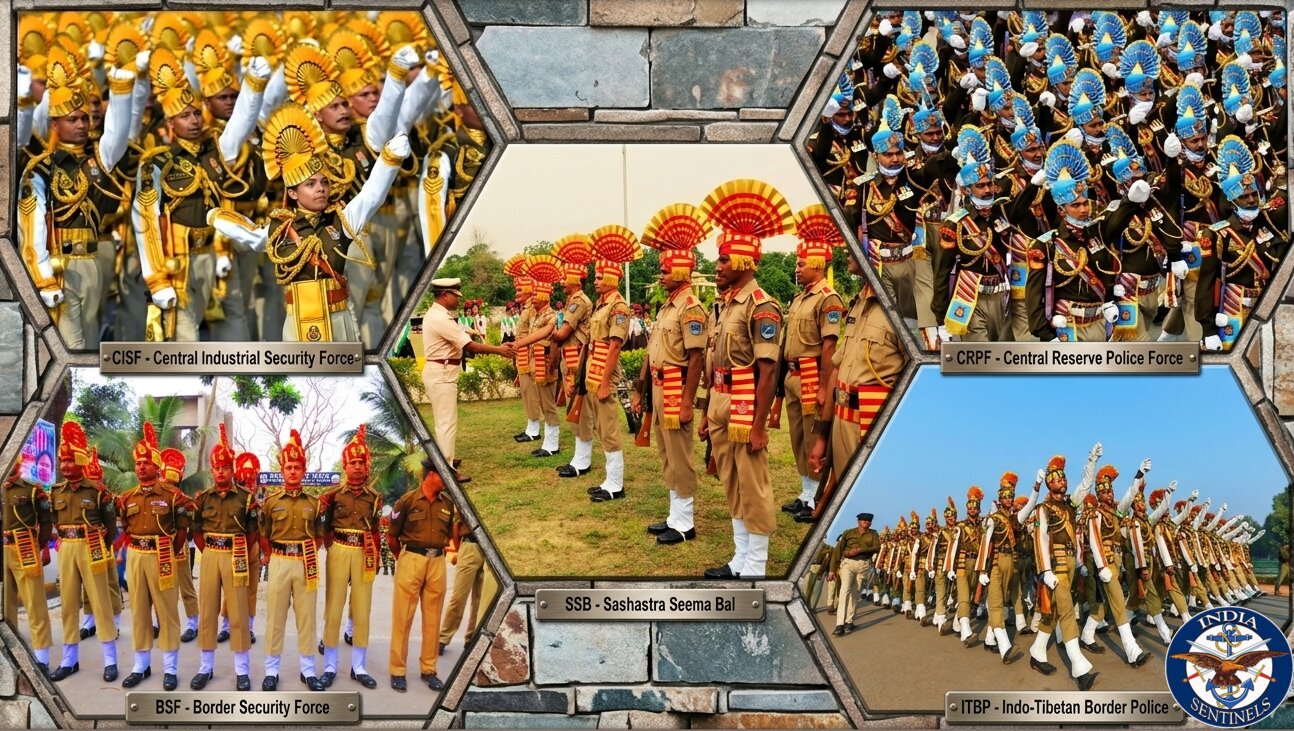
 India Sentinels illustration for representation. (© India Sentinels 2026–27)
India asks its central armed police forces (CAPFs) to hold difficult borders, confront internal-security challenges, protect vital infrastructure, restore and reinforce civil administration, and respond when public order breaks down. Yet the officers and personnel who carry this burden face a career system marked by acute stagnation, meagre progression and a leadership structure that too often treats institutional experience with indifference.
This is not simply a dispute over posts or pay. It goes to self-esteem and morale. Persistent stagnation corrodes confidence, strains the hierarchical command structure and, ultimately, blunts operational efficiency – all of which have a bearing on national security. Cadre officers and personnel of the CAPFs form the backbone of that security architecture, and unfortunately, both have constantly found the system treating them with an insensitivity their record does not justify.
Read also: Who Should Lead CAPFs? A national security debate beyond cadre politics
A judgment flouted, an act passed in its shadow
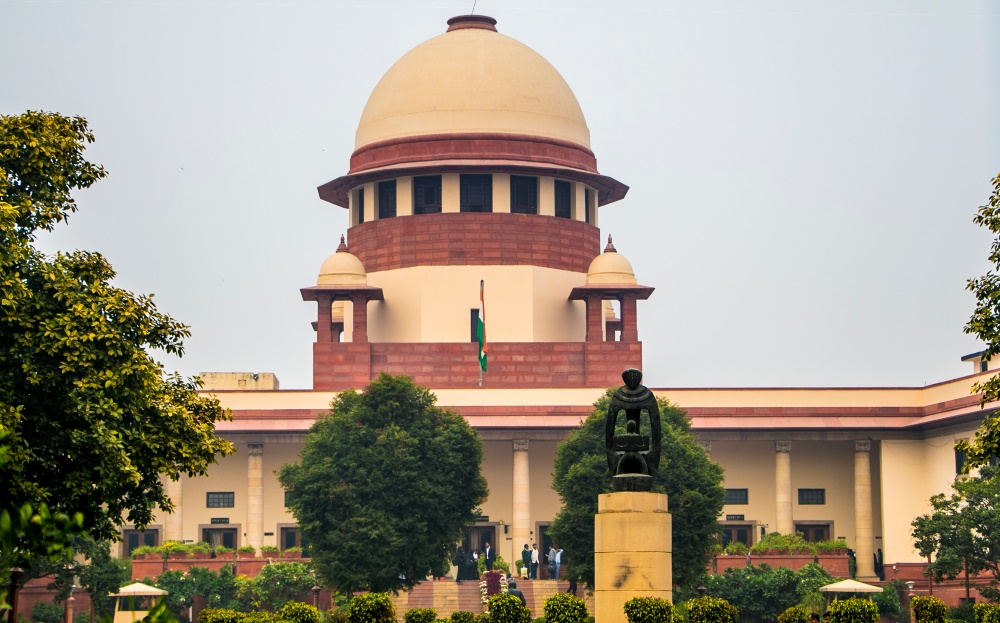
On May 23, 2025, in Sanjay Prakash and others versus Union of India, the Supreme Court held that the Group A executive cadres of the BSF, CRPF, CISF, ITBP and SSB must be treated as organized Group A services for all purposes. The court directed the government to progressively reduce posts earmarked for deputation from the Indian Police Service (IPS) up to the senior administrative grade – broadly equivalent to the rank of inspector general – within two years, and to complete the long-overdue cadre review within six months.
More than a year has passed since that deadline lapsed, and the cadre review is nowhere in sight. It may take a quarter, or considerably longer, to materialize, notwithstanding the publicity built around it for perception-building. This is the million-dollar question: will it be a cadre review for cadre officers alone, or will most posts still go to the IPS, whose entry into the deputy inspector general, inspector general and additional director general ranks has become institutionalized? If additionally created posts are shared with the IPS, the cadre gains little from such a review, and the exercise becomes a farce.
The Supreme Court, aware that its directions have not been honoured, asked the Union home ministry, during contempt proceedings, to furnish details of IPS deputation to the CAPFs since the judgment. The ministry informed the court that 46 IPS officers were brought on deputation to the five forces – Central Reserve Police Force (CRPF), Border Security Force (BSF), Indo-Tibetan Border Police (ITBP), Sashastra Seema Bal (SSB) and Central Industrial Security Force (CISF) – at the ranks of superintendent of police, deputy inspector general and inspector general, after May 2025.
Whatever the administrative justification, the pace of these appointments sits uneasily with the court’s direction for a progressive reduction, and deepens the perception that the system resists making space for cadre officers.
Read also: Illegal Immigration – India’s unfenced fault line on the eastern border
Even as the judgment sat unimplemented, the government allowed hype and publicity to substitute for genuine progress, an approach that risked misleading the court about the true state of compliance. The Union government then sought a review of the judgment itself, but the Supreme Court dismissed that petition on October 28, 2025, leaving the May ruling undisturbed.
Rebuffed, the Union home ministry moved to circumvent the Supreme Court’s judgment altogether: it pushed through Parliament the Central Armed Police Forces (General Administration) Act, 2026, despite reasoned objections from the opposition and from CAPF and military veterans, and notified it on April 9 this year. The law reserves 50 per cent of inspector general posts and at least 67 per cent of additional director general posts for IPS deputation, with special director general and director general posts reserved entirely for deputation.
Sections 3 and 4 of the act, which include a non-obstante clause giving it effect notwithstanding the 2025 judgment, are now under challenge before the Supreme Court. The petitioners – among them Bibhor Kumar Singh, an assistant commandant of the CRPF and a Shaurya Chakra recipient, and groups representing several thousand Group A officers – argue that the deputation structure the act prescribes undermines the court’s directions and violates constitutional guarantees. On August 4, the court sought the Centre’s response; the matter has since been listed for further hearing on November 18.
Read also: Tadmetla Operation 2010 – Supreme sacrifice that demands answers
A record written in service and sacrifice
Any debate over leadership structures must begin with what the CAPFs actually do. The BSF guards India’s borders with Pakistan and Bangladesh, the ITBP serves along the India-China frontier, the SSB secures the open borders with Nepal and Bhutan, the CISF protects airports and critical infrastructure, and the CRPF remains the country’s principal force for internal-security duties.
This record is not an argument for institutional privilege; it is an argument for professional respect. Officers and personnel who spend decades mastering the intricacies of field operations, and who lead and execute those operations, deserve a fair path to progression and senior command.
The BSF’s contribution to the 1971 war began before hostilities were formally declared, when the force helped train, organize and support the Mukti Bahini. Its personnel later fought in both the eastern and western theatres; their gallantry is embodied in officers such as Assistant Commandant RK Wadhwa, awarded the Maha Vir Chakra posthumously for the battle of Raja Mohtam, and Deputy Commandant Inderjit Singh Uppal, awarded the Vir Chakra posthumously for his courage in the eastern sector.
At Longewala in 1971, BSF personnel fought shoulder to shoulder with the Indian Army under the command of Major Kuldip Singh Chandpuri. The force also held difficult winter deployments in the Kargil sector before and during the 1999 conflict, sustaining a larger security effort along an unforgiving frontier.
Read also: Op Sindoor – Testimony to BSF’s grit and fighting spirit
During Operation Sindoor, the BSF fought a standalone battle under intense Pakistani fire and drone attacks along the Jammu frontier. Sub-Inspector Mohammad Imtiyaz and Constable Deepak Chingakham were awarded the Vir Chakra posthumously – a rare recognition that underlines the force’s role during the operation.
The CRPF’s contribution to the campaign against left-wing extremism has been equally significant. The prime minister, Narendra Modi, and the Union home minister, Amit Shah, have publicly credited the force for operations that allowed the government to declare the armed Maoist challenge defeated by its March 31, 2026 deadline.
That achievement was purchased through years of difficult operations and heavy sacrifice. Assistant Commandant Bibhor Kumar Singh – now among the petitioners challenging the 2026 act – lost both legs in an anti-Maoist operation and received the Shaurya Chakra; Commandant Chetan Kumar Cheetah survived nine bullet wounds in an encounter with terrorists in Jammu & Kashmir. Both represent the courage demanded of CAPF leadership at the sharp end.
Read also: CAPFs Act undermines the very forces it claims to strengthen
The ITBP’s personnel serve across the 3,488-kilometre India-China border, from the Karakoram pass in Ladakh to Jachep-la in Arunachal Pradesh, often at extreme altitude and in punishing weather. The SSB performs a different but no less sensitive task along two open borders, while the CISF secures assets ranging from airports and ports to nuclear and space establishments central to India’s economy and strategic capacity.
These duties demand more than physical endurance. They require professional judgment, familiarity with local conditions, trust between commanders and personnel, and a culture in which those who accept hardship can reasonably expect responsibility to rise with experience.
Stagnation as an operational problem
In the BSF, personnel wait for roughly two decades for their first meaningful promotion. By the time a second promotion arrives, many officers are older and have spent much of their working lives in remote, high-risk or family-separation postings.
Rank stagnation cannot be examined in isolation from long deployments, disrupted family life, limited control over postings and the psychological strain of armed duty. None of these pressures excuses indiscipline or violence, but together they create risks that a responsible personnel policy must confront rather than normalize.
Read also: Trampling of Trust – The nightmare of a ‘deshbhakt’
Official data reported in August 2026 showed that 262 CRPF personnel died by suicide between 2021 and 2025, including 59 in 2025 – the highest annual figure in that five-year period, with staff in the constabulary, the force’s lowest ranks, accounting for more than 80 per cent of the toll. More than 77 per cent of the deaths over the five years occurred while personnel were on duty. Including cases reported up to July this year, the toll since 2021 rises to 281.
The problem is not confined to the CRPF alone. Data placed before the Rajya Sabha in December 2025 showed that 730 personnel across seven CAPFs died by suicide over five years, alongside more than 55,000 voluntary retirements or resignations in the same period – a pattern that points to strain across the paramilitary system, not an isolated case.
The August 4, 2026, shooting at the CRPF’s 34th Battalion camp in Assam’s Nagaon district, in which an assistant sub-inspector allegedly killed two colleagues, injured another and then died by suicide, remains under investigation. It would be irresponsible to attribute that tragedy solely to career frustration, but it reinforces the need for humane HR policy, accessible mental-health care, a sensible leave policy, family support, sensitive command and credible grievance redress.
Read also: Address the deformities in CAPF structure
Morale is built not through ceremonial praise alone but through daily fairness. When personnel see outsiders move into senior appointments while experienced cadre officers wait, the message received at the lower levels is that sacrifice and institutional knowledge may not translate into trust.
The Union home ministry, as the cadre-controlling authority, needs to dispel the impression that it stands for anything less than the stable and permanent welfare of CAPF personnel and officers. The CAPFs have been recognized in court as armed forces of the Union, yet they have long been denied the benefits of the old pension scheme; when the Delhi high court ruled in January 2023 that the scheme should apply to them, the ministry appealed, and the Supreme Court stayed that judgment pending further hearing.
A similar pattern has recurred in the cadre officers’ case: despite favourable rulings in the constitutional courts, the ministry has pursued appeals rather than swift implementation.
Read also: Are elections compromising our border and national security?
What the government should do
First, the government should complete the cadre review without further delay and publish a clear implementation timetable under which all newly created posts go to cadre officers rather than the IPS – since this is, after all, meant to be a review of the CAPF cadre. Anything less turns the exercise into an eyewash: a majority review for the IPS and a minority review for the cadre it was meant to serve.
Second, recruitment and service rules should be aligned with the recognition of CAPF Group A cadres as an organized Group A service. That status must be honoured in financial terms, through non-functional financial upgradation, and applied to promotions up to the senior administrative grade. The cadre is now experienced and mature enough for all command positions up to director general.
Third, the Eighth Central Pay Commission, headed by Justice Ranjana Prakash Desai, offers a natural opportunity for a wider review of rank, appointment and pay structures across the CAPFs. Its recommendations should treat the Supreme Court’s recognition of CAPF Group A cadres as organized services as a starting point, not an afterthought.
Read also: Commanded into Crisis – Systematic wrecking of CAPFs’ moral fabric
Fourth, the government must examine the case for restoring intermediate ranks such as lance naik and naik, reconsider the utility of the assistant sub-inspector (general duty) rank, and end ad hoc arrangements such as appointing two officers as second-in-command in a single battalion merely to absorb stagnation. Such changes must follow a professional study, not another round of tinkering. Rank should correspond to responsibility, command authority and career progression; an upgraded designation without a meaningful appointment merely disguises the blockage.
Fifth, personnel welfare must be treated as part of operational planning, not as an afterthought to it. Assured promotions, predictable tenures, family accommodation, confidential counselling, early identification of distress and trusted grievance channels are as important to readiness as weapons, mobility and communications.
Read also: Stagnant Ranks, Broken Morale – The cost of CAPF’s skewed HR policies
The CAPFs follow the spirit of the Chetwode credo: the safety and welfare of the country come first, the safety and welfare of the force one commands come next, and personal comfort comes last. The state must honour the other side of that compact by ensuring that loyalty is met with fairness, competence with opportunity, and sacrifice with institutional respect.
India cannot demand military-grade courage from its central armed police personnel and offer them, in return, a career system governed by administrative inertia. The government should settle the pension and cadre questions with urgency, legality and empathy – because a force that feels respected is a force better prepared to defend the republic.
Disclaimer: The views expressed in the article are the author’s own and don’t necessarily reflect the views of India Sentinels.
Follow us on social media for quick updates, new photos, videos, and more.
X: https://x.com/indiasentinels
Facebook: https://facebook.com/indiasentinels
Instagram: https://instagram.com/indiasentinels
YouTube: https://youtube.com/indiasentinels
© India Sentinels 2026-27