 Aditya Jha
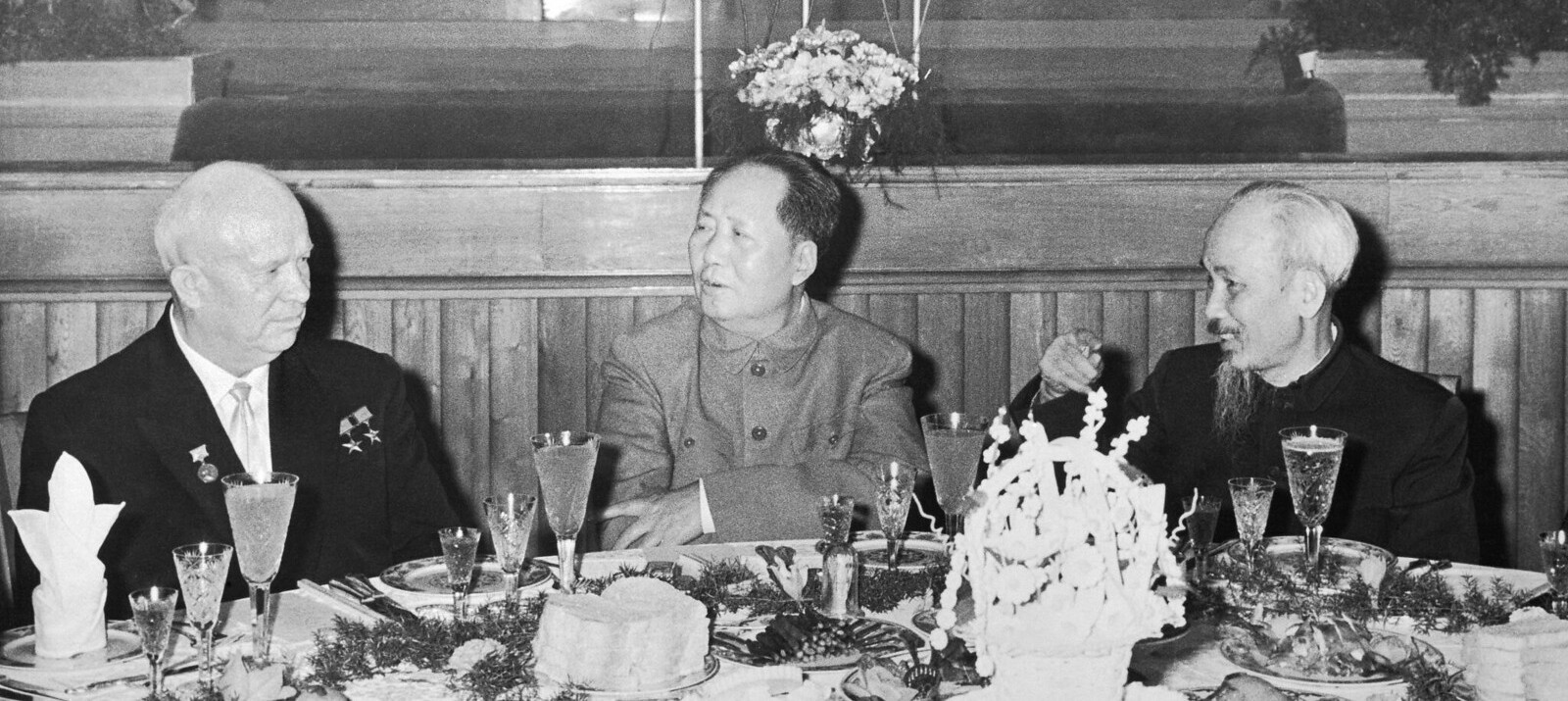 Nikita Khrushchev, Mao Zedong and Ho Chi Minh at a banquet in Beijing dedicated to the 10th anniversary of the People's Republic of China, 1959. (PC: X/@PicturesUssr)
China’s leaders told the Soviet premier, Nikita Khrushchev, in Beijing on October 2, 1959, that Indian troops had crossed the McMahon Line and fired first, and that no Chinese government had ever recognized the boundary. They also said the dispute would be settled through negotiations. This is according to a Soviet record of the meeting held in the Wilson Center’s digital archive. The same record shows Khrushchev telling his hosts that the crises over Tibet and the Indian border were largely of their own making.
The setting
Khrushchev reached Beijing on September 30, 1959, for the 10th anniversary of the People’s Republic. He had just returned from a visit to the United States that included talks with President Dwight Eisenhower at Camp David. Three subjects divided Moscow and Beijing: Taiwan and relations with Washington; the India-China boundary and the McMahon Line; and the Dalai Lama’s flight to India and the border clashes that followed.
The Soviet side included Mikhail Suslov and the foreign minister, Andrei Gromyko. The Chinese side was led by the Communist Party chairman, Mao Zedong, and included the premier, Zhou Enlai, the foreign minister, Chen Yi, and Marshal Lin Biao. Liu Shaoqi, Zhu De, Peng Zhen and Wang Jiaxiang were also present. Khrushchev noted at one point that it was three of them against nine. The note was signed by S Antonov and R Kudashev on October 3.
The talks followed a bad few months on the Sino-Indian frontier. The Dalai Lama fled Tibet and was given asylum in India in the spring of 1959. In August, Indian and Chinese forces clashed at Longju in the Upper Subansiri area of what was then the North-East Frontier Agency.
On September 9, the Soviet news agency TASS published a statement expressing regret over the clash and declining to back Beijing. China took this as a public rebuff.
Khrushchev’s case
Khrushchev told his hosts that territory should not be allowed to harden into a quarrel. He said the Soviet Union had a border dispute with Iran for about 150 years before settling it a few years earlier by handing over some land, and that a few kilometres more or less did not matter. He also cited Lenin’s cession of Kars, Ardahan and Ararat to Turkey.
He described the prime minister, Jawaharlal Nehru, as a bourgeois statesman but argued that no likely successor would be better for Moscow or Beijing. He recalled that Nehru had opposed the Soviet intervention in Hungary in 1956, yet Moscow had kept relations intact. On Tibet, he said China ruled the region and should have had intelligence on the Dalai Lama’s plans. He argued that the TASS statement was needed to avoid the impression of a united socialist front against India. Khrushchev also said the Dalai Lama should not have been allowed to escape and that it would have been better had he been ‘in a coffin’, a remark that sharpened the exchange.
Beijing’s reply
Mao said China’s mistake was not disarming the Dalai Lama at once, but that the long border with India made it impossible to stop him. He also blamed Nehru for the unrest in Tibet. He said that while China wanted to keep Nehru as a friend, it had to “crush him” on Tibet.
On the border, Mao and Zhou said Indian patrols had crossed the McMahon Line and fired for 12 hours. Zhou said local authorities had acted without authorization from the central leadership. Lin Biao reduced the argument to three points: India crossed first, India fired first, and India kept firing.
Zhou asked Khrushchev how he would react if Finland attacked the Soviet frontier. He said that disagreeing over the border was one thing, and that being blamed for defending it was another.
Zhu De said the line cut away 90,000 square kilometres from China. Peng Zhen called it a ‘dirty line’ that no Chinese government had accepted. Zhou noted that China had proposed talks to Nehru on January 22, 1959, and that Nehru had declined then but now agreed. He also said India’s vice-president, Sarvepalli Radhakrishnan, had been invited to China between October 15 and December 1.
Sharp words
The meeting turned acrimonious. Chen Yi accused Moscow of ‘time-serving’, a charge Khrushchev rejected, and the two men declined to shake hands. Khrushchev warned that an oak, though firm, can break, and said the Soviet Union would not be treated as a junior partner.
He added that Moscow had proposed dropping the formula of a socialist camp ‘headed by the Soviet Union’. Mao eventually calmed matters, saying the Tibet and border questions were temporary developments, and the talks moved on to Laos.
Mao on the McMahon Line
Mao called the border dispute a marginal issue and not a clash between governments. He said Nehru had not known what happened and had ordered Indian patrols to withdraw. He also told Khrushchev that the McMahon Line would be maintained and that the conflict would end. The Soviet leader replied that the issue was not about the line, which Moscow neither knew nor cared about.
Mao also said Beijing had wanted to delay changes in Tibet by four years but that the revolt gave it a good reason to act.
Background and aftermath
The McMahon Line was drawn at the 1914 Simla Convention, named after Sir Henry McMahon, the British Indian foreign secretary. It runs for roughly 890 km along the eastern Himalaya. China’s representative initialed the draft, but Beijing never ratified it. India treats the line as its international boundary, while China claims much of Arunachal Pradesh.
The meeting did not ease matters. On October 21, 1959, 19 days later, Indian policemen were ambushed at Kongka Pass in Ladakh, and nine of them were killed. Zhou visited Delhi in April 1960 for talks that failed, and the two countries fought a war in October 1962. The Sino-Soviet split also widened, and Beijing later made the TASS statement a central grievance in its polemics against Moscow.
The record has two limits. It is a Soviet account of a closed-door meeting, and the Russian text calls Indians ‘Hindus’, a usage reproduced in some English translations. India has long disputed the Chinese version of who fired first, saying Chinese troops attacked and seized its post at Longju.