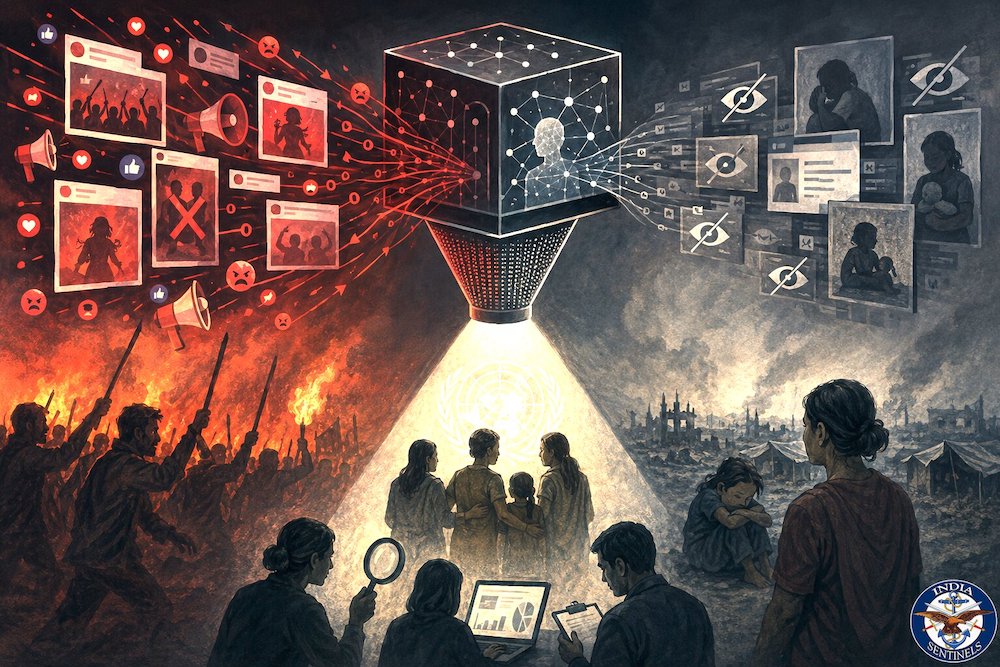
 Illustration for representation. (© India Sentinels 2026–27)
Every year on June 19, the world marks the International Day for the Elimination of Sexual Violence in Conflict. The date commemorates the United Nations security council’s recognition, through Resolution 1820 in 2008, that sexual violence is not an inevitable by-product of war but a tactic deliberately used to terrorize, displace and control populations. This year’s observance places particular emphasis on children caught up in such violence.
The scale of the crisis remains alarming. The United Nations secretary-general’s most recent report, released on May 29, 2026, verified 9,788 cases of conflict-related sexual violence in 2025 – more than double the 4,617 cases recorded the previous year. Victims ranged from infants to the elderly, the report noted, with women and girls remaining the overwhelming majority of those targeted.
Yet the UN’s special representative on sexual violence in conflict, Pramila Patten, has been careful to stress that even this doubling understates the true scale. Stigma, insecurity and the collapse of reporting mechanisms in active conflict zones mean that what gets verified is, at best, an indication of a far larger pattern that stays hidden.
The funding picture makes this worse. The United Nations Population Fund (UNFPA) cautioned in 2024 that less than 15 percent of the money needed for essential prevention and protection services addressing gender-based violence in crises was actually available. In 2025, funding constraints forced the cancellation of more than 40 existing projects worth over USD 330 million, precisely as needs were intensifying.
These numbers describe a world in which survivors already struggle to be seen. What receives far less attention is a newer, less visible layer of erasure – one shaped not only by silence but by the architecture of digital information systems. Just as algorithmic bias can reproduce existing inequalities, algorithmic visibility increasingly determines what gets amplified, what gets ignored, and how suffering gets framed once it does break through.
Manipur and the mechanics of a lie
In May 2023, ethnic violence broke out between the Meitei and Kuki-Zo communities in the northeastern Indian state of Manipur. As tensions escalated, misinformation spread rapidly across social media, including false claims of sexual violence accompanied by unrelated images. In one instance, a fabricated claim that a Meitei woman had been raped and killed circulated widely, paired with a photograph that fact-checkers later traced to an unrelated incident in Delhi, months earlier and hundreds of kilometres away.
It was in this volatile climate that, on May 4, 2023, two Kuki-Zo women were stripped, paraded naked by a mob, and sexually assaulted in Kangpokpi district. Reports suggest that circulating rumours of violence against Meitei women had already hardened into the retaliatory narrative that perpetrators later invoked. The video of the assault did not surface for over two months – and it was only then, once the footage went viral, that the country reacted with the outrage the original crime had never received.
This is not a story about one viral video. It is a story about disinformation functioning as part of the mechanism of violence itself. The false narrative did not simply follow events on the ground – it helped shape the moral logic through which the violence was later justified. The lie did not merely follow the violence; in a very real sense, it helped produce it.
In the aftermath, the Editors Guild of India sent a fact-finding team to Manipur and published a report criticizing sections of the local press for one-sided and inflammatory coverage. The Manipur government’s response – filing a police case against the Guild’s president and three committee members – became its own controversy about who gets to investigate the information environment around a conflict, and who is shielded from scrutiny while doing so. Either way, the episode underlined how thinly resourced India’s institutions still are when it comes to auditing how conflict narratives form and spread online.
A familiar, global pattern
Manipur is not an isolated case. A 2018 UN Independent International Fact-Finding Mission on Myanmar found that social media had significantly contributed to the violence against the Rohingya. Its chair, Marzuki Darusman, noted at the time that Facebook had played a “determining role” in shaping the conflict environment – for many users in the country, the platform was effectively synonymous with the internet itself. Amnesty International’s 2022 report – “The Social Atrocity: Meta and the Right to Remedy for the Rohingya” – concluded that Facebook’s engagement-driven algorithms had amplified anti-Rohingya content, creating what it called an “anti-Rohingya echo chamber”.
Across these cases, the common failure was not simply that platforms struggled to manage harmful content. It was that an information system designed to maximize engagement rather than accuracy failed to stop disinformation – and rewarded the content that spread it. In fragile contexts, such dynamics can amplify fear, grievance and calls for retribution faster than any fact-check can catch up.
Why this matters on a day for survivors
Algorithmic systems do not distribute attention evenly. They tend either to render certain experiences invisible or to amplify them in ways that strip away context and dignity. Violence against women and children risks either being ignored altogether or sensationalized, rather than being reported in ways that centre the survivor’s experience and the question of accountability.
In Manipur, women’s bodies became sites through which a false narrative was both constructed and avenged. In Myanmar, the suffering of Rohingya women was overshadowed by the hate speech the platforms’ own systems were busy amplifying. Whose suffering becomes visible, and whose becomes a viral spectacle stripped of context, is no longer simply a matter of journalism or government censorship. Increasingly, it is a matter shaped by code.
Where existing frameworks fall short
This is precisely the shift that existing international frameworks are not fully equipped to address. The Responsibility to Protect, adopted at the 2005 UN World Summit, rests on three pillars: that every state bears the primary responsibility to protect its population from genocide, war crimes, ethnic cleansing and crimes against humanity; that the international community has a responsibility to assist states in meeting that obligation; and that it must be prepared to take timely, decisive collective action when a state manifestly fails to protect its people. It is a doctrine built for an age before algorithmic amplification and AI-mediated information ecosystems became central to how conflicts actually unfold.
The Women, Peace and Security agenda, anchored in UN Security Council Resolution 1325 of 2000 and expanded through subsequent resolutions including 1820 itself, has embedded gender perspectives into conflict prevention. But it, too, does not fully account for the role digital information systems play in shaping violence.
National digital regulations, for their part, largely treat disinformation as a content-moderation problem – a matter of takedowns and platform liability – rather than as a driver of insecurity requiring early warning and prevention. India’s own experience is instructive here. In 2023, the government armed itself with the power to have a fact-check unit flag government-related online content as “fake or misleading”, only for the Bombay high court to strike the rule down in September 2024 as an unconstitutional restriction on speech. Whatever one makes of that legal battle, it illustrates the point: the conversation in India, as elsewhere, has been about who gets to call out falsehood after the fact, not about why the architecture of amplification rewards falsehood in the first place.
Each of these frameworks addresses an important dimension of the challenge. Yet none comprehensively addresses the intersection of AI-amplified disinformation, gendered harm and conflict prevention as a single governance problem.
Towards an Algorithmic R2P
It is this gap that the concept of an Algorithmic Responsibility to Protect, or Algorithmic R2P, seeks to address. I propose it as an extension of the international Responsibility to Protect into digital ecosystems – not a new doctrine so much as an old one being asked to catch up.
Digital tools, including open-source intelligence and AI-assisted verification, have become indispensable for documenting abuses and supporting accountability processes, and Algorithmic R2P does not question their utility. The question it raises is narrower, and I think more answerable: when these same systems shape who is seen and who is not, should they not be governed with the same seriousness as any other instrument capable of triggering or escalating violence against civilians?
Algorithmic R2P would rest on three core principles. First, gender-responsive auditing of AI systems used in conflict monitoring and information environments, so that biases in training data and amplification patterns are identified before deployment rather than after the damage is done. Second, context-sensitive algorithmic accountability standards for platforms operating in or near active conflict zones, recognizing that algorithmic risks are magnified in fragile settings in ways they are not in stable ones. Third, the integration of digital indicators – including patterns of gendered disinformation – into existing UN early-warning architecture, such as the secretary-general’s Rights Up Front framework.
For India, which has now lived through Manipur and watched its own attempt at a government fact-check unit collapse in court, the lesson is not that disinformation governance is impossible. It is that governance aimed only at the symptom – false content – without touching the underlying machinery of amplification, will keep arriving too late, as it did for the two women in Kangpokpi.
The code does not have to decide
On a day meant to honour survivors of conflict-related sexual violence, and one that this year asks us to look specifically at the children caught inside it, it is worth asking what it means that algorithmic systems can reproduce erasure and distortion in milliseconds, without ever being named as a perpetrator.
If the international community is serious about ending impunity in this space, it cannot leave the architecture of visibility itself ungoverned. The code does not have to decide whose suffering counts. But left unexamined, it already does.
Disclaimer: The views expressed in the article are the author’s own and don’t necessarily reflect the views of India Sentinels.
Follow us on social media for quick updates, new photos, videos, and more.
X: https://x.com/indiasentinels
Facebook: https://facebook.com/indiasentinels
Instagram: https://instagram.com/indiasentinels
YouTube: https://youtube.com/indiasentinels
© India Sentinels 2026-27