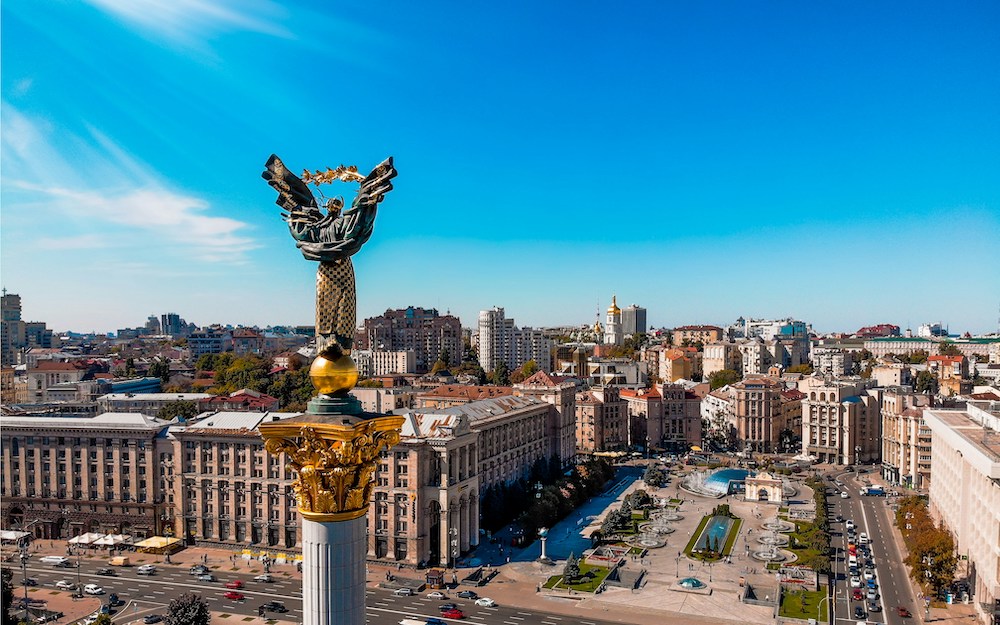
 The Kyiv city centre. (Photo: Glib Albovsky/Unsplash)
In nearly four decades of soldiering, this author has stood on some of India’s most unforgiving frontiers – commanded a battalion in the western sector during Operation Parakram against Pakistan, led a brigade along the contested Tawang sector, and was in charge of a division in the cauldron of eastern Ladakh. Therefore, this author knows what escalation looks like – and when a red line has not merely been approached but obliterated. What is unfolding in Ukraine today is precisely that – and the world, particularly Europe, is sleepwalking into the consequences.
Now, to be blunt, a devastating Russian strike on Ukraine – almost certainly including Kyiv – is no longer a possible scenario but in this author’s considered assessment, a near-certainty. The only serious debate is about timing and scale.
Read also: Petrodollar’s last rites, yuan’s quiet coronation, and India’s self-inflicted wounds
How We Got Here
Since early 2024, Ukraine has systematically escalated a deep-strike campaign inside Russia, targeting oil refineries, export terminals, pipelines, and port infrastructure, often more than 1,500 kilometres from the front line. On June 1, 2025, Ukraine carried out the audacious “Operation Spiderweb” – a covert drone attack on Russian air force’s strategic air assets at five airbases – Belaya, Dyagilevo, Ivanovo Severny, Olenya, and Ukrainka. The attacked spanned five oblasts across five time zones with the strike on the Belaya airbase in eastern Siberia being at 4,300 kilometres from Ukraine.
That attack, according to US intelligence, hit 20 military aircraft, 10 of which were destroyed, including Tu-95MS and Tu-22M3s long-range nuclear strategic bombers.
By late 2025 and into 2026, Ukrainian drones were routinely reaching the Volga region, the Black Sea and Baltic coasts, and even offshore Caspian platforms. The International Energy Agency estimated that these strikes reduced Russia’s effective refining capacity by around 500,000 barrels per day, contributing to domestic fuel shortages and fiscal strain.
Read also: Iran is winning the war – and Washington knows it
So far, all these might have been tolerable for Moscow. What crossed the final threshold was something qualitatively different: long-range drones built by Britain, guided by German technology, striking strategic energy infrastructure deep inside Russia. Not Ukrainian ingenuity alone – but a Nato technological assembly line directed at Russia’s economic jugular. The British intelligence services are reportedly selecting targets; the CIA, by its own admission in the New York Times in December 2025, has been providing operational guidance.
Now, just on May 22, Ukraine apparently struck a student dormitory in the Russian-controlled erstwhile Ukrainian town of Starobilsk, killing 10 and injuring 38, with many missing. This evoked a rare strong remark from the Russian president, Vladimir Putin, who vowed retaliation.
To any military analyst who understands Russian strategic doctrine, this is Nato directly at war with Russia – just without a formal declaration. So, one shouldn’t make the error that it is still a Nato-Russia proxy war through Ukraine.
Read also: Netanyahu’s War, America’s Blood – The trap being set in the Persian Gulf
Existential Factor
Russia’s updated nuclear doctrine, published in the past two years, for the first time explicitly permits the pre-emptive use of nuclear weapons against a non-nuclear threat when conventional military capabilities manifest themselves at an existential level against Russia. That threshold, by Russia’s own articulation, has now been crossed.
Russia’s economy is largely hydrocarbon-dependent. By credible estimates, Ukraine’s deep-strike campaign has eliminated approximately 20 per cent of Russia’s oil export capacity – not temporarily disrupted it, but inflicted damage that cannot be repaired for months. In January 2026, Russia launched one of its largest ever combined missile-and-drone salvos on Ukraine, deploying the Oreshnik hypersonic ballistic missile for only the second time – a weapon travelling at approximately 13,000 kilometres per hour, effective against existing Ukrainian air defences. The January strike left roughly half of Kyiv’s apartment buildings without heat in subzero conditions.
This author sees this as a preparation and not something as showing off as Moscow’s strike capabilities and options.
Read also: Putin visit masterclass in geopolitical theatre, but where’s the beef?
Real Threat to Europe
Here is what many European chancelleries refuse to process: Russia has explicitly put Europe on notice. Russian officials have publicly identified European weapons-production facilities cooperating with Ukraine and, in some instances, published their addresses. Dmitri Medvedev, the deputy chair of Russia’s national security council – not a blogger, not a pundit, but a senior state official – issued a formal warning to the west through Russia Today, a state-controlled outlet with a wide international audience. This was a deliberate, authorized communication.
The maths of Russian drone production makes this more than rhetorical bluster. Russia is reportedly producing approximately 3,000 drones a day near Kazan while expending fewer than 500 on the Ukrainian battlefield – banking the surplus every single day. Russia currently possesses, by credible assessments, enough drones to, as former US Marine Corps intelligence officer and UN weapons inspector Scott Ritter, a few days earlier on a YouTube debate, said, “blacken the skies of Europe for six months.” And Europe has no integrated air defence to stop them. The Patriots sent to Ukraine have been destroyed; there is effectively no layered air-defence architecture across the European continent.
Poland lies directly under the drone corridors being used to ferry weapons into Ukraine for strikes on Saint Petersburg and other Russian cities. Germany built the guidance systems that are hitting Russian energy infrastructure. Both countries know this. Russia knows this too. If Russia decides to send a signal to Europe – hitting Düsseldorf, striking the production facilities for the FP5 drone components in Britain – the Europeans have no credible answer.
Their deterrence rests entirely on an Article 5 guarantee from a United States, whose current president, Donald Trump, has already made abundantly clear it has no appetite for a European war.
Read also: Pakistan’s Last Refuge – Nuclear rhetoric after military defeat
Washington Won’t Come
This is the hard truth that European capitals must confront. The US under the current administration is not going to ride to Europe’s rescue. European heads of state have already held quiet, senior-level discussions about how Nato functions without American cover – precisely because they know Article 5 is a hollow promise in the current environment. Trump has influence over the Ukrainian president, Volodymyr Zelenskyy, as the three-day ceasefire during Russia’s Victory Day commemorations demonstrated, but that influence has limits. And critically, Russia’s foreign minister, Sergei Lavrov, has publicly declared the US to be “agreement incapable”. Moscow is not waiting for Washington to broker a deal.
This author is in agreement with western observers who say that Europe’s political leaders are, by and large, deeply unpopular at home. Macron in France, Merz in Germany, Starmer in Britain – none of them commands the domestic mandate required to face down the full weight of Russian escalation. They have been playing at conflict, believing Russia is bluffing. They are wrong.
Read also: Thank you, Trump, for making India understand America like never before
Kyiv in Crosshairs
Russia has warned – formally, through multiple channels, several times – that its strikes on Kyiv’s command-and-control centres are coming. These were not rhetorical flourishes simply because of the fact that Russian military does not issue specific operational warnings unless it has the capability and the intent to execute. The warnings were accompanied by calls for the evacuation of foreign embassies. And the most interesting thing is that the US moved staff.
That tells you everything.
Ritter is a man with direct, recent access to Russian policymakers – put it with brutal clarity: if Ukraine strikes the Saint Petersburg International Economic Forum, Kyiv will cease to exist. He foresees a regimental Oreshnik salvo – nine missiles or more – falling on the Ukrainian capital in a strike whose kinetic impact would approximate a tactical nuclear detonation. Add to that the Iskander-M, the Kalibr, and the newer Oreshnik 2.0 reportedly in development, and you have the prospect of a multi-layered ballistic assault on a capital city unprecedented in modern military history.
The two previous Oreshnik strikes on Ukraine, notably, used inert warheads – demonstrations of reach and precision, not lethality. The real thing has yet to be unleashed.
From a purely military standpoint, the logic is iron-clad. Russia cannot allow the systematic destruction of its energy-export infrastructure to continue. Every analyst – including Russian ones – acknowledges this is unsustainable. A nation does not bank 2,600 surplus drones daily, formally warn foreign embassies to vacate, publicly publish European weapons-factory addresses, and update its nuclear doctrine – and then do nothing. Far from bluffing, these are warning signs of the preparations of a state that has made a decision.
Read also: How Trump lost India – and why America must win it back
Measured Note of Caution
Ray McGovern, the distinguished former CIA Soviet analyst, urges a degree of restraint in these conclusions. He notes – not without merit – that Putin is, above all, a circumspect strategic actor who does not act from emotion. Putin, in McGovern’s reading, has drawn a clear distinction between Europe and the US, and is unlikely to risk a direct military confrontation with Nato unless he is in truly dire straits – which McGovern does not believe he is, given Russia’s continued advances on the Ukrainian battlefield. McGovern also points to the accelerating political and legal exposure of Zelensky domestically, arguing that a change of government in Kyiv, combined with Chinese diplomatic pressure, might yet produce an off-ramp before the worst occurs.
It is a thoughtful position, and this author respects it. The possibility that diplomacy, however improbable, could intercede – perhaps through Beijing – cannot be entirely ruled out.
But this author keeps returning to this: Russia does not warn unless it intends to act. The decision, in this author’s assessment, has been made. Kyiv’s fate may hinge on whether Ukraine strikes one target too many – a drone into the Saint Petersburg Economic Forum, a hit on a facility that cannot be tolerated. When that trigger is pulled, the archangel, as Ritter put it, will descend.
Europe had better start listening. The time for strategic wishful thinking is over.
Disclaimer: The views expressed in the article are the author’s own and don’t necessarily reflect the views of India Sentinels.
Follow us on social media for quick updates, new photos, videos, and more.
X: https://x.com/indiasentinels
Facebook: https://facebook.com/indiasentinels
Instagram: https://instagram.com/indiasentinels
YouTube: https://youtube.com/indiasentinels
© India Sentinels 2026-27