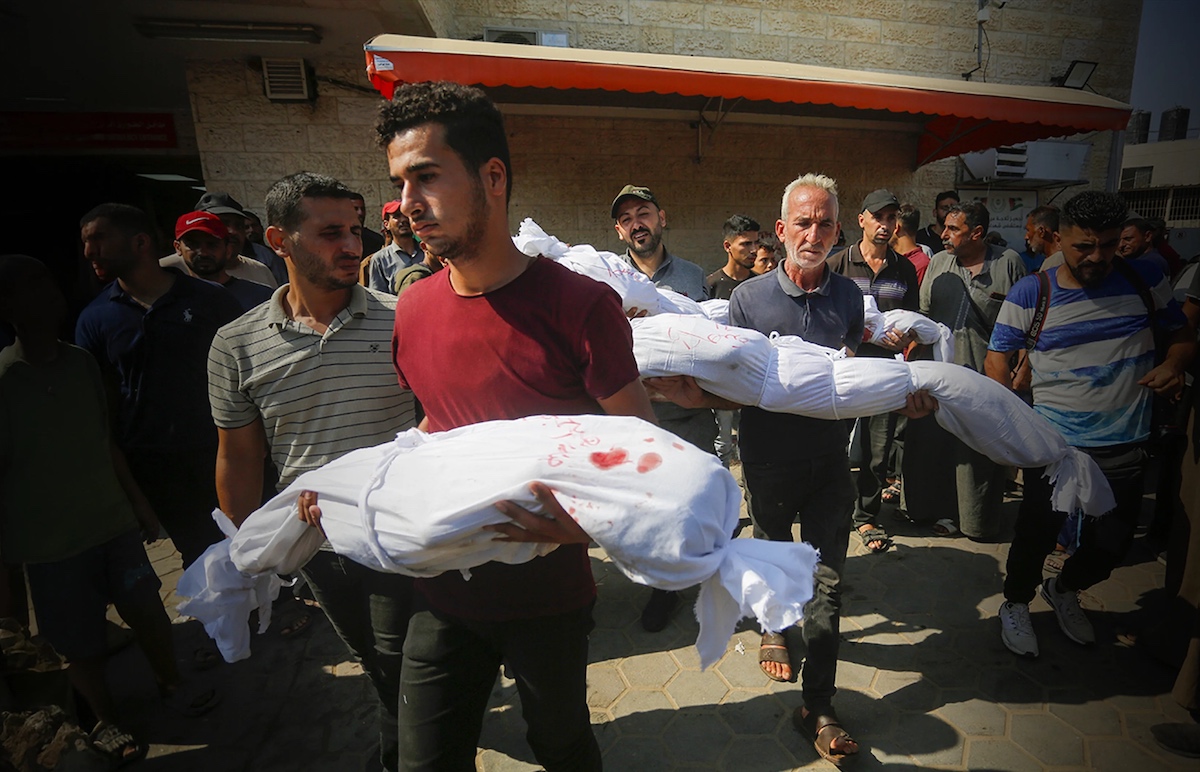
 Relatives and helpers carrying bodies of children killed by Israeli forces in Gaza. (Photo via Yaqeen Institute)
This author has stood over the bodies of children before – dead children, mutilated children, dead children with mutilated bodies. Not in Gaza, not on the line of actual control (LAC), not in Kashmir or the northeast during their peak days of insurgency, but in the red laterite dust of Sierra Leone, in 1998 and 1999, as part of a United Nations peacekeeping deployment tasked with something the world now seems to have forgotten how to value, which is putting children back together after war has taken them apart.
This author sat across from boys of 12 and 13 who had been handed rifles heavier than their own bodies by the Revolutionary United Front, and watched, over months, as patient, unglamorous work – disarmament, demobilization, reintegration, a hot meal, a school bench, a counsellor who didn’t flinch – slowly returned something like childhood to them.
It was the most humane work this author has ever done in a uniform. It is also why the findings released in Geneva on June 23 by the UN Independent International Commission of Inquiry on the Occupied Palestinian Territory read, to this soldier, like an obituary for everything that peacekeeping work was meant to prevent.
Read also: Ukraine has crossed the Rubicon putting Kyiv at Russia’s crosshairs
A 100-page indictment
The commission’s report, formally titled “The essence of childhood has been destroyed” and covering the period from October 7, 2023, to March 31, 2026, documents the deaths of at least 20,179 Palestinian children and the injury of 44,143 more. Children made up around 30% of those killed in the occupied territories – a proportion sharply higher than the roughly 24% recorded in the 2008-09 and 2014-15 Gaza conflicts. Unicef’s own tally, as of February 2026, put the toll even higher: 21,289 children killed, 44,500 injured.
The commission found that Israeli security forces continued using high-payload, wide-area munitions in densely populated residential neighbourhoods despite mounting child casualties, and concluded this was not incidental but part of a deliberate strategy treating Gaza’s civilians as collectively associated with Hamas combatants. That finding, the commission says, is one of the key elements establishing genocidal intent – building directly on its own September 2025 determination that Israel had committed four of the five acts prohibited under the 1948 Genocide Convention.
Even the October 2025 ceasefire, which the world exhaled over, did not stop the killing of children. The report documents torture, including sexual and gender-based violence, against detained Palestinian children, particularly boys subjected to forced stripping, beatings and food deprivation – conduct the commission has characterized as crimes against humanity. It documents 151 children’s deaths from malnutrition as of October 1, 2025, more than 1,000 child amputations between October and December 2023 alone, 22 of 38 Gazan universities razed, and birth rates in Gaza in the first half of 2025 running 41% below the same period in 2022.
Read also: Petrodollar’s last rites, yuan’s quiet rise, and India’s self-inflicted wounds
This is a demographic wound inflicted, the commission notes, by the deliberate targeting of neonatal and maternity care.
One case, recounted by commissioner Chris Sidoti, will stay with this author for a long time: a 14-year-old boy shot by an Israeli military patrol as he stepped out of his house, at a moment when no fighting was under way. He bled to death over roughly 45 minutes, surrounded by soldiers who did not intervene. When his mother tried to reach him, she was shot at too. Sidoti told journalists that every international legal norm was violated in that single incident.
This author commanded troops for several years in his nearly four decades as an officer in the Indian Army – along the LAC in eastern Ladakh and Tawang, in the deserts of Rajasthan along the western border, and served in Kashmir and northeast India – the toughest counterinsurgency terrain this country has. Soldiering has rules. A child stepping out of his own front door is not a target. A mother running to her dying son is not a target. An army that cannot teach its soldiers this has abandoned the profession of arms for something else entirely.
Read also: Iran is winning the war – and Washington knows it
It matters, and it matters to this author as an Indian, that the commission was chaired by Srinivasan Muralidhar, the retired chief justice of the Odisha high court and a former judge of the Delhi high court. Muralidhar’s record on the bench – decisions that held the powerful accountable when it was neither easy nor popular to do so – earned him a reputation for judicial courage that survives well beyond his retirement.
When a jurist of that calibre puts his name to a finding this severe, after his commission sent Israel 13 requests for information and received not one response, it deserves to be read with the seriousness it was written with, not dismissed as, in Israel’s words – a “libelous sham”.
Read also: Netanyahu’s War, America’s Blood – The trap being set in the Persian Gulf
Apartheid has a name, and this is it
The commission’s mandate was narrow – Palestinian children specifically, but its findings sit inside a wider, well-documented picture. Amnesty International’s 2022 report and successive findings by the UN special rapporteur on the occupied Palestinian territories have already described Israel’s system of control over Palestinians – differentiated legal regimes, land seizure, movement restriction, settler violence enabled rather than punished – as apartheid under international law. Even Ehud Olmert, a former Israeli prime minister, wrote in a column published on June 18 that his own government was running an organized, state-funded campaign of ethnic cleansing in the West Bank.
When a former head of the Israeli government uses language like that about his own state, the rest of us can stop pretending this is merely a matter of perspective.
Read also: Putin visit masterclass in geopolitical theatre, but where’s the beef?
Where has India gone?
This author is the son of a man who spent years in British colonial prisons for the crime of demanding his country’s freedom during the Independence Movement. This author also grew up understanding, in his bones, that India’s foreign policy was never meant to be transactional. We were the country that stood with Palestinian self-determination when it was unfashionable, that hosted Yasser Arafat as a state guest, that never confused a security relationship with a moral one.
That tradition has, in recent years, been quietly buried – exchanged for photo opportunities, for a “special strategic partnership” with Israel, for a silence on Gaza that grows more conspicuous with every UN report New Delhi declines to comment on.
This is not a call to abandon India’s security cooperation with Israel, which serves genuine and legitimate interests. It is a call to remember that strategic partnership and moral clarity are not mutually exclusive, and that a country which built its own identity on resistance to colonial subjugation cannot indefinitely avert its eyes from apartheid and the killing of children elsewhere.
Read also: Pakistan’s Last Refuge – Nuclear rhetoric after military defeat
India should – and must – use its voice at the UN human rights council and the security council to demand implementation of the 2024 International Court of Justice advisory opinion on ending the occupation. It should support, not obstruct, accountability mechanisms directed at the International Criminal Court. It should say, plainly, what this commission has now documented in 100 pages: that the killing of more than 20,000 children is not collateral damage in anyone’s war. It is the war.
Critics of the commission, including the NGO UN Watch, argue it carries a structural bias and reads intent into what may be the tragic byproduct of urban warfare. That argument deserves to be weighed – the commission’s conclusions are findings, not a court verdict, and Israel disputes them fully, citing its own facilitation of vaccination drives, medical staff access and field hospitals, and pointing to Hamas’s October 7, 2023, raid inside Israel, which resulted in the deaths of many Israelis, including children.
However, none of that erases what this report documents. It sharpens the obligation to test these findings, seriously, before the tribunals equipped to do so – and to stop looking away in the meantime.
This author buried enough children’s futures in Sierra Leone to know what happens when the world decides a conflict is too complicated to have a conscience about. It does not get simpler with time. It gets forgotten. Gaza’s children deserve better than the world’s silence.
Disclaimer: The views expressed in the article are the author’s own and don’t necessarily reflect the views of India Sentinels.
Follow us on social media for quick updates, new photos, videos, and more.
X: https://x.com/indiasentinels
Facebook: https://facebook.com/indiasentinels
Instagram: https://instagram.com/indiasentinels
YouTube: https://youtube.com/indiasentinels
© India Sentinels 2026-27