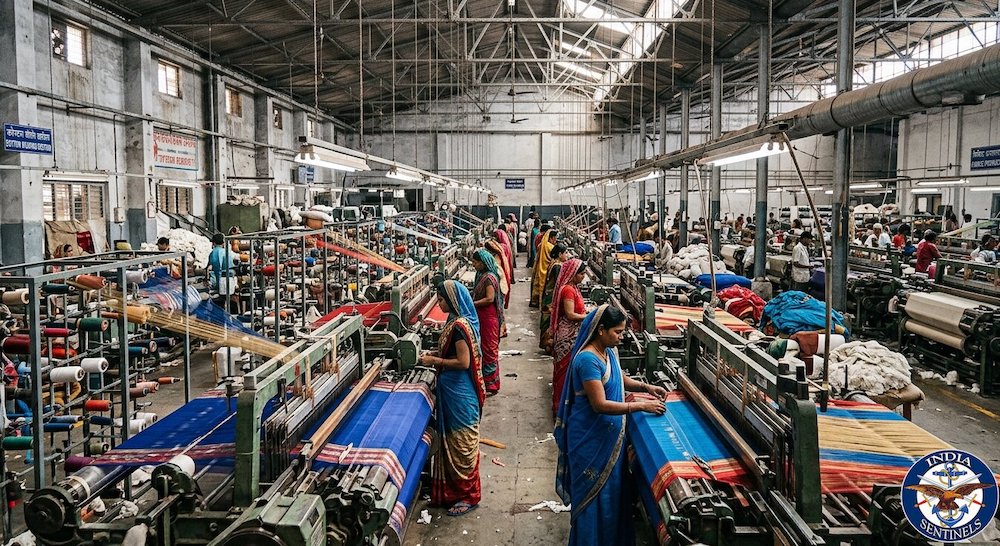
 lllustration for representation. (© India Sentinels 2026–27)
— By Bhanavi Mathur and Dr Aparaajita Pandey
International Relations tends to conventionally focus on the visible instruments of power. Military alliances, trade agreements, sanctions, maritime chokepoints and strategic resources such as crude oil, rare earth minerals and semiconductors dominate discussions of geopolitics.
Culture, by contrast, is often relegated to the margins, regarded as a subsection of identity politics or public diplomacy rather than a field of strategic rivalry. A closer reflection suggests otherwise. Long before states competed over digital infrastructure or artificial intelligence, they competed over textiles. Cotton, muslin, silk and pashmina were not only commodities; they were mechanisms through which empires amassed wealth, structured identities and legitimized political authority.
The histories of South Asian textiles reveal a neglected dimension of international politics. Muslin from Bengal, pashmina from Kashmir and chintz from the Coromandel coast were once among the most sought-after luxury goods in the world. Their craftsmanship made them icons of stature across Europe, but their success also intimidated emerging European industries.
The colonial response was not merely commercial competition; it was political intervention. Through trade restrictions, industrial imitation, monopolistic practices and cultural appropriation, European empires systematically dismantled indigenous textile economies while absorbing their aesthetic value. The politics of textiles thus offers a formidable lens to understand how material culture has historically acted as an instrument of statecraft.
This history also raises a broader question. Why are governments today investing heavily in protecting geographical indications, reviving endangered crafts, funding museums and promoting traditional clothing at international summits? The answer lies in recognizing that legacy is no longer simply a repository of the past; it is increasingly instrumental in geopolitical influence.
How empire used trade policy against Indian textiles
The colonial intervention in South Asia’s textile economy demonstrates this dynamic with remarkable transparency. Between the seventeenth and nineteenth centuries, Indian textiles dominated global commerce. Dhaka muslin was admired for its extraordinary fineness, Kashmiri pashmina defined luxury craftsmanship and Indian chintz revolutionized European fashion. Unable to match the quality of these products, colonial powers resorted to political measures rather than market competition.
The British Calico Acts prohibited the import and even the consumption of Indian cotton textiles to protect domestic manufacturers. At the same time, British and French industries appropriated Indian designs, reproducing them through mechanized production – a pattern that continues today in global fashion houses. Kashmiri shawls inspired the famous Paisley pattern, while chintz motifs were reproduced across European textile centres. Meanwhile, the East India Company enforced monopolistic controls over Bengal’s muslin industry, compelling artisans into exploitative production systems before flooding international markets with cheaper machine-made alternatives.
These policies were far more than exercises in economic protection. They amounted to an attempt to reform the global political economy by determining whose knowledge, labour and craftsmanship would be recognized as modern, valuable and legitimate. Colonialism did not simply reorder production; it rearranged cultural hierarchies. European imitation became innovation, while South Asian excellence was recast as exotic, backward or obsolete.
Fashion as a language of power
Empire governed not only through military conquest but also through aesthetics. Fashion became a language of power. The political theorist Andreas Behnke describes fashion as a “technology of sovereignty”, a method through which political authority, legitimacy and identity are performed.
The colonial experience of South Asia illustrates precisely this proposition. Clothing stopped being merely functional or decorative; it became a marker of civilization and political belonging. European clothing increasingly symbolized modernity, while indigenous dress was interpreted as confirmation of cultural inferiority.
Even more striking was the transformation of pashmina. European imitations gradually displaced authentic Kashmiri products, compelling local artisans to modify their own designs according to western tastes. The colonized were essentially encouraged to imitate the imitation of their own heritage. This inversion reveals that colonial power extended beyond territorial occupation into the regulation of cultural meaning itself. Yet the politics of textiles did not end with empire; it has evolved.
Politics of textiles today
Governments across Asia are now reclaiming cultural industries once marginalized under colonial rule. Bangladesh’s restoration of Dhaka muslin, supported by scientific research and artisan training, seeks to reestablish a textile that had almost disappeared from history. India has strengthened legal protections for Kashmiri pashmina through Geographical Indication (GI) certification while encouraging handloom traditions through diplomatic gifting, museum exhibitions and international cultural events.
These initiatives are often labelled heritage conservation. They are, in fact, something more strategic: cultural statecraft, the deliberate use of heritage, aesthetics and material culture by states to expand political interests, consolidate legitimacy and shape international narratives.
Unlike traditional understandings of soft power, which highlight attraction, cultural statecraft underscores agency. States do not simply hope their culture will attract admiration; they actively invest in building, protecting and projecting cultural assets as instruments of national strategy. Museums become diplomatic spaces. Geographical indications become legal mechanisms of economic sovereignty. Traditional textiles become representations of national resilience.
This shift echoes a broader pattern in international politics. Contemporary geopolitical competition increasingly extends beyond military capability into contests over identity, authenticity and historical memory. China’s promotion of Silk Road heritage under the Belt and Road Initiative, South Korea’s global success with the Korean Wave, Japan’s international branding of washoku cuisine, France’s legal protection of Champagne and India’s promotion of yoga, Ayurveda and handloom traditions all demonstrate that culture has become an arena of strategic competition. These are not episodic exercises in public diplomacy; they are deliberate efforts to shape global perceptions and generate long-term political influence.
Textiles occupy an intensely important place within this landscape because they blend economic production, historical continuity, environmental sustainability, craftsmanship and civilizational identity within a single product. A Kashmiri shawl or a Dhaka muslin sari carries significance far beyond the fabric; it communicates authenticity, memory, resilience and nationhood without the need for translation.
Limits of cultural statecraft
Cultural statecraft also carries important limitations. Heritage diplomacy risks becoming performative if symbolic recognition is not matched by meaningful investment in artisan communities. GI protection, international exhibitions and cultural branding produce visibility, but they do not necessarily enhance the livelihoods of weavers, pastoralists or traditional producers. Without sustainable economic ecosystems, heritage becomes branding rather than empowerment.
The challenge for states, therefore, is not purely to commemorate tradition but to fold cultural preservation into broader development policies. The credibility of cultural diplomacy ultimately depends on whether those who create heritage gain from its global recognition.
Acknowledging textiles as instruments of international politics requires a broader rethinking of power itself. International Relations has long held military strength and economic capability as the primary foundations of state influence. The histories of muslin, pashmina and chintz suggest a wider understanding: political authority has been exerted not only through coercion but also through the regulation of meaning, identity and cultural legitimacy.
Before supply chains ever became geopolitical, textile routes already were. Before strategic narratives became fashionable within International Relations, empires had already conquered the politics of aesthetics. As geopolitical competition expands into technology, heritage, intellectual property and historical memory, material culture can no longer remain marginal to strategic analysis. The future contests of influence will not be fought exclusively over critical minerals, artificial intelligence or maritime corridors; they will also be fought over authenticity, identity and the authority to define civilization itself.
About the authors: Bhanavi Mathur is a student of International Relations and Dr Aparaajita Pandey is a senior assistant professor at the Amity Institute of Defence and Strategic Studies, Amity University, Noida.
Disclaimer: The views expressed in the article are the author’s own and don’t necessarily reflect the views of India Sentinels.
Follow us on social media for quick updates, new photos, videos, and more.
X: https://x.com/indiasentinels
Facebook: https://facebook.com/indiasentinels
Instagram: https://instagram.com/indiasentinels
YouTube: https://youtube.com/indiasentinels
© India Sentinels 2026-27