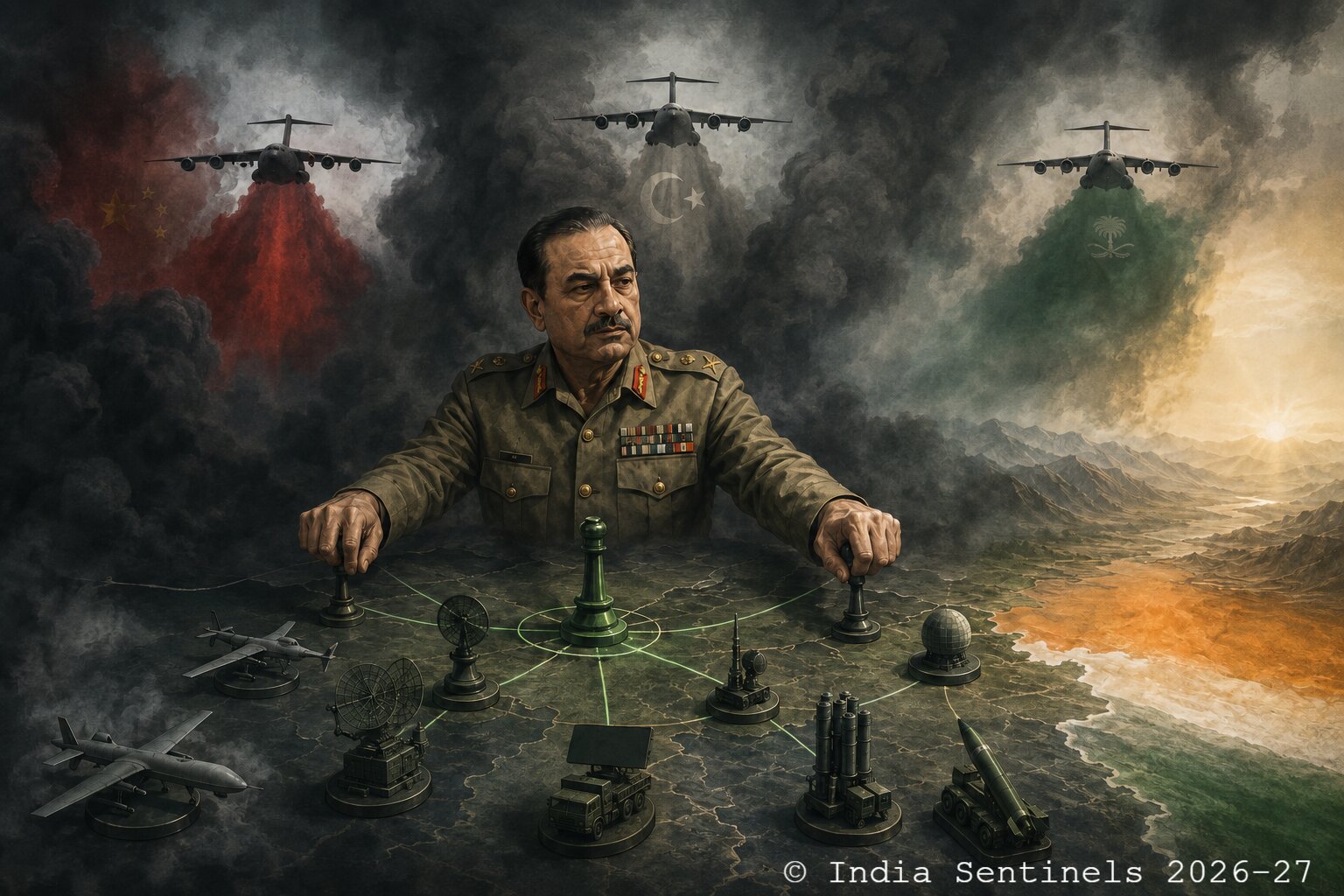
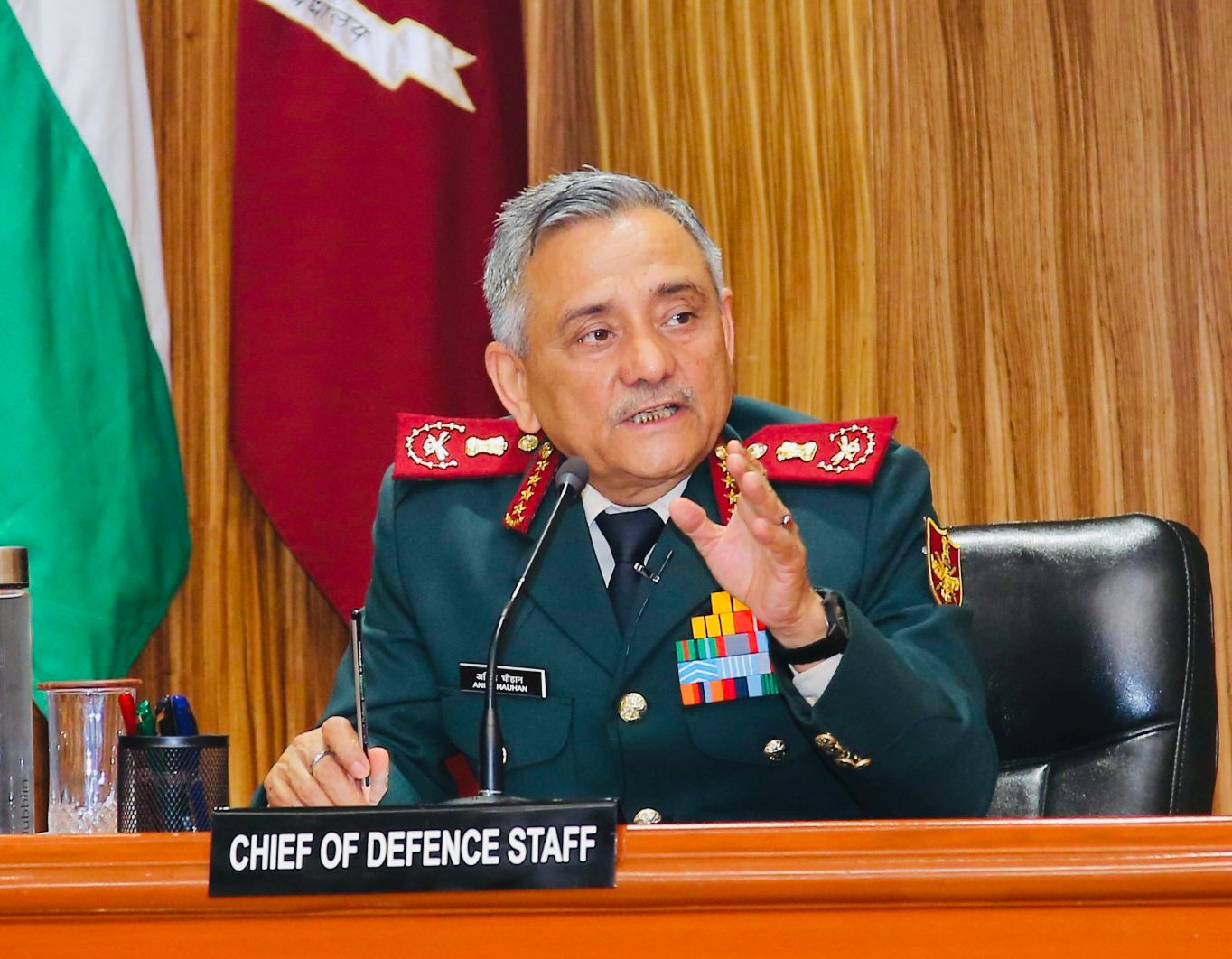
 CDS General Anil Chauhan. (File photo)
— By Dhanashree Valunjkar
On May 14 in the wood-panelled hall of the Manekshaw Centre at Delhi Cantonment, General Anil Chauhan, the second chief of defence staff, delivered what may well be remembered as one of the defining statements of his tenure.
Speaking at the “Kalam & Kavach 3.0” Defence and Strategic Dialogue, before an audience that included defence attaches of several friendly foreign countries, the country’s most senior military officer announced that he had completed and submitted his final report on the proposed integrated theatre commands to the Ministry of Defence, and, with the measured confidence of a commander who builds for the long term, characterized the work of military reform as “an unending process”.
That message, delivered some 16 days before his distinguished tenure formally concludes on May 30 is the key to reading Gen Chauhan’s CDS-ship. Where his predecessor, General Bipin Rawat, brought the founder’s urgency to the post, Gen Chauhan brought the architect’s vision and strategic patience.
The theatre commands he has steered to the Cabinet’s desk amount to the most far-reaching reorganization of the country’s armed forces since Independence, a landmark achievement he has delivered ready for political approval. Just as enduring is the body of ideas behind it: a clear framework of jointness, joint culture, and the principle that doctrine must shape structure, not the other way round, a vocabulary now firmly embedded across all three services.
This article reflects that Gen Chauhan’s legacy is both historic and twofold: the integrated theatres he has brought to the threshold of approval, and the powerful intellectual framework he has built to ensure they succeed.
An Inspired Appointment
In appointing Gen Chauhan as CDS in September 2022, the government was reaching for an exceptional kind of officer. Few contemporaries of equivalent operational seniority offered his combination of attributes. His four decades in olive green spanned both the operational and the conceptual ends of the soldier’s profession in unusual balance.
As major general he commanded 19 Infantry Division in the Kashmir valley; as director general of military operations (DGMO) from 2018 to 2019, he oversaw the operational execution of the Balakot airstrike of February 26, 2019 and the parallel deployment that deterred Pakistani retaliation; he supervised Operation Sunrise, the India-Myanmar joint action against northeastern insurgent groups; and as general officer commanding in chief of Eastern Army Command from September 2019 he managed the eastern sector of the line of actual control (LAC) through the post-Galwan years.
What set him apart, however, was the second arc of his career: a distinguished period spent as military advisor at the National Security Council Secretariat under the national security advisor (NSA), Ajit Doval, an appointment that placed him at the very heart of India’s China file. Few generals in the country have moved so fluently between the field and the file.
A distinguished recipient of the Param Vishisht Seva Medal, the Uttam Yudh Seva Medal, the Ati Vishisht Seva Medal, the Sena Medal and the Vishisht Seva Medal, he was as much a master of strategic policy as a battlefield commander. That rare combination is precisely what the moment called for. The CDS-ship that followed flowed naturally from that intellectual breadth: a tenure led by a soldier who thinks with the vision and depth of a national strategist.
Read also: CDS says theatre command plan ready for Cabinet
Operation Sindoor: A Doctrinal Turning Point
Operation Sindoor stands as a landmark in Gen Chauhan’s tenure. At one level, the operation was a decisive exercise in deterrence; at a deeper level, it became, in Gen Chauhan’s own telling, the empirical foundation for an emerging and distinctly Indian doctrine of conflict.
The most striking feature of his public account is its candour and command of fact. With the quiet assurance of a leader who trusts the record to speak for itself, Gen Chauhan has consistently presented Operation Sindoor as a decisive demonstration of Indian resolve, precision and professional mastery.
At the Manekshaw Centre, he summed up the operation with well-earned assurance: Indian forces, he said, had “dominated the escalation matrix on all four days” of the conflict. Yet his characteristic candour was never lost. Reform, he reminded the audience in the same address, remains “an unending process”. That candour matters, because it signalled, more clearly than any doctrinal document, the modern, self-assured force he was determined to build.
In an August 2025 address, he framed Operation Sindoor as exemplifying a paradigm in which “wars are often fought to achieve political purposes” through “very short, precise” operations rather than territorial conquest. The implication is consequential. A force whose chief defines victory by speed, precision and political effect, rather than by ground gained or prisoners taken, requires a different architecture from the one India has fielded since 1947. Operation Sindoor, in this reading, did not merely vindicate the theatre commands project; it made it operationally urgent.
No Peace Without Power: The Mhow Doctrine
The most quoted public articulation of Gen Chauhan’s strategic philosophy came not at a war memorial or in a formal doctrine release, but at the Ran Samwad 2025 conclave at the Army War College, Mhow, on August 26, 2025, an event he himself had conceived. Before serving officers of all three services and defence attaches of several foreign countries, he delivered what amounted to a realist credo: ”India has always stood on the side of peace. We are a peace-loving nation, but don’t get mistaken, we cannot be pacifists. I think peace without power is utopian.”
To frame the proposition, he reached past the immediate Indian strategic vocabulary and invoked a Latin maxim: “Si vis pacem, para bellum” (If you want peace, prepare for war). The choice of register was itself instructive.
By anchoring his position in the classical European tradition rather than in indigenous strategic vocabulary alone, he was signalling a particular intellectual lineage, the realist tradition that runs from Vegetius through Clausewitz, and an audience: the educated military professional, domestic and foreign, who would recognise the citation. He was also making the new matrices of victory explicit: not the 93,000 prisoners of 1971, but “the speed and tempo of operations, effects of long-range precision strikes”.
This is the bridge between Operation Sindoor as an event and theatre commands as architecture. If the future of conflict belongs to short, precise, multi-domain operations, then a more deeply integrated command structure, in place of coordination routed upward through three chiefs and defence ministry intermediation, becomes not merely desirable but essential. The Mhow address, in this sense, was less an aphorism than a compelling and farsighted case for reform.
Culture Before Structure
The decision that most defines Gen Chauhan’s tenure was never loudly announced: it was his considered, statesmanlike choice not to force-march theaterization to an arbitrary deadline.
Gen Rawat had brought the urgency of a founder to the post. When Gen Chauhan inherited it nine months after Gen Rawat’s death in December 2021, the obvious expectation was a rapid resumption: announce theatres, name commanders, push the structure through Cabinet. Gen Chauhan chose a wiser and more visionary path.
In May 2024, delivering the 22nd Major General Samir Sinha Memorial Lecture at the United Service Institution of India, he articulated what he termed “Jointness 2.0”, a deliberate slowing down to address what he saw as the missing variable.
“Jointness 1.0”, he argued, had been about bonhomie and consensus between the three services; “Jointness 2.0” was about cultivating a ‘Joint Culture’, a fourth culture, distinct from but respectful of the three service cultures, that would “distil the best of each service” rather than settle for the lowest common denominator.
This was the move that distinguished him most clearly from his predecessor, and it stands as a defining mark of his strategic foresight. It was no hesitation, but a farsighted architectural judgement. Reform programmes that begin with the organisation chart, the global record of military reorganisations offers ample examples, from the protracted US implementation of the Goldwater-Nichols Act of 1986 to the cultural frictions of the People’s Liberation Army’s 2015 reforms, tend to produce structures that the underlying culture immediately reroutes around.
By insisting that culture precede structure, Gen Chauhan made the wise and deliberate choice to ground theaterization in a substrate of joint training, joint doctrine and shared institutional habit, ensuring a reform far more durable than any hasty one imposed from above. It is precisely this foresight that gives his modernisation of the armed forces its enduring strength.
Operation Tiranga: From Concept to Cabinet
And the structure itself was delivered. On May 14, at the same Kalam & Kavach address with which this article began, Gen Chauhan announced that he had successfully concluded the inter-service deliberations, internally designated “Operation Tiranga”, and submitted his final report on integrated theatre commands to the Ministry of Defence.
The proposed architecture is the most significant restructuring of the military since Independence: a Northern Theatre focused on China, a Western Theatre focused on Pakistan and a Maritime Theatre, each led by a four-star Theatre Commander with a deputy commander drawn from a different service to reinforce jointness.
Earlier in the year, he had operationalized a “Joint Operations Centre”, formalized integration across eight functional verticals, from operations and intelligence through logistics, training and human resources, and accelerated the build-up of new triservice organisations, including the Defence Cyber Agency, the Defence Space Agency, and a planned Defence Geospatial Agency and Cognitive Warfare Action Force.
It is worth pausing on the significance of this. The CDS post itself was created only in December 2019, and theatre commands had been debated without resolution since the Kargil Review Committee report of 2000, a full quarter-century of deliberation across successive governments.
It was Gen Chauhan who, in April-May this year, finally forged the first genuinely inter-service-agreed proposal and carried it through to the Cabinet Committee on Security. Where others had stalled for 25 years, he delivered. That achievement, the fruit of patience and persistence in equal measure, now stands ready for the political assent it has so clearly earned.
The Inheritance: A Foundation to Build On
Gen Chauhan’s tenure has done much of the conceptual heavy lifting for the years ahead. The theatre commands proposal is with the Cabinet, ready for political assent. The Joint Operations Centre has begun functioning. The cyber and amphibious joint doctrines are in place, awaiting the operational experience that will refine them. The Defence Geospatial Agency and the Cognitive Warfare Action Force are taking institutional shape. Each of these stands as a strong foundation laid for the future, which is precisely why the next CDS inherits a tenure of exceptional generosity.
The architecture is in motion; the political ground has been prepared; the inter-service deliberations have been completed. What remains is the rewarding work of implementation and the next exciting phase of evolution that every great reform invites.
The most enduring part of the legacy, however, is not architectural at all. It is the reasoning that holds the architecture together: the case for jointness as the foundation on which any structure must rest; the reading of Operation Sindoor as evidence of a new kind of war fought short, precise and across many domains; the philosophical anchoring at Mhow that places power and peace in their right order.
These are intellectual bequests, and they are the most generous kind, because they give the next incumbent a fully articulated framework to work with from day one. They have already entered the professional vocabulary of all three services, which means the conversation has shifted permanently. Whatever specific structural choices follow, they will be made on this conceptual terrain.
Gen Chauhan’s tenure represents a landmark in the modernisation of India’s armed forces. The architect has done his work, and done it well; the foundations are firmly laid; the blueprint is on the desk.
The institution he leaves behind, and the ideas he has embedded within it, stand ready and well prepared for the next stage of building, a fitting testament to one of the most thoughtful and accomplished military leaders of his generation.
The author is a research assistant at CENJOWS (Centre For Joint Warfare Studies). She has completed her MA in International Relations from Department of War Studies at King’s College, London
Disclaimer: The views expressed in the article are the author’s own and don’t necessarily reflect the views of India Sentinels.
Follow us on social media for quick updates, new photos, videos, and more.
X: https://x.com/indiasentinels
Facebook: https://facebook.com/indiasentinels
Instagram: https://instagram.com/indiasentinels
YouTube: https://youtube.com/indiasentinels
© India Sentinels 2026-27