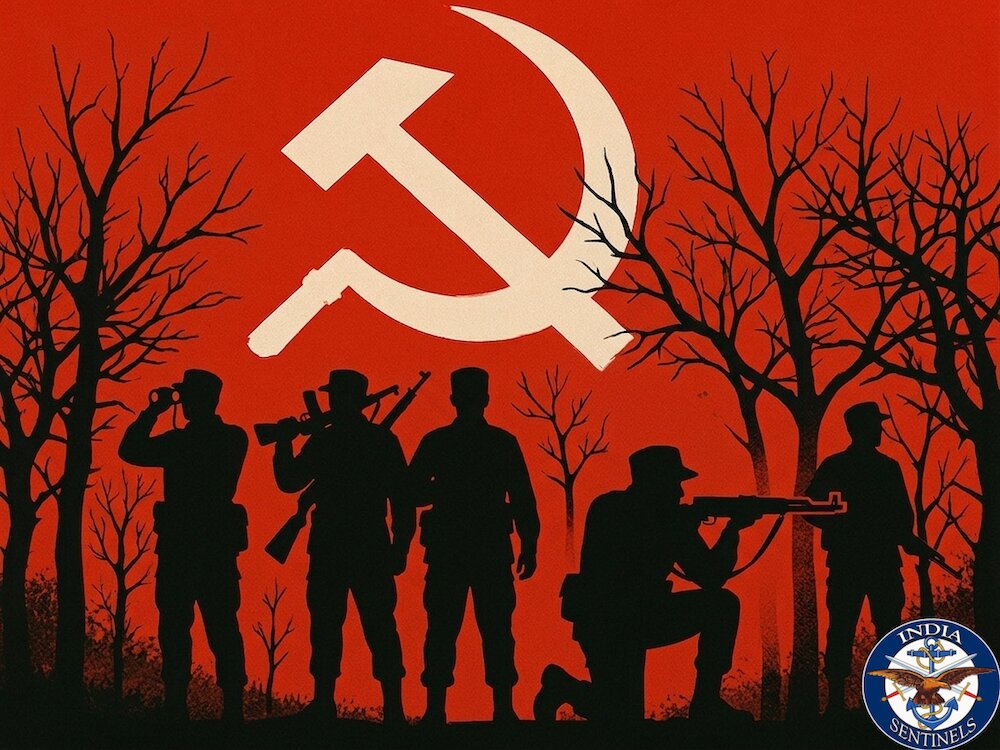
 Illustration for representation. (© India Sentinels 2026–27)
In March 2026, the Ministry of Home Affairs (Union home ministry) declared what few had once thought possible: the eradication of decades-old left-wing extremism within the scheduled deadline of March 31, 2026. It was a historic milestone – one purchased at an enormous cost in blood, sweat, and sacrifice.
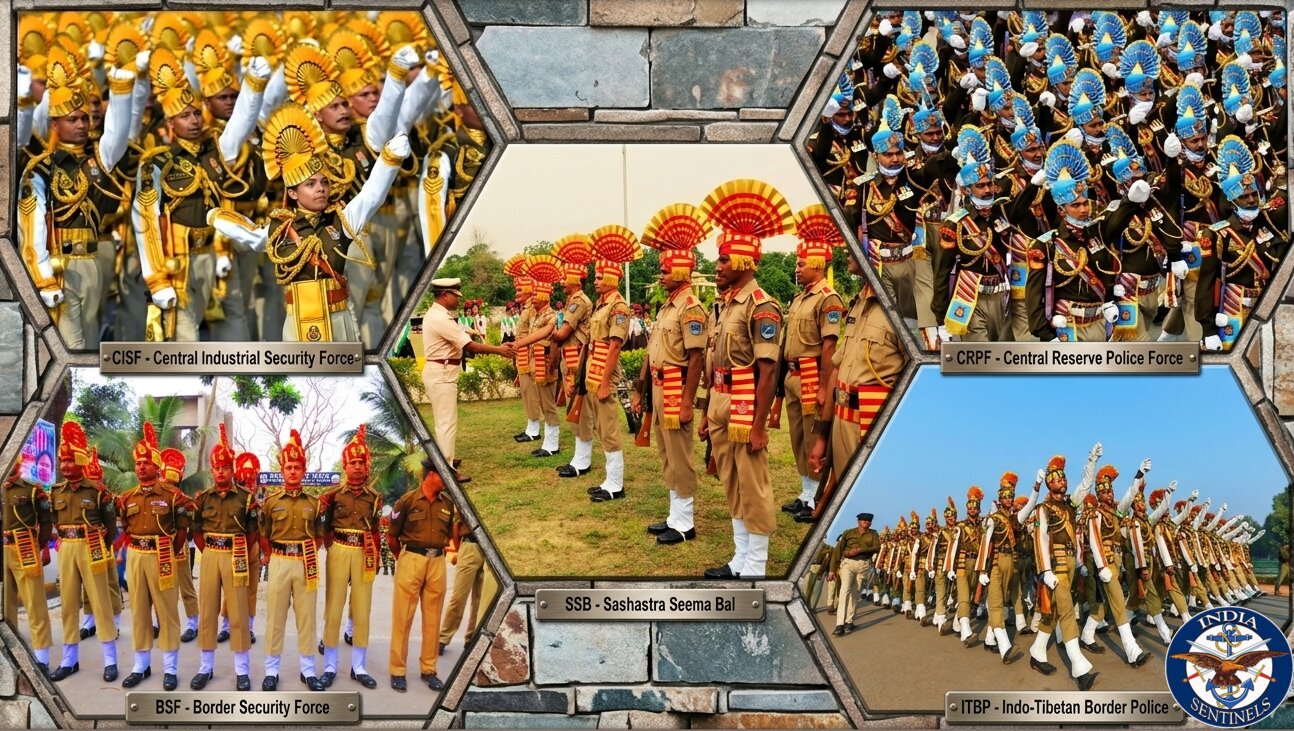
The achievement was the result of sustained, relentless offensive and defensive operations mounted by the central armed police forces (CAPFs): the CRPF, BSF, ITBP, SSB, and CISF, with the CRPF’s elite Commando Battalion for Resolute Action (CoBRA battalion) playing an especially decisive role. The dreaded “Red Corridor”, which once stretched across the heartland of India like a wound, has been all but decimated. A few remnants linger, and they must be dealt with firmly lest the Maoists find space to regroup, rearm, and reorganize.
The success is real. The pride is earned. But success, even the most hard-won, must be accompanied by honest introspection. And there is no more pressing case for such introspection than the disaster that unfolded in the forests of Bastar on April 6, 2010 – the Tadmetla (also known as Tadmetala) ambush, in which 75 CRPF personnel and one state police officer were killed in a single day, in the single most devastating blow ever struck against India’s security forces by the Maoists.
As the nation celebrates the end of the Maoist insurgency, it owes those 76 men – and their families – far more than a ceremonial salute. It owes them truth, accountability, and justice.
Read also: Op Sindoor – Testimony to BSF’s grit and fighting spirit
What Happened at Tadmetla
Let there be no ambiguity about the nature of the Tadmetla incident: it was not a chance encounter, not a skirmish that escalated beyond anyone’s expectations, and certainly not an unavoidable tragedy in the fog of war. It was a meticulously planned, coldly executed Maoist offensive – a deliberate military operation carried out against a better-equipped, better-trained force that had been thrust into the field without adequate planning, preparation, or appreciation of the threat it faced.
The Maoists had conducted sustained observation and reconnaissance of the CRPF column. They tracked its movements, identified its vulnerabilities, and chose their killing ground with tactical precision. The CRPF troops, it appears, were unaware they were being shadowed. They circled the same area repeatedly. On successive nights, they returned to sleep in the same school building adjacent to their camp – a basic tactical error that any professional soldier would recognize as an open invitation to the enemy.
The Maoists accepted that invitation. They sealed the exit routes, surrounded the force, and struck from dominant positions on three sides. The men were pinned down in a vast killing ground with no viable escape. They fought with courage – of that there is no question – but courage without competent leadership is a tragedy waiting to happen.
Seventy-five CRPF jawans and one state police officer died. It remains the single largest loss of personnel in the history of the CRPF, and one of the most catastrophic single-day losses suffered by any of India’s security forces since Independence.
The ambush also marked a significant inflection point in Maoist tactics. It confirmed their graduation from guerrilla hit-and-run tactics to a more sophisticated form of mobile warfare – the kind that involves coordinated military groupings capable of encircling and annihilating a substantial security force deployment. The leadership at the helm failed to appreciate this evolution. They paid for that failure with the lives of their men.
Read also: CAPFs Act undermines the very forces it claims to strengthen
The Leadership Question
The central question that this piece seeks to raise – and that the nation must squarely confront – is one of leadership accountability. Who authorized a three-day area domination-cum-familiarization operation that ended in catastrophe? Were the troops properly briefed? Was an “operations group” briefing conducted by the commandant and the deputy inspector general (DIG)? Were the company commanders and tactical group leaders familiar with the terrain? Were contingencies war-gamed and rehearsed?
Every military and paramilitary doctrine insists on thorough pre-operation preparation: detailed reconnaissance, intelligence verification, contingency planning, and clear command channels. The evidence – or rather, the absence of evidence – suggests that much of this was bypassed or neglected.
The intelligence inputs that apparently triggered the operation were never properly verified for accuracy. The ambushes the column was meant to set up never materialized, because the Maoists had no intention of walking into a trap – they were laying one of their own. The force went out looking for an enemy that was, in fact, looking for them.
Field Marshal William Slim, the great British commander of the Burma campaign and one of the finest military minds of the 20th century, set a clear leadership standard: a competent leader can get efficient service from poor troops, while an incapable leader can demoralize the best. By Slim’s reckoning – and by any honest assessment – the leadership that sanctioned and executed the Tadmetla operation fell dangerously short of the mark.
The battalion command, the range DIG, the sector inspector general – none of these can escape responsibility. Nor, frankly, can those above them in the chain of command who reviewed and green-lighted the plan. A multi-day operation of this scale could not have been launched in isolation; it required authorization from above. The question of who gave that authorization, and on what basis, has never been satisfactorily answered.
It is worth emphasizing, with equal force, what is not being suggested here: the men on the ground bear no blame. They fought against overwhelming odds, in terrain they were inadequately prepared for, with escape routes already sealed. The blame lies not with the foot soldier but with the leadership structure that failed him.
Read also: Trampling of Trust – The nightmare of a ‘deshbhakt’
The Second Failure: Shoddy Investigation
The Tadmetla ambush was the first failure of leadership. What followed – or, more precisely, what did not follow – constitutes a second, equally damning failure.
Writing in the Hindu [archived link], RK Vij, a former IPS officer, made a candid and professional admission that deserves to be acknowledged publicly. He conceded that the investigation into Tadmetla was poor, that no special attention was given to a case that had shaken the conscience of the nation, that no special investigation team (SIT) was formed, that the case was not supervised by a senior police official, and that the provisions of the Unlawful Activities (Prevention) Act (UAPA), 1967, or the Chhattisgarh Special Public Security Act, 2005 – both of which were applicable – were never invoked. For this rare and honest professional assessment, Vij deserves credit.
The consequences of this investigative failure have been grave. After roughly 16 years, the case has seen the acquittal of all accused – not because the evidence exonerated them, but because the evidence was never properly gathered, preserved, or presented.
There is a painful irony here. The CRPF and other CAPFs were capable of operating in the most hostile and inaccessible terrain that Bastar had to offer. They faced the threat of IEDs, ambushes, and sniper fire as a matter of routine. Yet the police leadership – the same IPS officers who command these forces – claimed, in effect, that the environment was too difficult for a thorough investigation. That argument does not hold. If the uniform is fit for purpose in the field of battle, it must be fit for purpose in the field of justice.
The region was, and remains, densely covered by security force deployments. The investigation team could have sought – and should have been offered – the full protective cover of the CRPF and other CAPFs to conduct its work. The failure to do so was not operational; it was a failure of will and of political and institutional priority.
A troubling parallel presents itself. In the RG Kar Medical College case in Kolkata, speedy investigation was promised, and justice was pledged. As in Tadmetla, the promises rang hollow until the judiciary stepped in. In the RG Kar case, the Calcutta high court ordered an SIT inquiry. In the Tadmetla case, a similar intervention – by the Supreme Court, if necessary – is now warranted.
Read also: Address the deformities in CAPF structure
EN Ram Mohan Report: Hidden in Plain Sight
In the aftermath of the ambush, the Union home ministry commissioned a one-man inquiry committee, headed by EN Ram Mohan, a former director general of the BSF. The committee was tasked with examining the various aspects of the incident and suggesting corrective measures.
That report has never been made public.
This is unconscionable. The families of the 76 fallen – men who gave their lives in the service of the Indian state – have a right to know what that report found. The nation, whose security forces absorbed this catastrophic blow, has a right to know. Parliament, which allocates resources and mandates accountability for such forces, has a right to know. And the CRPF personnel currently serving in Bastar and elsewhere, whose lives may depend on the lessons drawn from Tadmetla, certainly have a right to know.
Now that the Maoist insurgency has officially ended, there is no operational sensitivity that could justify further concealment. The government of the day must release the Ram Mohan committee report in its entirety, along with the action taken on each of its recommendations.
Did heads roll? Were senior officers removed from command? Were their careers affected in any meaningful way commensurate with the scale of the failure? Or did the institutional reflex kick in – the familiar police‑hierarchy manoeuvre of quietly transferring the responsible officers and calling it accountability?
Transfers are not accountability. They are the bureaucratic equivalent of sweeping a problem under a very thick rug.
Read also: Are elections compromising our border and national security?
Brave Men Who Won the War
It would be incomplete, and profoundly unjust, to conclude without acknowledging those who ultimately prevailed. The end of left-wing extremism was made possible by the courage and sacrifice of officers and jawans of the CAPFs who served for years in some of the most unforgiving terrain in India. Among those who gave their lives or risked them daily were officers like Vibhor Singh and Ajai Malik – their names representative of a generation of field leaders and their men who did not allow the failures of higher leadership to define their own conduct.
It is because of such men, and the thousands of unnamed others who toiled alongside them, that India can now speak of a post-Maoist Bastar. That is no small thing. It is, in fact, a defining achievement of Indian internal security in the post-Independence era.
Yet this piece is also written with another purpose in mind: to place this story before generations who were not yet born, or barely conscious of the world, when the forests of Bastar ran red in April 2010. Generation Z (Gen Z) and Generation Alpha (Gen A) – young Indians who have grown up in an era of social media timelines and algorithmic news feeds – know little of Tadmetla, less of the Red Corridor, and almost nothing of the quiet, grinding sacrifice that went into dismantling it.
They know India as a rising power; they deserve to know, too, the price at which that stability was secured.
The end of left-wing extremism did not arrive through a policy announcement or a diplomatic accord. It came through the relentless courage of CAPF officers and jawans who fought in areas without roads, without phone signals, and without any guarantee of returning home. Tadmetla is not ancient history. It is the story of how the India they inhabit came to be.
But a victory is only truly complete when the fallen are honoured with justice, not merely with memorial services. A ceremonial salute at a passing-out parade does not substitute for a credible prosecution of the men who killed their comrades.
Read also: Commanded into Crisis – Systematic wrecking of CAPFs’ moral fabric
What Must Happen Now
The path forward is clear, even if the political will to walk it is not yet evident.
First, the Union home ministry must release the EN Ram Mohan committee report in its entirety, along with the action taken on its recommendations. The country has waited 16 years; it cannot wait indefinitely.
Second, the Chhattisgarh government, nudged where necessary by the Union government, must constitute a fresh, professionally credible investigation – led by senior specialists, shielded by adequate security cover, and supervised at the highest level of the police hierarchy. The acquittals must be challenged. Every available legal provision, including those under the UAPA, must be invoked where applicable.
Third, accountability must be fixed – genuinely and visibly – for both the operational failure of April 6, 2010, and the investigative failure of the years that followed. Officers who were at the helm of command during the Tadmetla operation must answer for what went wrong. Officers who presided over the investigation must answer for why it was allowed to collapse.
Fourth, and perhaps most importantly, the lessons of Tadmetla must be formally institutionalized in training curricula for CRPF and all CAPF officers. The operational failures of that day are precisely the kind of case studies that distinguish a professional force from an amateur one. Have those lessons been systematically incorporated into leadership and tactics training? That question deserves a direct and public answer from the CRPF directorate.
The Union home minister, Amit Shah, and the senior leadership of his ministry bear a particular responsibility here. This is not a routine administrative matter but a question of institutional honour, of the promise the Indian state makes to those it sends into battle, and of the moral foundation upon which future operational decisions will rest.
Those who sacrificed their lives on April 6, 2010, for the integrity of this country deserve at least this much from the nation they served: that their killers do not walk free while their names adorn memorial walls. The case is unfinished. India’s conscience should not rest until it is.
Disclaimer: The views expressed in the article are the author’s own and don’t necessarily reflect the views of India Sentinels.
Follow us on social media for quick updates, new photos, videos, and more.
X: https://x.com/indiasentinels
Facebook: https://facebook.com/indiasentinels
Instagram: https://instagram.com/indiasentinels
YouTube: https://youtube.com/indiasentinels
© India Sentinels 2026-27