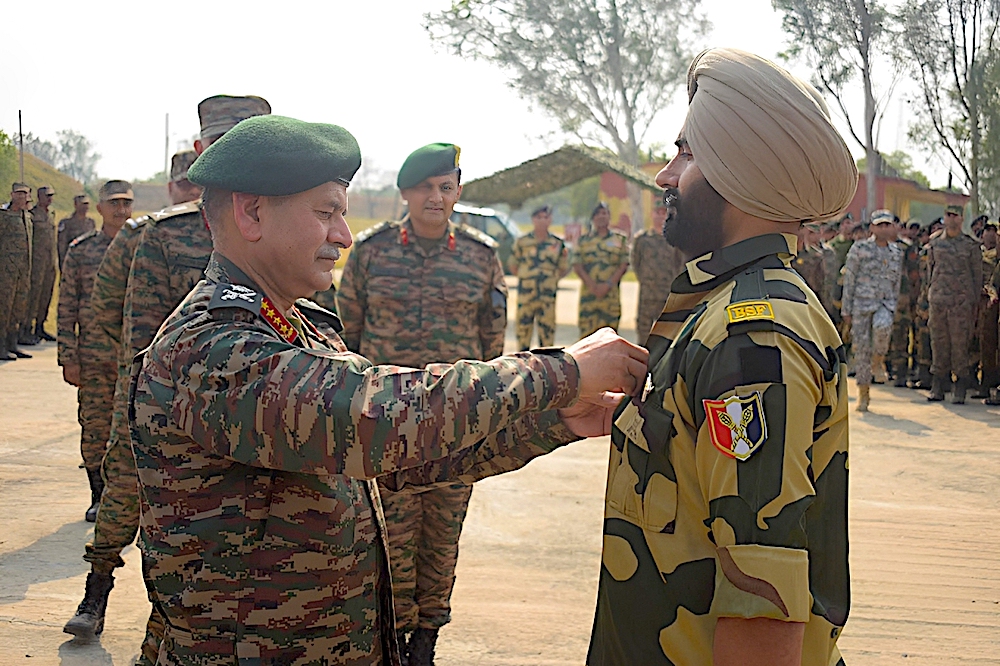
 The Indian Army chief, Gen Upendra Dwivedi, pinning a medal on a BSF soldier for playing an exceptional role during Operation Sindoor, in May 2025. (File photo)
On December 1, 2025, the Border Security Force marked its Diamond Jubilee – 60 years of standing watch on India’s most contested frontiers. It was a milestone worth celebrating, not merely for the passage of time, but for what those six decades represent: an institution forged in crisis, tested repeatedly by fire, and consistently found equal to the moment.
Few moments tested that mettle more sharply than Operation Sindoor in May 2025.
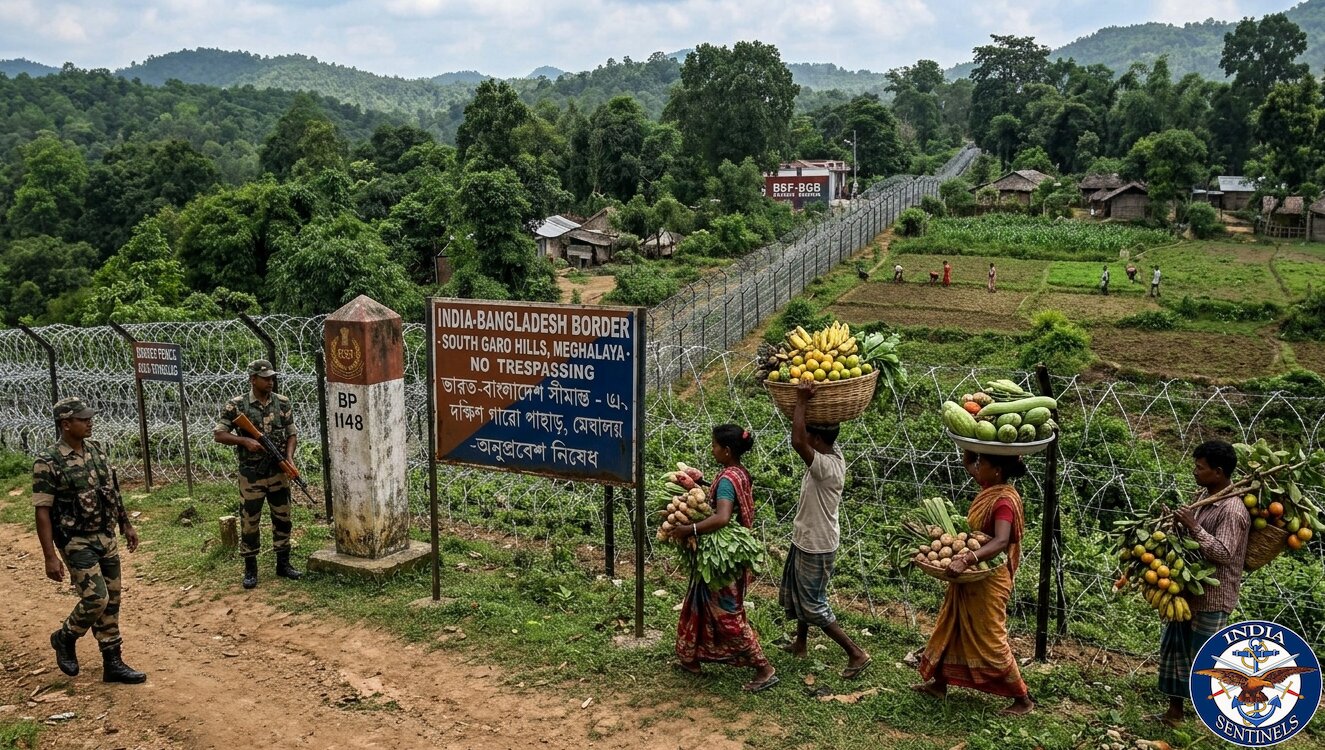
The BSF was born out of necessity. After Pakistan’s incursions into the Rann of Kutch in April 1965, and the war that followed that August, it became painfully evident that state armed police forces were ill-equipped to handle even minor border skirmishes. Policymakers and security planners drew the logical conclusion: India needed a dedicated, permanently deployed border force, organized and equipped along the lines of an infantry battalion. That force was the BSF – raised to guard the borders with Pakistan, and later, Bangladesh.
Read also: Op Sindoor – Testimony to the BSF’s grit and fighting spirit
What the wider public rarely appreciates is that the BSF carries a formal wartime role. In times of conflict, the force operates under the command of the Indian Army, pooling resources – including artillery – into the larger war effort. Its wartime responsibilities include holding independent defensive positions, operating in conjunction with the Army, and executing limited offensive actions against enemy positions.
This was not an untested theory, because as far back as 1971, when the force was barely six years old, BSF personnel displayed battlefield gallantry that earned them one Mahavir Chakra and 11 Vir Chakras, among many other honours. Those were extraordinary decorations for a force so young, and they set a standard that subsequent generations of the BSF have sought to honour.
Operation Sindoor gave them the opportunity to do precisely that.
Read also: When Leadership Lacks Grounding – The real risk in the CAPF-IPS debate
Intelligence That Shaped the Operation
The groundwork for India’s response began long before the first shot was fired. In the immediate aftermath of the Pahalgam terror attack – carried out by Pakistan-sponsored terrorists – the BSF’s intelligence branch shifted into high gear. Officers and jawans on the ground began systematically gathering and reporting information about enemy movements, logistics preparations, and the repositioning of assets along the international border.
Their observations were precise and actionable. BSF troops identified and reported exact locations of enemy recoilless gun positions, mortar emplacements, terrorist launch pads, and fuel dumps situated close to the border. The repositioning of these “direct-fire” assets nearer to the boundary line was a significant tactical signal – one that was read correctly.
By May 7 last year, the picture had become unmistakably clear. BSF personnel observed a marked increase in vehicular activity on the Pakistani side, the dumping of ammunition near the border, and the selective evacuation of villages in the forward areas. Intercepts revealed visits by several senior Pakistani army commanders to forward positions. Taken together, these indicators pointed to imminent military action.
Read also: Op Sindoor’s success cannot mask Pahalgam’s security failures
This intelligence did not merely sit in reports but directly shaped the operational response. Indian commanders were able to discern Pakistani intentions early enough to place troops on alert, fortify BSF defensive positions, and allow the Army to occupy its wartime positions in an orderly, prepared manner. The proactive measures that followed kept casualties to a minimum. The impact of the enemy’s opening moves, when they came, was negligible – a tribute to the value of timely, ground-level intelligence.
Four Days on the Western Border
The bulk of Pakistani fire assaults targeted the 199-kilometre stretch of the international border in the Jammu sector – terrain that falls under the BSF’s direct charge. Simultaneously, BSF units deployed along the line of control, under the operational command of the Army, came under sustained pressure.
The BSF’s response was resolute. Troops and their operational commanders met each fire assault head-on, retaliating with accuracy and discipline. The ferocity and effectiveness of BSF fire gave Indian forces a decisive operational and moral ascendancy over the adversary – an outcome later acknowledged at the highest levels of the defence establishment.
Read also: Kashmir Book Ban – Why censorship can’t cure valley’s complex reality
The results on the ground spoke for themselves. Pakistani post Dhandar, positioned opposite the Samba sector, suffered extensive structural damage from retaliatory engagements by BSF posts. Multiple Pakistani positions were struck with sustained mortar shelling. The Pakistani communications network – a critical enabler of coordinated military action – was systematically degraded through BSF artillery and mortar fire.
Further north, opposite the Sunderbani sector, BSF units executed devastating precision fire assaults. Enemy posts at Tibba and New Chinor were destroyed. The Looni and Putwal launch pads – used to facilitate infiltration – were neutralized. These strikes crippled the enemy’s infiltration capability and dismantled key elements of their forward command infrastructure.
Read also: Akhand Bharat and ‘retaking’ Pakistan-occupied Kashmir
Stopping Infiltrators in Their Tracks
Even as the conventional battle raged, BSF troops continued their primary mission: keeping the border sealed. On May 8, exactly a year ago from today, alert BSF personnel detected a large group of approximately 50 militants attempting to infiltrate Indian territory, moving between the Pakistani villages of Mukhwal and Dhandhar. The troops engaged them with effective fire, inflicting seven casualties and forcing the remainder into a hasty retreat back across the border.
It was a reminder that the BSF’s role in Operation Sindoor was not singular. The force was simultaneously fighting a conventional engagement, guarding against infiltration, and gathering intelligence – all at once, all along a vast stretch of contested frontier.
The drone threat was handled with equal effectiveness. BSF troops downed several Pakistani drones along the border, using light machine guns in an anti-aircraft role. Equally important was the timely reporting of drone movements, which enabled the interception of multiple aerial assets before they could cause damage. The recovery and analysis of debris from downed drones yielded valuable insights into the technology Pakistan was deploying.
That intelligence, in turn, allowed Indian forces to develop precise countermeasures and sharpen their strategic posture for the remainder of the operation.
Read also: Modernization and reforming our border-guarding forces
Recognition at the Highest Level
The praise that followed Operation Sindoor was not incidental. It came from the very top of India’s political and military establishment.
The prime minister, Narendra Modi, in his address to the nation, specifically acknowledged the BSF’s role, stating that the force – alongside India’s other paramilitary forces – remained “on constant alert” throughout the operation. The Union home minister, Amit Shah, commended the BSF for degrading enemy defensive positions and border outposts, for the stoutness of its response to enemy fire assaults along the entire western border, and for maintaining its regular border-guarding duties – including the prevention of infiltration – without interruption.
The-then director general of military operations, Lieutenant General Rajiv Ghai, also commended the BSF’s contribution in post-operation briefings – a recognition that carries particular weight coming from the Army’s senior operational leadership.
In terms of formal honours, BSF personnel were awarded two Vir Chakras and sixteen other gallantry medals, along with several commendations – recognition of the courage, commitment, and professional excellence displayed during those four days in May.
Read also: Efficiency of CAPFs suffering from ‘glass ceiling’ effect
Women Who Refused to Leave
It would be a serious omission to conclude without speaking of a particular act of courage that stands apart even in a story full of them.
At Akhnoor, a team of seven women personnel from a BSF battalion held their position on a forward border outpost for three consecutive days and nights under relentless enemy fire. They were led by Assistant Commandant Neha Bhandari, alongside six young women constables. When intense shelling erupted all along the border, they were given the option to withdraw. They declined.
Unintimidated by bullets, artillery shells, and drones, this small team not only held their ground but actively launched fire assaults on enemy troops and infiltrators. In a conflict that tested the resolve of thousands of trained soldiers, these seven women exemplified something beyond training – a quality of courage that defies easy description.
The chief of Army staff, General Upendra Dwivedi, personally felicitated Bhandari with the commendation disc in recognition of her bravery. It was an honour richly deserved.
Read also: Border Security Force is an armed force, not police, nation must know
The Lessons Must Be Learned
A year on from Operation Sindoor, it is time for the BSF’s leadership to sit with what happened – not to celebrate, though there is much to celebrate, but to analyse. The operation revealed much about what the force does well: its intelligence-gathering, its ground-level coordination with the Army, its ability to fight a multi-dimensional battle simultaneously. It also surfaced lessons about training gaps, equipment needs, and infrastructure requirements that must now be addressed with urgency and seriousness.
The BSF has always risen to the moment when India needed it. Operation Sindoor was the most recent proof. But the next test, whenever it comes, will demand a force that has absorbed the lessons of the last one.
The border held in May 2025. The task now is to ensure it holds again.
Disclaimer: The views expressed in the article are the author’s own and don’t necessarily reflect the views of India Sentinels.
Follow us on social media for quick updates, new photos, videos, and more.
X: https://x.com/indiasentinels
Facebook: https://facebook.com/indiasentinels
Instagram: https://instagram.com/indiasentinels
YouTube: https://youtube.com/indiasentinels
© India Sentinels 2026-27