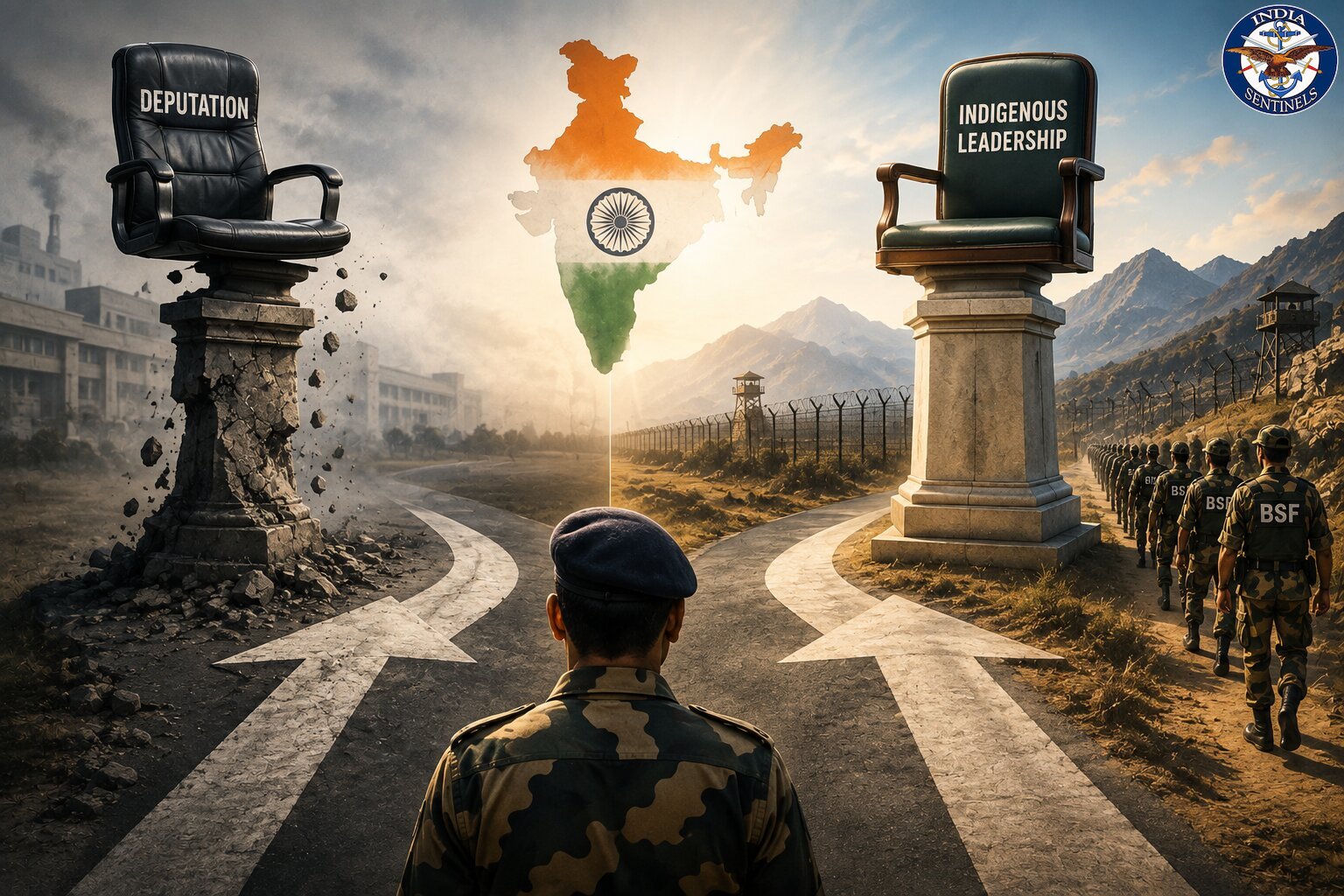
 Illustration for representation. (© India Sentinels 2026–27)
The Central Armed Police Forces (General Administration) Bill, 2026, has been presented as a groundbreaking move by the government that was overdue for the purpose of making sure there’s clarity and uniformity in handling the paramilitary forces of the country. On the surface, that framing sounds reassuring, even compelling. But when you look closely at what the act actually says, and more tellingly at what happened in the days immediately after it came into force, the picture becomes considerably less clear and considerably more troubling.
Let me be direct about where my concern lies. The act raises a deceptively simple but deeply important question: Is this truly reform, or is it a continuation of the old, entrenched practices dressed up in the language of modernity?
Read also: Debunking the myth of IPS superiority over CAPF cadres
Provisions Warranting Scrutiny
In particular, there’s one clause in the act that has gone largely unnoticed and requires greater scrutiny than what it has been receiving so far. It grants the central government the power to frame recruitment and service rules even when those rules run contrary to existing court judgments. This is no routine administrative clause but a sweeping override mechanism, and its constitutional implications are serious.
It seems that the aim of bringing the new CAPF Act is also to take the “Group A” executive cadre of the CAPF out of the purview of the Department of Personnel and Training (DOPT) and thus deny the status of belonging to the organized “Group A” services (OGAS) since 1986, which the Supreme Court has upheld.
The Supreme Court has examined the question of deputation of Indian Police Service (IPS) officers into the central armed police forces (CAPFs) on more than one occasion. The court has never objected to the practice in principle. But it has consistently and emphatically stressed that such deputation must not come at the cost of the career progression of CAPF cadre officers. The principle has been stated with admirable clarity over the years: operational efficiency must be balanced with institutional fairness.
The new act appears to disturb precisely that balance.
What makes this more constitutionally problematic is that it does so without addressing – let alone resolving – the legal reasoning that informed those earlier judicial pronouncements. The legislature unquestionably has the authority to amend the law. What it can’t do, without inviting serious challenge, is simply bypass judicial reasoning without curing the underlying infirmities that the courts identified. This distinction matters enormously, and it’s one the act conspicuously ignores.
There’s also the broader question of fundamental rights in public employment. If the act perpetuates a system that structurally limits the upward mobility of CAPF officers – men and women who have spent entire careers in service – it may well be seen as a violation of their constitutional entitlements. These aren’t abstract arguments but questions that courts will be asked to answer.
Read also: Address the deformities in CAPF structure
The Week That Told the Story
But beyond the legal arguments – significant as they are – what has generated the most immediate concern is the sequence of events that followed the act’s notification.
The law was notified on April 9. By April 10, an IPS officer had been appointed as deputy inspector general (DIG) in the Border Security Force (BSF) on deputation. The ink had barely dried on the act when the old pattern reasserted itself – almost as if to signal that nothing, in substance, had changed.
The act itself doesn’t clearly lay down a framework governing IPS deputation at the DIG rank. In fact, it’s conspicuously silent on the matter. In such a situation, the speed of this appointment raises questions that deserve straightforward answers rather than bureaucratic deflection. If the law provides no enabling provision for this, on what legal basis does the executive act? And if the executive can act without such a basis, what was the point of enacting the law in the first place?
If you look at them objectively, these aren’t rhetorical questions. They go to the heart of how the rule of law is understood and practised in our institutions.
Read also: When Leadership Lacks Grounding – The real risk in the CAPF-IPS debate
What This Means for CAPF officers
For officers serving within the CAPFs, this isn’t a distant legal or administrative debate, but something that’s deeply, personally felt.
Consider what these officers give to the country. Decades spent in some of the most inhospitable terrain that India has to offer – the frozen heights of the Himalayas, the insurgency-ravaged dense jungles of central and northeast India, the volatile border strips of Rajasthan and Punjab, and the militancy-hit Jammu & Kashmir. They accumulate knowledge that can’t be replicated by an outsider, no matter how capable: knowledge of the terrain, the adversary, the community, and the culture of service that sustains these forces.
When officers with this depth of experience repeatedly see senior positions going to those who arrive from outside the force on deputation – often with no prior operational exposure to these specific environments – it doesn’t merely disappoint them. It demoralizes them. It plants the corrosive belief that their decades of sacrifice carry no institutional value when advancement is being considered.
Over time, that belief erodes motivation, weakens institutional culture, and – most critically – undermines the trust between the officer corps and the system they serve. For forces whose effectiveness depends not just on discipline but on the confidence of their personnel in the fairness of the system, this isn’t a minor personnel matter but a strategic vulnerability.
Read also: Commanded Into Crisis – The systematic wrecking of CAPFs’ moral fabric
Government’s Reach into the Ranks
What gives particular weight to these concerns is that they are evidently not confined to the editorial pages or the drawing rooms of retired officers. Recent developments suggest that the anxiety has cut deep enough to prompt a response from the very top of the administrative structure.
It’s reliably learned that the Ministry of Home Affairs has asked the directors general of the CAPFs to engage directly with assistant commandant- and deputy commandant-level officers and gather their feedback on the new act. Simultaneously, there are credible indications that the government has been genuinely unsettled by the strong and organized reactions from former CAPF officers and their associations – particularly in Delhi and Kolkata – over the past week.
This outreach appears to be both an attempt to gauge the depth of sentiment within the active ranks and an implicit acknowledgement that something in the handling of this legislation has gone wrong. When a government feels compelled to conduct internal sentiment surveys within days of a major law’s notification, it’s a sign that the law hasn’t landed as intended.
Read also: Stagnant Ranks, Broken Morale – The cost of CAPF’s skewed HR policies
Valid Goal, Poorly Served
Let me be clear about something that tends to get lost in debates of this kind: the government’s stated objectives for the act aren’t without merit. Better coordination with state police forces, improved uniformity in service conditions across the CAPFs, and enhanced operational effectiveness are all legitimate and worthy aims. No serious student of India’s internal security landscape would dismiss them.
But valid objectives do not validate every means chosen to pursue them. Coordination can be strengthened without structurally disadvantaging the career prospects of career CAPF officers. Uniformity can be achieved without legal provisions that appear designed to override judicial oversight. Operational effectiveness, in these forces more than in any other, is inseparable from the morale and institutional confidence of the officers who deliver it.
The government hasn’t explained why these goals required the specific provisions that have generated such controversy. That explanation is owed – not just to the retired officers who have raised their voices publicly, but to the tens of thousands of serving personnel whose careers and futures are directly shaped by this legislation.
Read also: Chanakya’s Warning and India’s Shame – How the state fails its CAPFs
Cosmetic Change or Real Reform?
What makes the situation more troubling than the specific legal provisions is the broader perception it has created: that nothing has really changed. The structural hierarchy remains as it was. The outcomes for CAPF officers remain as they were. And the same patterns – IPS deputation into senior CAPF positions – now continue, but with the additional legitimacy of a fresh statutory framework.
This is what is meant when people describe a law as cosmetic. It isn’t an accusation of bad faith but an observation about effect. If the act was intended to signal a genuine break from the past, the appointment on April 10 was a peculiarly timed way to demonstrate that intent.
If the government believes this characterization is unfair, it has both the opportunity and the obligation to say so clearly – and to demonstrate through its subsequent actions that the act’s purpose is substantive rather than symbolic.
Read also: Give CAPF officers what Supreme Court ordered – and what they earned
The Question of Trust
Ultimately, what’s at stake here is something more fundamental than legal provisions, service rules, or administrative appointments. It’s trust – the trust of the CAPF officer corps in the system that commands their service and shapes their lives.
India’s paramilitary forces – the BSF, the Central Reserve Police Force (CRPF), the Central Industrial Security Force (CISF), the Indo-Tibetan Border Police (ITBP), and the Sashastra Seema Bal (SSB) – collectively deploy nearly a million personnel across the country’s most demanding security environments. Their effectiveness is built on discipline, courage, and, crucially, on the institutional belief that the system they serve is fundamentally fair.
A law that seeks authority must also earn confidence. A reform that is presented as transformative must, at some point, transform something.
At present, the CAPF Act, 2026, leaves too many questions unanswered. For the men and women who serve in these forces, those questions aren’t academic. They are the measure of whether their service is truly valued.
The government still has time to provide the answers. But time, as any border officer will tell you, has a way of running short when you least expect it.
Disclaimer: The views expressed in the article are the author’s own and don’t necessarily reflect the views of India Sentinels.
Follow us on social media for quick updates, new photos, videos, and more.
X: https://x.com/indiasentinels
Facebook: https://facebook.com/indiasentinels
Instagram: https://instagram.com/indiasentinels
YouTube: https://youtube.com/indiasentinels
© India Sentinels 2026-27