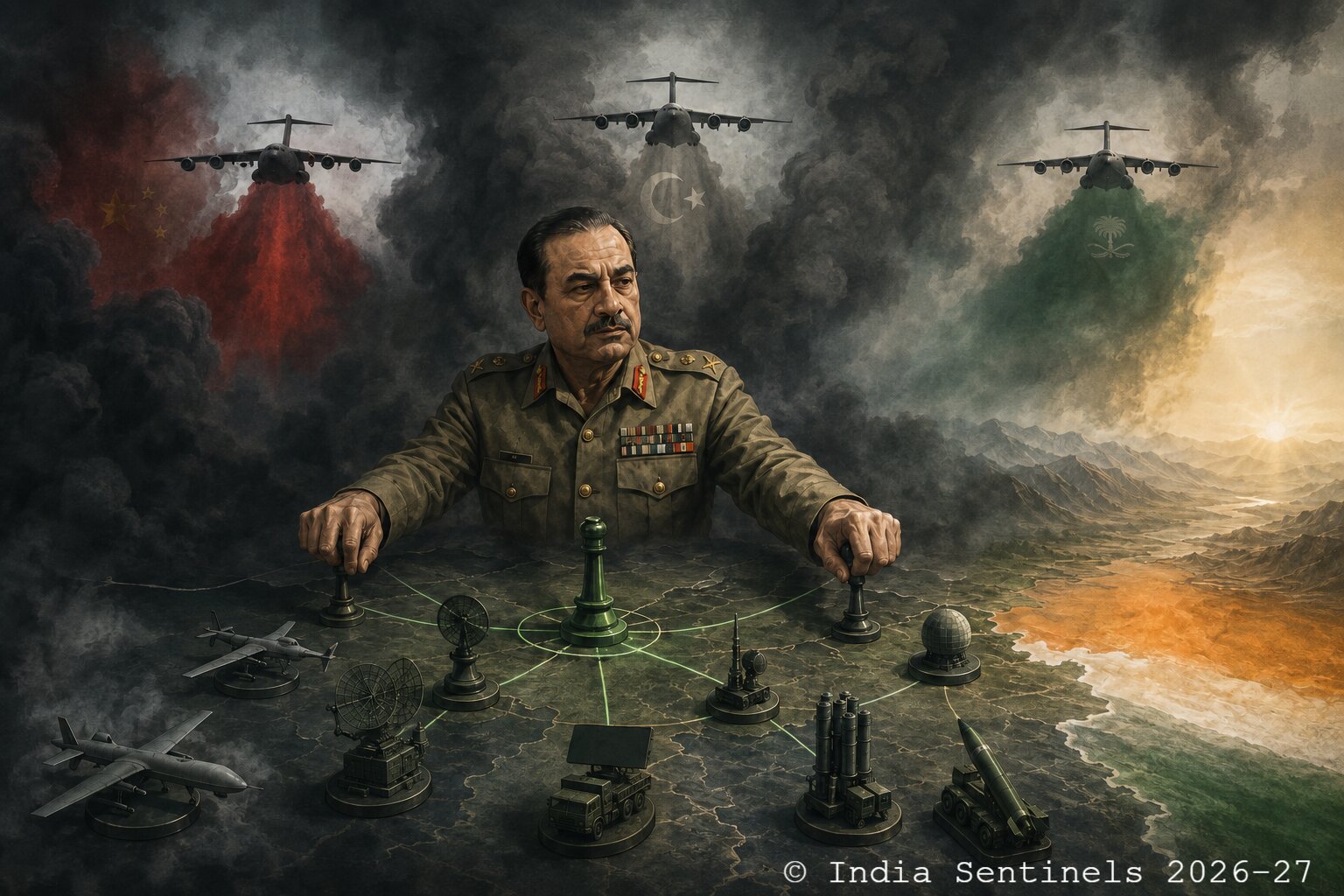
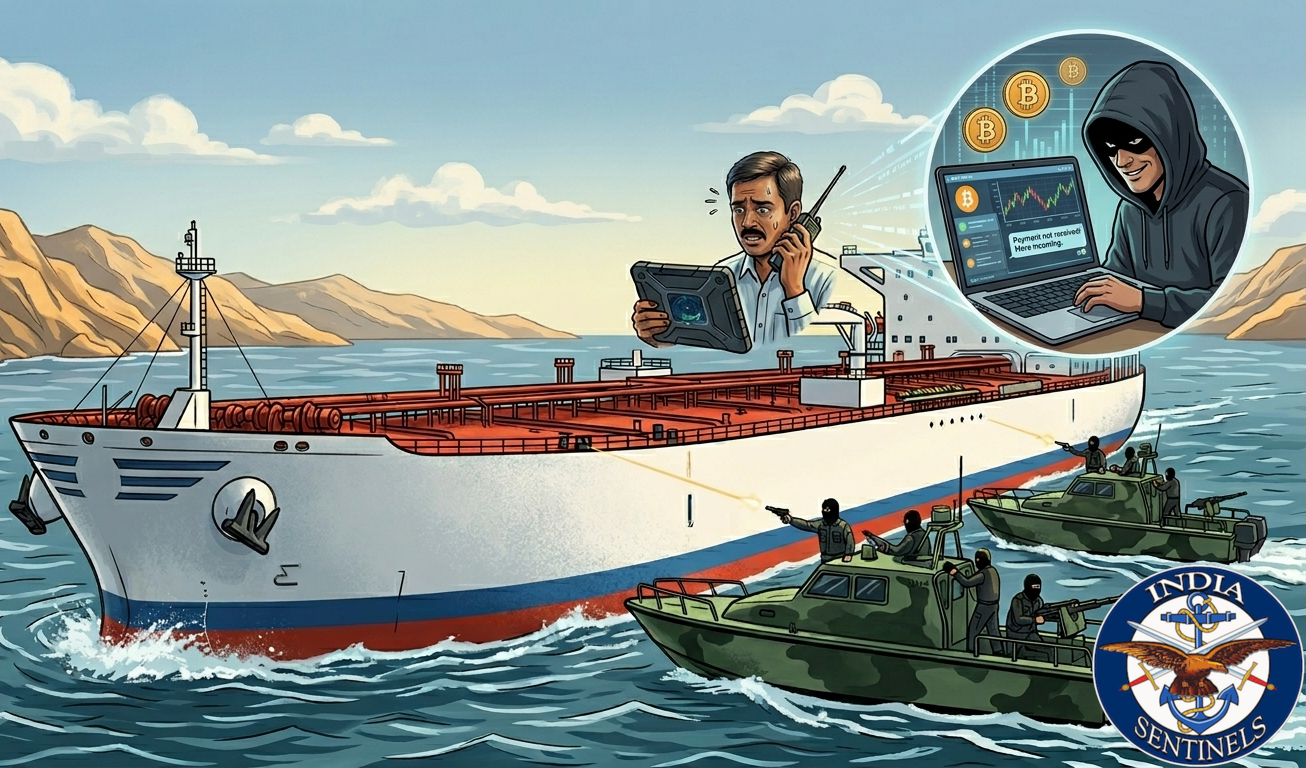
 Illustration for representation. (© India Sentinels 2026–27)
There is a particular horror in the transcript of a ship captain’s radio call, broadcast into open waters – a man begging the very naval force that is shooting at him to remember that they gave him permission to be there.
“You gave me clearance to go!” the captain of the Sanmar Herald reportedly pleaded with the IRGC on April 18, as his vessel came under fire in the Strait of Hormuz. “You are firing now! Let me turn back!”
That one desperate exchange captures the disorder now afflicting one of the most strategically vital waterways in the world – and it crystallizes a problem no government has yet managed to solve.
Four Incidents. One Day. One Chokepoint.
On April 18, Iran’s Islamic Revolutionary Guard Corps attacked two Indian-flagged vessels – the crude oil tanker Sanmar Herald and the bulk carrier Jag Arnav, which was heading to Saudi Arabia. An unidentified projectile struck a French container ship. The cruise liner Mein Schiff 4 reported that the IRGC threatened to fire but ultimately held back, though a splash was reported dangerously close.
Four separate incidents. One day. One chokepoint. This was not a skirmish but a pattern. However, in reality, it is what may have happened before the shots were fired that deserves the most scrutiny.
The Scam in the Shadows
Greek maritime risk management firm MARISKS had been sounding the alarm even before the shooting began. In the weeks prior, unknown actors posing as IRGC officials had been contacting shipping companies whose vessels were stranded west of the strait – hundreds of ships, carrying thousands of seafarers – and offering something irresistible: safe passage, in exchange for cryptocurrency.
It could be bitcoin or tether. Transferred to a wallet with no face, no name, and no authority behind it whatsoever.
The fraudulent messages were professional in tone. One cited by MARISKS read: “After providing the documents and assessing your eligibility by the Iranian Security Services, we will be able to determine the fee to be paid in cryptocurrency (BTC or USDT). Only then will your vessel be able to transit the strait unimpeded at the pre-agreed time.”
MARISKS has stated that it believes at least one of the vessels fired upon on April 18 may have been defrauded by exactly this scheme. The implication is staggering: a ship’s crew, believing in good faith that they had purchased clearance, attempted a transit – and were met with gunfire from an Iranian naval force that had no record of any such arrangement.
India Pushes Back
India’s government has pushed back hard. The Ministry of External Affairs labelled as “fake news” reports suggesting the Sanmar Herald had fallen victim to the scam. Mukesh Mangal, additional secretary at the Ministry of Ports, Shipping, and Waterways, cited direct confirmation from the vessel’s owner that no cryptocurrency transaction had occurred.
India summoned the Iranian envoy, and the foreign secretary, Vikram Misri, expressed “deep concern” in terms that left little room for diplomatic ambiguity. New Delhi’s position is clear, and it deserves respect.
Yet the scam’s existence is not in dispute – only its victims are. MARISKS and the UK Maritime Trade Operations (UKMTO) authority have both confirmed that fraudulent clearance messages are in circulation. Both have declined to name the vessel they believe was targeted. The scam exists. The only question under dispute is which ship fell for it.
Crisis Goes Beyond One Ship
Even if the Sanmar Herald paid nothing to anyone, the larger crisis remains. More than 100 ships are currently trapped in the Persian Gulf, with approximately 20,000 maritime workers waiting for a resolution that has not come.
The United States has maintained a naval blockade preventing ships from entering Iranian ports. Iran, in turn, has imposed restrictions on the Strait of Hormuz – a waterway that, before this conflict, handled roughly 20 per cent of the world’s oil and liquefied natural gas trade. Insurance costs for ships attempting to cross the area have reportedly surged by up to 300 per cent.
Scammers have moved into this environment with dangerous precision, exploiting desperation and financial pressure.
Think about what that means in practice. A shipping company with a vessel stranded for weeks, losing money by the day, receiving a message that appears official, citing Iranian security procedures, quoting fees in crypto – and offering a way out. The temptation to believe it is entirely human.
New Geometry of Maritime Crime
This is the new geometry of maritime crime. It does not require a weapon. It requires only a convincing email address, a crypto wallet, and a shipping company too desperate to wait any longer.
The strait has become not just a military chokepoint but a psychological one – where the line between an IRGC naval officer and an anonymous fraudster has been deliberately blurred, and where acting on false information can get people killed.
Tehran has, in fact, proposed a system that would require ships to pay official fees for secure passage. That proposal, however well-intentioned in its framing, creates a permission structure that criminals can mirror almost perfectly. When a government announces a fee-for-passage system, it hands scammers a ready-made script.
Beyond Gunboats and Demarches
The attacks on the Sanmar Herald and Jag Arnav are, on the surface, a geopolitical story about IRGC aggression and Indian diplomatic protest. But beneath that surface lies something far harder to address through a demarche or a summit.
What we are looking at is a new threat architecture – one in which the tools of financial crime, anonymous cryptocurrency, social engineering, and digital impersonation, have been weaponized against critical global infrastructure. No Indian warship can interdict a bitcoin wallet. No diplomatic note can recover funds transferred on the blockchain.
This is exactly the kind of convergence that counterterrorism financing specialists have warned about for years: the point where geopolitical conflict, financial crime, and digital anonymity collide. In the past, disrupting a maritime extortion racket meant going after people and physical networks. Today, the racket can be run from a laptop, with no physical presence near the strait at all.
What Needs to Happen Now
International shipping companies, flag states, and maritime security organizations need to work together urgently – to verify communication systems, establish approved transit procedures, and share real-time threat intelligence.
The UKMTO and firms like MARISKS are already doing this work. But they are doing it after the fact, warning companies about a scam that may have already cost a crew its safety and a shipper funds it will never recover. That is reactive. What is needed now is a proactive, multilateral framework with verified, tamper-proof communication channels between shipping companies and legitimate authorities – one that makes impersonation significantly harder and leaves scammers without a script to follow.
Uncertainty as a Weapon
The Strait of Hormuz has always been a place where military power, energy economics, and geopolitics collide. Now it is also a place where a ship captain, in the most terrifying moments of his professional life, cannot be sure whether the clearance in his hand came from a naval authority – or from someone sitting at a laptop on the other side of the world, counting Satoshis.
That uncertainty is its own kind of weapon. And no one has yet figured out how to disarm it.
Disclaimer: The views expressed in the article are the author’s own and don’t necessarily reflect the views of India Sentinels.
Follow us on social media for quick updates, new photos, videos, and more.
X: https://x.com/indiasentinels
Facebook: https://facebook.com/indiasentinels
Instagram: https://instagram.com/indiasentinels
YouTube: https://youtube.com/indiasentinels
© India Sentinels 2026-27