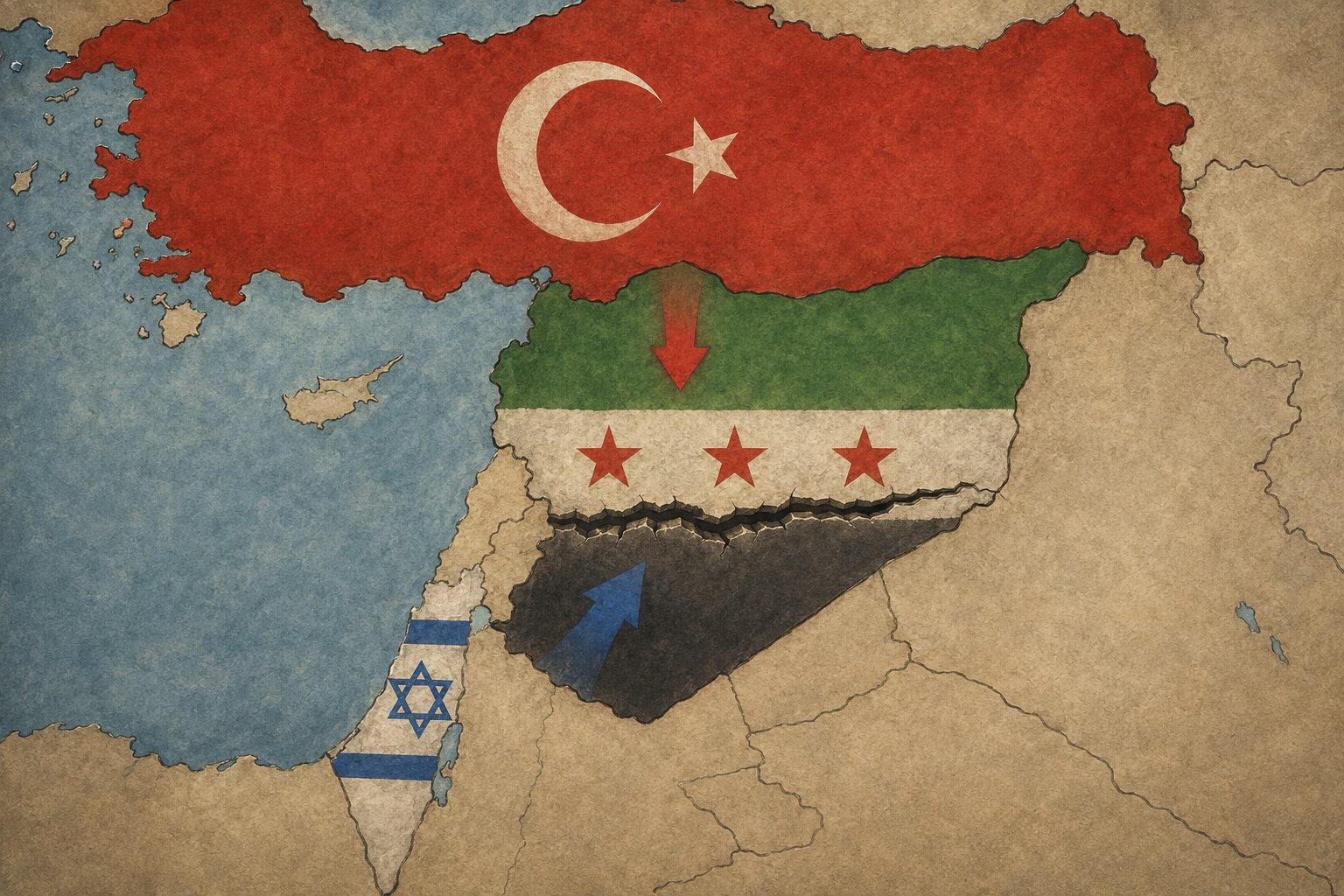
 Illustration for representation. (© India Sentinels 2026–27)
In this piece, this author wouldn’t discuss how the Israel & US-Iran war is going, as he has already done so in his last two op-eds here with a very high degree of accuracy in the predictions made in them. This article is about the future of the petrodollar, economic implications of the war, and an analysis of the current geopolitical quagmire India has managed to put itself in – a quagmire dug, brick by brick, by a government that confused looking west with thinking clearly.
So, where do we begin?
Read also: Iran is winning the war – and Washington knows it
The Strait That’s Strangling the Dollar
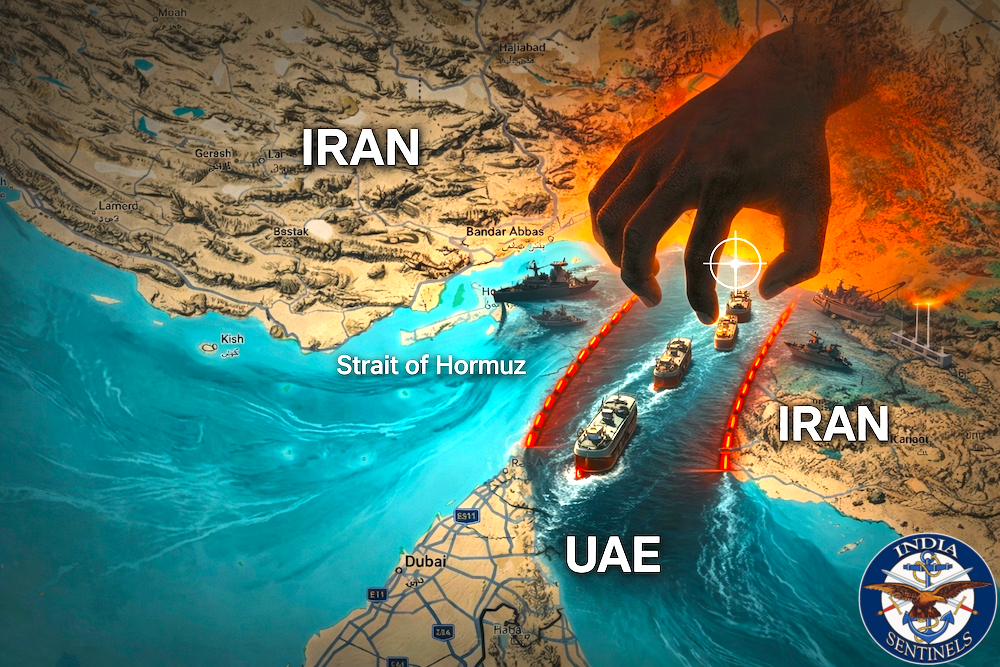
Thirty-one kilometres. That is the width of the Strait of Hormuz at its narrowest point – a sliver of water that carries, on a normal day, roughly one-fifth of the world’s oil and liquefied natural gas. There’s nothing normal about it today. Iran has turned that sliver into a geopolitical weapon of extraordinary precision, one that is simultaneously squeezing global energy markets, accelerating the slow death of the petrodollar system, and serving up a masterclass in asymmetric statecraft that military analysts – including this one – will be studying for decades.
This author spent years commanding troops in Tawang and in eastern Ladakh, staring across the LAC at an adversary that understood one fundamental truth: you don’t need to match your opponent’s firepower if you can identify and control the terrain that matters most. Tehran has done exactly that at Hormuz. It hasn’t indiscriminately shut down the strait – that would be a blunt instrument. Instead, it has created what one can only describe as a militarized toll booth: selective passage, an IRGC-managed “safe corridor”, and reports of at least one tanker company that has already paid around $2,000,000 for the privilege of transit.
Private companies paying protection money to the Islamic Revolutionary Guard Corps – let that sink in for a moment.
And it gets more consequential than that. Tehran has reportedly been negotiating with at least eight countries – China, India, Pakistan, Malaysia, Iraq, and others – over a system that would grant preferential passage to oil cargoes traded in Chinese yuan. Not dollars. Yuan. An Iranian official has publicly stated that Tehran may allow only a limited number of tankers through Hormuz if the underlying oil sales are denominated in yuan. Think about what that means. The world’s most critical oil chokepoint is, effectively, being offered as an on-ramp to the petroyuan.
Iran is continuing to export oil to China – at least 11 to 12 million barrels have moved through Hormuz since the war began on February 28, largely through dark fleet vessels and Iranian-flagged tankers. So this isn’t an indiscriminate shutdown. This is leverage being wielded with the precision of a scalpel, not the bluntness of a sledgehammer. The contrast with American strategy in the region couldn’t be starker.
Read also: Netanyahu’s War, America’s Blood – The trap being set in the Persian Gulf
The Petrodollar’s Slow Funeral
Here’s something that ought to unsettle every finance ministry official in New Delhi, Washington, and Riyadh: the petrodollar system – that five-decade-old arrangement under which most internationally traded oil is priced and settled in US dollars, with surplus Gulf revenues recycled into American financial assets – is showing cracks that no amount of short-term safe-haven demand can fully paper over.
Yes, the dollar has strengthened in the immediate aftermath of the war. The dollar index has risen by over two per cent since the strikes began in March. Investors flee to safety, and the dollar remains the world’s safety blanket – for now. But don’t mistake a short-term cyclical bounce for structural health. Beneath that surface, the tectonic plates are shifting.
China already conducts just over half of its cross-border transactions in renminbi, down from over 80 per cent in dollars barely a decade ago. Russia conducts roughly 90 per cent of its trade with fellow BRICS members in national currencies. Saudi Arabia has publicly discussed yuan-denominated oil futures. Argentina and Pakistan are settling significant Chinese imports in yuan.
India itself – before the current government’s allergy to pragmatism took hold – was buying Iranian crude in rupees, parking payments in Indian banks, allowing Iran to purchase Indian goods with those rupee balances. It was an elegant arrangement that insulated us from dollar volatility and strengthened our own currency.
We threw it away.
The Iran war is an accelerant, not a root cause. It’s pouring fuel onto a fire of de-dollarization that was already burning. When Hormuz – the world’s most price-setting energy chokepoint – becomes a yuan-denominated corridor, the ripple effects on global benchmarks, risk premia, and derivatives pricing will be felt for years. Over time, two truths can coexist: the dollar remains the primary crisis currency that investors clutch in moments of panic, while a growing portion of normal-time trade – especially among non-western states – quietly migrates to the yuan, the rupee, or bilateral settlement arrangements.
The dollar doesn’t collapse dramatically. It erodes, slowly and irreversibly, like a coastline after decades of storms.
Read also: Putin visit masterclass in geopolitical theatre, but where’s the beef?
Yuan’s 25-Year Moment
The yuan won’t replace the dollar next year. It won’t replace it in five years. Anyone who says otherwise is selling something. But here’s what this author believes, based on decades of studying how power transitions actually work – not in dramatic ruptures, but in patient, compounding shifts: within 25 years, the dollar’s share of global oil trade could fall from near-total dominance to something in the range of 50 to 60 per cent, with the yuan, a BRICS reserve currency, or a basket of emerging-market units filling the gap.
The conditions for this are being assembled right now. China is already the primary buyer of Iranian oil under sanctions, with much of that trade reportedly settled in yuan or through barter and shadow-fleet arrangements. BRICS, now an 11-member bloc that includes Iran, has been discussing petroyuan mechanisms – however tentative – for years. The Iran war deepens Beijing’s energy security leverage and gives it a platform to internationalize its currency in the most sensitive segment of the global market.
The yuan has real limitations – tight capital controls, shallower bond markets than US treasuries, weaker investor protections. These are genuine handicaps, not talking points. But they are the handicaps of a currency at an earlier stage of internationalization, not inherent and permanent defects. China is building CIPS – its cross-border interbank payments system – steadily and deliberately. It is accumulating gold and cutting US treasury holdings. It is playing the long game, and it isn’t impatient.
A BRICS currency – a unit backed by a basket of member currencies and commodities, designed for settlement among the bloc’s members and trade partners – isn’t a fantasy. It’s a project whose logic becomes more compelling with every American sanction, every weaponization of SWIFT, every punitive tariff deployed against a country that dared to maintain an independent energy policy. Washington keeps handing the architects of alternative financial arrangements their best arguments.
Read also: Pakistan’s Last Refuge – Nuclear rhetoric after military defeat
India’s Spectacular Own Goal
And now we come to the part that genuinely pains this author to write. Not because the author lacks the language for it, but because he spent 37 years in uniform defending a country that was capable of conducting a genuinely independent foreign policy – one that maintained respectful relations with Iran, with the Arab world, with Russia, with the United States, without prostrating itself before any of them. That tradition has, in recent years, been exchanged for something that looks, from the outside, disturbingly like satellite status.
Consider what India has managed to achieve, through a series of foreign-policy choices made with breathtaking confidence in the face of mounting evidence that they were wrong. The prime minister, Narendra Modi, made a high-profile visit to Israel in February 2026 – just days before the joint US-Israeli strikes on Iran – upgrading the relationship to a “special strategic partnership” and being photographed hugging the prime minister of Israel, Benjamin Netanyahu, at a moment when Israel’s international reputation was at its nadir over Gaza. The imagery was beamed across the Muslim world and into Iranian homes.
That photograph cost us something in Tehran. The price is now being tallied.
When the strikes killed Iran’s supreme leader, Ayatollah Ali Khamenei, on February 28, the Iranian embassy in New Delhi issued a furious statement calling it an “unforgiveable crime” and appealing to governments worldwide for condemnation. India stayed silent for several days. Modi called the UAE to express solidarity with Abu Dhabi after Iranian strikes there, and he called Netanyahu to discuss the situation. But for the killing of a head of state – an act that most international law experts are describing as a crime of aggression without UN security council authorization – New Delhi had nothing to say. Not a word.
Only on March 5 did the foreign secretary, Vikram Misri, quietly visit the Iranian embassy to sign a condolence book – after significant domestic and international criticism forced the government’s hand. Compare this to 2024, when the external affairs minister, S Jaishankar, personally visited the embassy after the death of then Iranian president Ebrahim Raisi. The downgrade in protocol wasn’t missed in Tehran. These things are noticed, catalogued, and remembered.
Then there’s the BRICS disaster. India currently holds the BRICS chair – a position that should have been a platform for demonstrating genuine leadership in a moment of global crisis. Iran is now a full BRICS member. The bloc’s most significant military conflict in its history is being waged against one of its own members. And India, under whose chairmanship this happened, has been unable – or unwilling – to steer the group toward even a minimally adequate collective statement. China, Russia, and South Africa wanted strong language condemning the strikes. India, apparently more concerned about offending Washington and Tel Aviv, blocked or delayed any consensus.
The result: BRICS fell silent on the biggest story in the world. So much for India’s leadership of the global south.
Read also: Thank you, Trump, for making India understand America like never before
Price of Friendship with Trump
Let us be honest about what the relationship with the United States has actually delivered. Washington imposed a 50 per cent tariff on Indian goods – 25 per cent as an initial “reciprocal” measure in mid-2025, and then a further 25 per cent explicitly to punish India for buying discounted Russian crude. Note, carefully, that China was purchasing even larger volumes of Russian oil and faced no equivalent surcharge. The US apparently found it considerably easier to financially bludgeon a democracy that calls itself a strategic partner than to confront Beijing directly.
The tariff deal eventually concluded is being described in official communiqués as a triumph. Indian tariffs were cut from 50 per cent to 18 per cent – while the pre-crisis rate sat at a comfortable two to three per cent. India has also committed to purchasing 500 billion dollars’ worth of American goods over five years. Economists projected that the full tariff burden could have contracted India’s GDP by up to 0.8 per cent and cut US-bound exports by around 35 billion dollars annually. Textile workers, gem-cutters, and leather craftsmen discovered, quite brutally, that they were caught in the crossfire of someone else’s geopolitical choices.
And then there’s Operation Sindoor – the military operation against Pakistan – conducted at a moment of extraordinary diplomatic sensitivity, when India needed all the goodwill it could muster. The operation itself may have had domestic political compulsions, but the timing and the international messaging exposed a government that had badly miscalculated the geopolitical weather. Trump’s public comments about our prime minister – patronizing at best, dismissive at worst – told us something about the true nature of a relationship that has been built, on our side, primarily on photo opportunities and state dinner enthusiasm.
Meanwhile, Iran – the country India has spent seven years distancing itself from under American pressure – sits astride the Strait of Hormuz, controls access to Chabahar port (India’s only overseas port venture and its gateway to Afghanistan and Central Asia), and is now a full BRICS member with growing ties to Russia and China. Neither Israel nor the United States can substitute for Iranian geography. No amount of goodwill in Tel Aviv or Washington can replicate Iran’s position at the junction of the Gulf, the Caspian, and Central Asia.
This isn’t a matter of sentiment. It’s a matter of maps.
Read also: How Trump lost India – and why America must win it back
Way Forward, if There’s One
India’s relationship with Iran before sanctions was one of the most strategically elegant bilateral arrangements in our foreign-policy history. Iran was our second- or third-largest crude supplier, meeting roughly 10 per cent of our oil demand, often at discounts of up to 40 per cent versus benchmark prices, with a substantial portion of payments settled in rupees. The rupee-rial trade mechanism strengthened our currency and insulated us from dollar volatility. It was, in the truest sense, strategic autonomy made flesh.
Since 2019, under US pressure, India has reduced Iranian oil imports to near zero. Bilateral trade has reportedly fallen by 80 to 90 per cent from earlier peaks. The 10-year operational agreement signed at Chabahar in May 2024 – a genuine strategic achievement – now sits in a state of diplomatic limbo, its potential unrealized because we can’t bring ourselves to upset Washington. We have sacrificed an asset that no other country can replace, in exchange for tariff rates that are still six times what they were before the crisis and a bilateral relationship with the United States that humiliates us whenever it becomes convenient for the American side.
The path out of this hole requires honesty, and honesty requires acknowledging that we are in one. India needs to quietly and urgently institutionalize transit arrangements with Iran through Hormuz – combining limited transit fees, partial rupee settlement, and assurances on cargo destinations in ways compatible with international law. India needs to use its BRICS chair to facilitate, not block, a carefully worded collective statement that reaffirms the UN Charter and calls for cessation of hostilities. India needs to fast-track the Chabahar and INSTC development pipeline and stop treating it as a bargaining chip in negotiations with a country that sees us as a disposable partner.
And India needs to begin the long overdue process of genuinely diversifying its energy system – not just its crude sources, but its entire exposure to any single chokepoint. Every crisis we have faced, from Russia-Ukraine to the current Iran conflict, has made the same argument: a country that can’t secure its energy supply independently is not, in any meaningful sense, a great power.
Read also: Charting India’s Strategic Autonomy – A perspective on geopolitical reset
Closing Thoughts
This author has watched the dollar’s structural dominance erode, slowly and then less slowly, over the past decade. He has watched China build its yuan internationalisation project with the patient, unhurried confidence of a civilization that has been playing the long game for three thousand years. He has watched the United States repeatedly use its financial infrastructure as a geopolitical weapon, and watched every country on the receiving end quietly begin constructing an exit.
The petrodollar won’t die this year or next. But its monopoly on the global energy trade is over. A multipolar currency world is coming – one in which the yuan plays a substantially larger role, in which a BRICS settlement currency becomes a real possibility within 25 years, and in which countries that have diversified their monetary exposure will be considerably more resilient than those that haven’t.
India has the intellectual capital, the civilizational depth, the demographic weight, and – until recently – the diplomatic tradition to navigate this transition better than almost any other country. We have chosen, instead, to hand our foreign policy over to the optics of state dinners and the warmth of handshakes with leaders who are, at the same time, imposing punitive tariffs on our exporters, questioning our military operations, and treating our strategic autonomy as an inconvenience to be managed rather than a principle to be respected.
Iran is fighting a war on its own timeline and by its own design. The petrodollar is fighting a war it didn’t anticipate. India is losing the peace that it had already won.
It isn’t too late to course-correct. But the window is closing.
Disclaimer: The views expressed in the article are the author’s own and don’t necessarily reflect the views of India Sentinels.
Follow us on social media for quick updates, new photos, videos, and more.
X: https://x.com/indiasentinels
Facebook: https://facebook.com/indiasentinels
Instagram: https://instagram.com/indiasentinels
YouTube: https://youtube.com/indiasentinels
© India Sentinels 2026-27