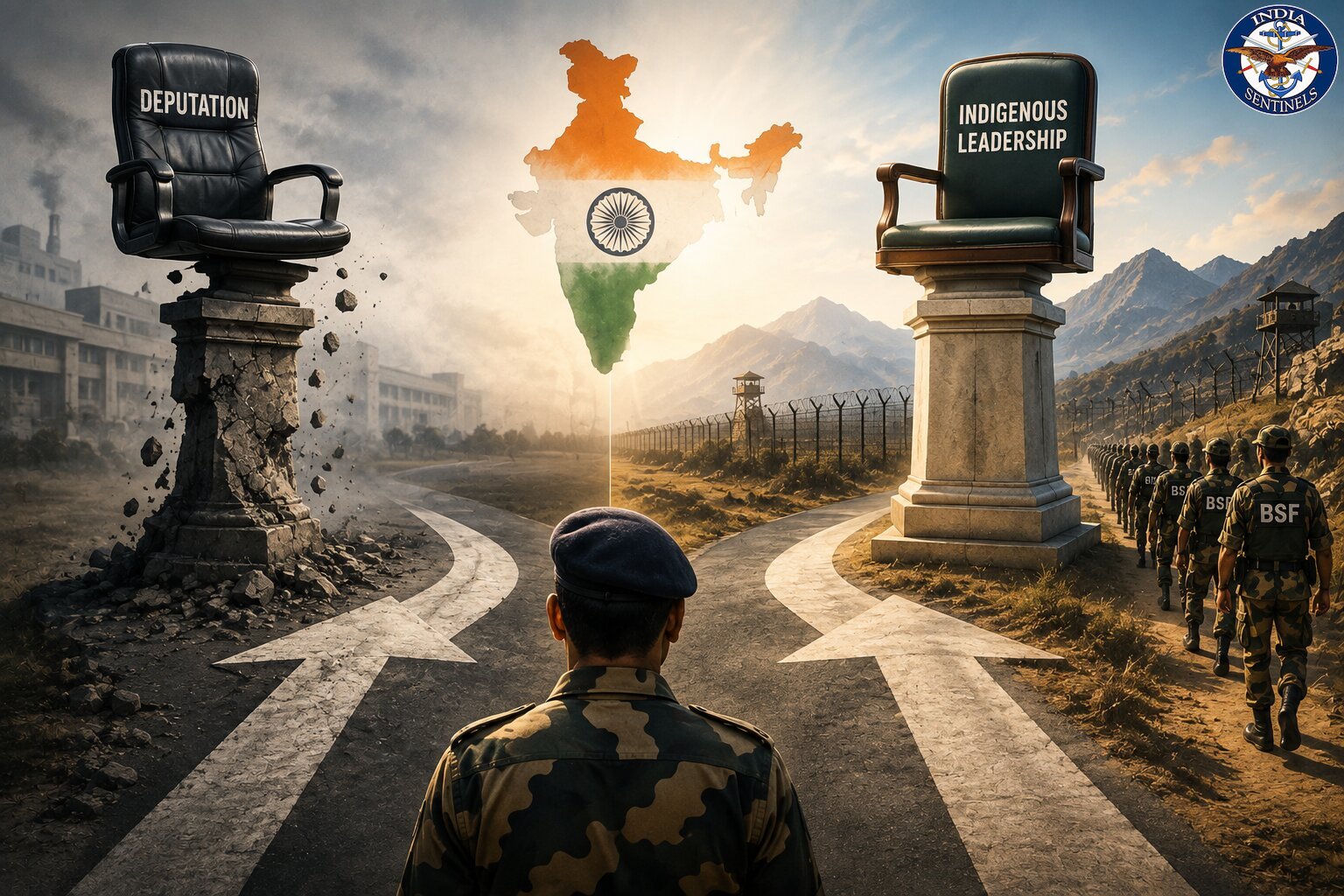
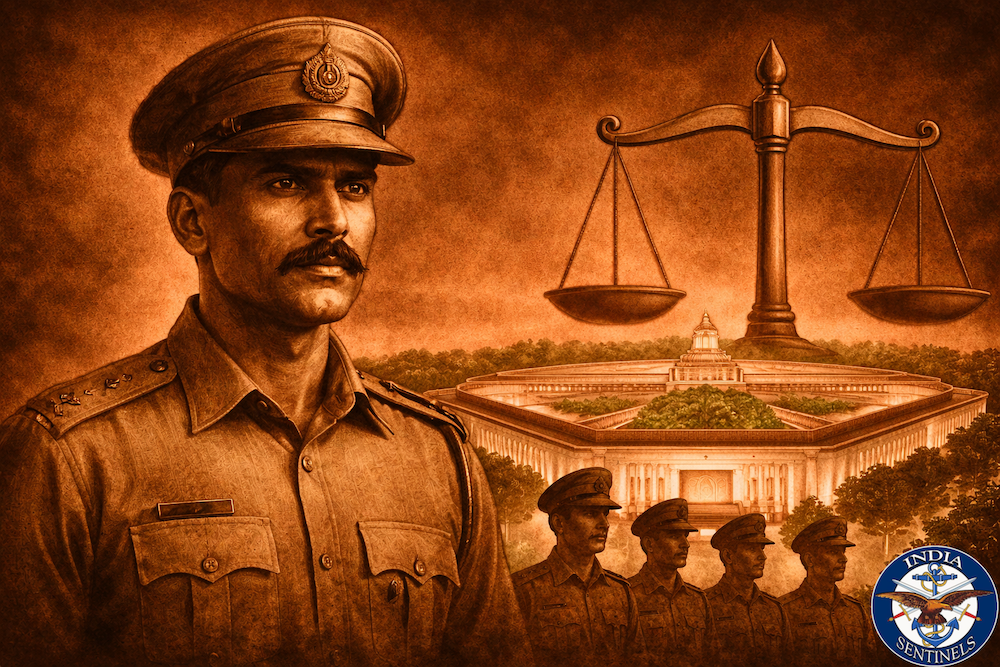
 Illustration for representation. (© India Sentinels 2026–27)
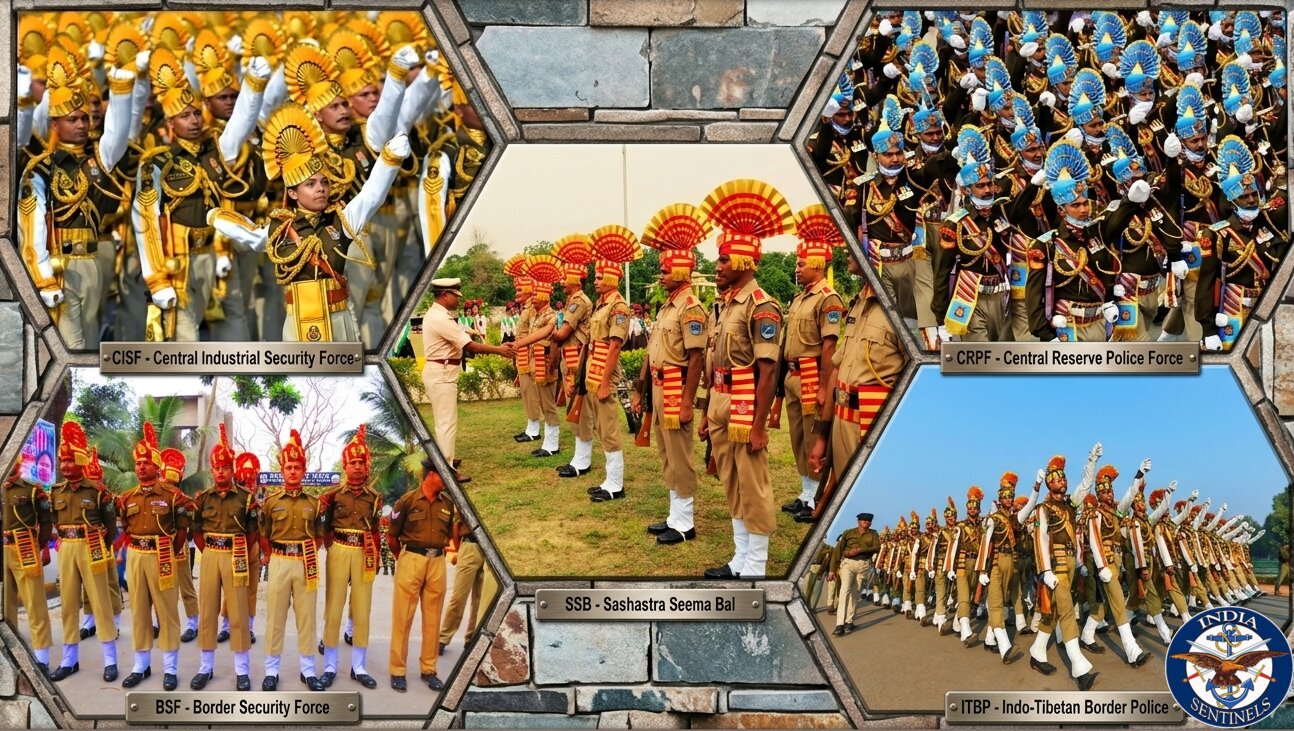
The central armed police forces – BSF, CRPF, CISF, ITBP, and SSB – are, in a very real sense, miniature Indias. Drawn from every corner of this huge country, they bring together men and women of different faiths, languages, cultures, and traditions, yet function as a single, seamless operational entity. Their mandate is sweeping: guarding thousands of kilometres of borders with Pakistan, Bangladesh, China, Nepal, and Myanmar; countering left-wing extremism (LWE) in the heartland; battling insurgencies in the northeast, combating terrorism wherever it raises its head, and protect critical infrastructure upon which our nation stands.
What holds this extraordinary mosaic together? The answer is moral fabric – an integrated sense of shared purpose, institutional trust, and professional pride that binds diverse individuals into a cohesive fighting force. Strip away that fabric, and what remains is a collection of individuals in uniform, not a force capable of defending the nation.
That fabric is fraying. And the reasons are neither accidental nor obscure.
Read also: Stagnant Ranks, Broken Morale – The cost of CAPF’s skewed HR policies
Moral Fabric for an Armed Force
For any uniformed organization, moral fabric is not an abstraction. It is the lived reality of how an institution treats its people – whether it honours its commitments to them, whether the leadership understands the ground realities faced by those it commands, whether justice and fairness govern promotions and postings, and whether the bonds of trust between officers and men are nurtured rather than corroded.
In the context of the CAPFs, moral fabric means understanding the ethos, conventions, and operational philosophy of each force. It means acknowledging the physical and psychological toll of prolonged deployment in inhospitable terrain – from the Rann of Kutch to Siachen’s approaches, from Bastar’s jungles to the line of actual control (LAC). It means ensuring that officers at every level feel that the institution has their back, that merit will be rewarded, and that their sacrifices will not go unrecognized.
When moral fabric is strong, units display cohesion, cooperation, and combat effectiveness. When it is weak, trust collapses, grievances fester, and operational readiness suffers – outcomes that ultimately serve the interests of India’s adversaries far more than any tactical setback on the ground.
Read also: Chanakya’s Warning and India’s Shame – How the state fails its CAPFs
Defined by Constitution, Misrepresented by Name
The constitutional status of the CAPFs is unambiguous. Schedule VII, Article 246, List I, Entry 2 of the Constitution of India describes “naval, military and air forces; any other armed forces of the Union.” The CAPFs fall squarely within this definition. They are armed forces of the Union, with a militaristic character designed for border-guarding, warfighting alongside the Army in both conventional and sub-conventional roles, and serious internal security duties – not routine law and order, but insurgency, terrorism, and LWE.
Yet from their very inception, a fundamental confusion was baked into their identity. The word “police” was retained in their original nomenclature – central police organizations, or CPOs – ostensibly for administrative convenience when these forces were young and lacked a mature organic officer cadre. At that nascent stage, it was entirely understandable that officers from the Army and the Indian Police Service (IPS) were seconded to raise and structure them.
However, what was a pragmatic arrangement for a young institution gradually calcified into a structural injustice. As the decades passed and organic CAPF cadres matured – producing battle-hardened, professionally accomplished officers who had spent careers in the field – the Army officers rightly reverted to their parent service. The IPS did not. Instead, IPS officers entrenched themselves at the apex of these forces, monopolizing the ranks of deputy inspector general (DIG), inspector general (IG), additional director general (ADG), special director general (SDG), and director general (DG), thereby blocking the career trajectories of thousands of organic CAPF officers.
Read also: Give CAPF officers what Supreme Court ordered – and what they earned
The Stagnation Crisis
The consequences for CAPF cadre officers have been devastating. Consider the numbers: cadre officers earn two promotions reaching the rank of second in command and IPS officers earn about six promotions reaching the rank of ADG in the same period. The situation for other ranks is, if anything, grimmer.
Jawans have routinely stagnated in a single rank for 20 to 22 years – a duration that is not merely demoralizing but operationally corrosive. The Limca Book of Records, one might say, would find few more egregious entries.
This is not a minor human resources anomaly. Prolonged stagnation breeds resentment, erodes commitment, and signals to every serving member of the force that the institution does not value them. When men who have spent their prime years in the harshest field conditions see that advancement is effectively foreclosed, the moral fabric of the organization does not merely fray – it tears.
The guiding credo of any professional officer, captured in the famous Chetwode motto adopted by the Indian Military Academy, is clear in its hierarchy of obligations: the safety, honour, and welfare of one’s country come first; the honour, welfare, and comfort of the men one commands come next; and one’s own ease, comfort, and safety come last, always and every time. By this measure, the IPS leadership of the CAPFs has, with honourable individual exceptions, been found wanting. Their own career progression has been advanced; the welfare of the men they command has too often been an afterthought.
Read also: Why 8th pay panel must recognize CAPF personnel as true soldiers
Supreme Court vs Brute Parliamentary Majority
For years, CAPF cadre officers pursued their legitimate grievances through the courts, seeking implementation of organized “Grade A” service (OGAS) and non-functional financial upgradation (NFFU) – benefits that the government had, in principle, accepted as far back as 1986. The legal battle stretched across more than a decade.
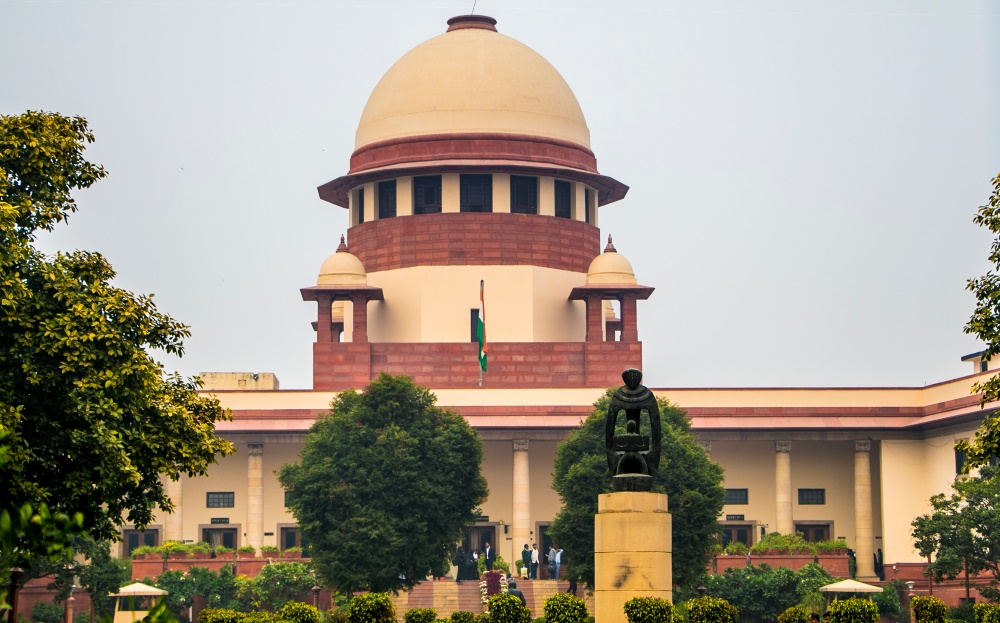
On May 23, 2025, a two-judge bench of the Supreme Court of India delivered a landmark judgment in their favour, granting OGAS and NFFU to CAPF cadre officers and – crucially – directing the gradual reduction of IPS officers in these forces up to the rank of IG. Every argument advanced by the government was rejected. The court’s reasoning was grounded in constitutional logic: CAPF cadre officers had a legal right to these benefits, and that right could not be denied by administrative convenience.
The response of the IPS lobby, the bureaucracy, and the ruling political establishment was swift. Rather than accepting the judgment in the spirit of the rule of law, a campaign was mounted by retired bureaucrats to undo it through an ordinance. The argument put forward – that the CAPFs would somehow be crippled without IPS leadership – collapsed on first examination. After all, no such calamity has befallen the Indian Coast Guard, which has successfully transitioned to cadre officer command, replacing naval officers without any diminution in operational effectiveness.
Read also: Border Security Force is an armed force, not police, nation must know
The CAPFs (General Administration) Bill, 2026
On April 25, 2026, the government introduced the Central Armed Police Forces (General Administration) Bill, 2026, in the Rajya Sabha. The bill’s stated intent is administrative streamlining. Its actual effect is to institutionalise the permanent induction of IPS officers into CAPFs at the highest ranks, effectively nullifying the Supreme Court’s judgment through legislative majority.
The bill invokes Section 312 of the Constitution, which deals with the creation of all-India services. This is a curious choice. Belonging to an all-India service does not, by any constitutional logic, confer the right to command a specialized armed force at its apex – particularly when the highest court of the land has ruled that such an arrangement is unjust and directed its unwinding.
The government’s argument about Centre-state relations and coordination, too, was specifically addressed and settled by the Supreme Court. Repeating it in the bill’s statement of objects and reasons suggests that the government lacks a principled legal defence and is instead relying on its parliamentary majority to achieve what the courts have denied it.
What makes the bill particularly indefensible is its scope. It does not merely seek to retain IPS officers at the DG level – a position one might debate. It seeks to entrench them at the ranks of IG – precisely the level at which the Supreme Court had ordered their gradual reduction. Additionally, the bill proposes to exclude the CAPFs from the purview of the Department of Personnel and Training (DoPT), thereby denying cadre officers and veterans the OGAS and NFFU to which the Supreme Court has said they are entitled.
The bill also reverses the government’s own announcement of July 2019, which had conferred a truncated form of OGAS and NFFU on officers of the rank of DIG. In effect, it takes away with one hand what was grudgingly offered with the other.
Affected by this are approximately 13,000 serving cadre officers and an almost equal number of veterans who stand to be denied NFFU. The frustration this has generated – among serving officers, their families, and the broader community of CAPF veterans across India – is palpable and legitimate.
Read also: My Identity Crisis – The CAPF soldier’s perennial dilemma
Operational Case Against Parachuted Leadership
Beyond the legal and constitutional arguments lies an operational one that is, if anything, more compelling.
A CAPF unit in the field is a complex, high-stakes organism. Its effectiveness depends on a chain of command in which every officer, from company commander upwards, has served in the ranks below – has led patrols in the Sundarbans or the high-altitude passes of Uttarakhand, has commanded a company during a counterinsurgency operation in Manipur, has served as a battalion’s second in command and commandant and understood the thousand details of maintaining a unit’s operational readiness. This institutional knowledge is not theoretical; it is accumulated through years of hard experience and cannot be parachuted in from outside.
An IPS officer inducted as a DIG or IG, however accomplished in their own domain, arrives without this experiential foundation. They cannot, in any meaningful professional sense, command. Their ignorance of force ethos, operational philosophy, and the lived conditions of the men they lead is not a personal failing – it is a structural one, created by a system that places the wrong people in the wrong roles.
The proverb that “a little knowledge is a dangerous thing” is nowhere more apt than in the command of an armed force. Decisions taken without professional knowledge and ground experience – on deployment, on operational tempo, on the welfare and management of men under extreme stress – do not merely inconvenience; they can cost lives.
When men do not trust their commanders, when they believe that those at the top have neither the competence to understand their work nor the commitment to protect their interests, cohesion breaks down. And when cohesion breaks down in a border-guarding force or a counter-insurgency unit, the national security implications are direct and serious.
Read also: End Colonial Charade – Implement SC ruling on CAPF officers now
A Government That Must Choose
The CAPFs Bill has been met with dismay not merely among those directly affected but among military veterans, security analysts, and ordinary Indians who understand what a professionally commanded, well-motivated paramilitary force means for the country’s security.
The logic of the opponents of this bill is straightforward: India cannot boast of its commitment to national security while simultaneously undermining the institutional foundations of the forces that provide it. A government that genuinely prizes the welfare of its security forces – as the current establishment has repeatedly proclaimed – cannot in the same breath legislate to perpetuate stagnation, deny court-mandated benefits, and keep in place a leadership structure that the Supreme Court has found to be unjust.
The government has a choice. It can withdraw the bill, implement the Supreme Court’s judgment in good faith, and embark on a genuine reform of CAPF human resources – one that rewards merit, ensures timely promotions, and gives cadre officers the career progression they have earned. Or it can press ahead, win the vote in Parliament, and in doing so send a clear signal to every CAPF officer and jawan that their sacrifices are valued less than the career interests of a powerful service lobby.
The first path strengthens the moral fabric of the CAPFs and, by extension, the security architecture of the nation. The second path fragments it further – and the beneficiaries of that fragmentation are not India’s friends.
There is a reason the Chetwode motto places the welfare of the men one commands above one’s own comfort. Military and paramilitary forces fight with their hearts as much as with their weapons. A force that believes it is valued will endure; a force that knows it is not will falter. India’s CAPFs deserve leadership that understands this, and a government that proves it believes it.
The moment to demonstrate that belief is now.
Disclaimer: The views expressed in the article are the author’s own and don’t necessarily reflect the views of India Sentinels.
Follow us on social media for quick updates, new photos, videos, and more.
X: https://x.com/indiasentinels
Facebook: https://facebook.com/indiasentinels
Instagram: https://instagram.com/indiasentinels
YouTube: https://youtube.com/indiasentinels
© India Sentinels 2026-27