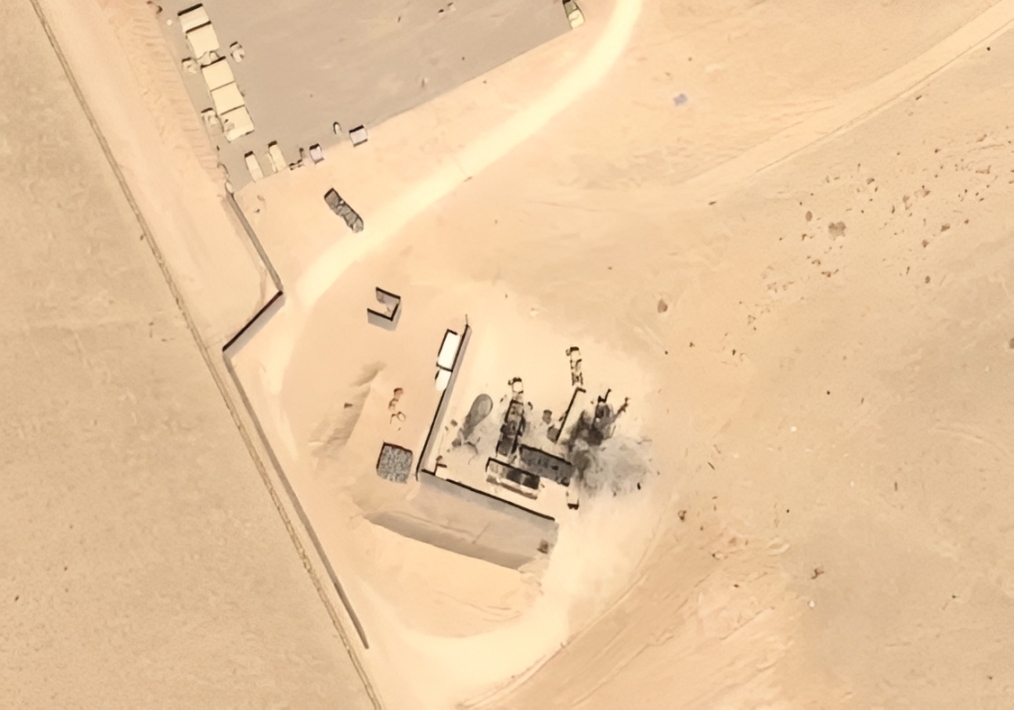
 This satellite image shared by Tehran Times on X shows a destroyed US THAAD AN/TPY-2 radar site in Jordan’s Muwaffaq Salti airbase.
In his earlier piece here, this author argued that the war against Iran – Netanyahu’s war, fought with America’s blood – was a trap being set in the Persian Gulf. The trap has now sprung. What we are watching unfold across the Gulf, over the skies of Tel Aviv, and inside the charred ruins of some of the most expensive military infrastructure ever assembled, isn’t chaos. It is a plan being executed. And the plan belongs to Tehran.
Let this author be direct: Iran is winning. Not on the margins, and not by luck. It is winning systematically, methodically, and on a timeline that it set for itself long before the first American bomb fell on February 28.
Read also: Netanyahu’s War, America’s Blood – The trap being set in the Persian Gulf
Iran’s Pre-Written Script
A soldier who has commanded at every level from battalion to division learns – above all else – to read the enemy’s intent from his actions rather than his words. This author has spent time on that cold, thin-aired ridgeline at Tawang and in the bleak high-altitude stands of eastern Ladakh where patience and preparation – not firepower alone – determine who walks away.
What Iran has executed in the Gulf bears exactly those hallmarks. Strip away the propaganda from both sides, and a coherent three-act operational design becomes unmistakable.
The opening act was about forcing a haemorrhage of the costliest consumable in modern warfare: interceptor missiles. Tehran understood, long before this campaign began, that the American missile defence architecture in the Gulf – however formidable on paper – rested on a finite and irreplaceable inventory. So, it didn’t open with its best weapons.
It opened with its most expendable: ageing ballistic missiles, low-cost drones, ordnance that costs a fraction of what the Americans must spend to knock it down. For every cheap Iranian projectile that prompted a Patriot launch, Washington burned through a missile that takes months to manufacture and can’t be conjured back into existence by a presidential tweet.
The Patriot inventory under the US Central Command (Centcom) has been slashed by half. Fewer than 600 missiles remain. The Indo-Pacific Command – watching China with nervous attention – refuses to release its stockpile, and the American defence industry simply lacks the production cadence to restock at wartime speed. The first act achieved exactly what it was designed to achieve.
The second act was surgical: take out the nervous system. In military terms, the difference between an armed force with full situational awareness and one operating without it is the difference between a trained soldier and a blindfolded one. Iran knew it couldn’t out-intercept the Americans in a straight exchange. What it could do was eliminate the sensors that give those interceptors their targeting data. It did.
Five THAAD fire-control radars – the AN/TPY-2, each worth between half a billion and a billion dollars – have been destroyed. The $1.1 billion radar at Al Udeid airbase in Qatar has been put out of action. The early warning installation serving the Fifth Fleet headquarters in Bahrain – the electronic cornerstone of American naval dominance in the Gulf – is gone. Before February 28, American commanders had 15 to 30 minutes of warning time to identify and respond to incoming missiles.
That window now barely exceeds one to two minutes, if it exists at all. The second act left Washington and Tel Aviv operationally blind at the very moment they needed clarity most.
The third act is what Iran had been reserving all along. With the enemy’s interceptor stockpiles gutted and its radar cover shredded, Tehran unleashed the Fattah hypersonic missile – a weapon that travels at Mach 15, manoeuvres in flight, and covers every American installation and Israeli city within a 1,600 to 1,700-kilometre arc. The entire Patriot and THAAD defensive architecture was engineered for threats moving at Mach 5–7.
A system designed for that speed envelope has no reliable answer for a target moving at double or triple that velocity, adjusting its flight path mid-course. Simultaneously, Iran launched the Qadr – a Shahab-3 class long-range strike weapon – ensuring that whatever scraps of defensive attention the Americans still possess are divided between two entirely different threat profiles at the worst-possible moment. The third act was not a response to events. It was always the destination. The preceding weeks of seemingly attritional exchange were simply the preparation.
Iran has known since at least 2005 that an air campaign against it was not a remote contingency but a scheduled appointment. It has spent 20 years quietly dispersing its missile stocks underground, hardening its command architecture, and rehearsing exactly this sequence. What the world is watching today isn’t a country improvising under fire. It is a country performing a script it has been rehearsing for two decades.
Read also: Putin visit masterclass in geopolitical theatre, but where’s the beef?
Information War Is Being Lost Too
Washington has been telling the American public that casualty numbers at targeted installations run to single digits. Anyone who has commanded troops – as this author has, in terrain where the enemy fires with intent – knows that direct missile strikes on fully operational bases with thousands of personnel don’t produce single-digit casualties.
Social media is abuzz with information pointing towards a different story from the US-Israel official figures, like hospitals in Germany are suspending obstetric and paediatric services to accommodate combat casualties. Blood donation drives have been called at American military installations in Europe.
These are signals of a war now going well for the two aggressors.
We are told that Iran’s missile capability is being degraded. What we know is that Iran just deployed its hypersonic weapons – systems it had been deliberately holding in reserve for this phase of the campaign. This is an indication that the war is proceeding precisely on Iran’s own script, undisrupted by American or Israeli countermeasures.
We are told that Israel has destroyed 60 per cent of Iranian missile infrastructure. If that were true, the rate of inbound fire on Israeli cities and US targets in the region would have decreased significantly. It has not decreased; rather, it has escalated to hypersonic.
Israel’s information blackout tells its own story. When things go your way in war, you show the footage. You broadcast the intercepts. You publicize the damage assessments. Israel is doing none of that. What is being blocked by Israeli military censorship – and dutifully unquestioned by a Zionist-aligned western media – suggests, by absence alone, that Tel Aviv is absorbing a punishment severe enough to require concealment. Russian social media, not subject to those pressures, tells a different story: the damage to Israeli cities is extensive.
Read also: Pakistan’s Last Refuge – Nuclear rhetoric after military defeat
America’s Strategic Depletion
Over the past six days, Iran has destroyed roughly 40 per cent of the total THAAD inventory in the American arsenal – systems that take a year or two to manufacture, and that can’t simply be replenished on demand. The rare earth mineral restrictions imposed by China have deprived Washington of the materials needed to build certain precision systems. The Ukrainian war has already consumed enormous quantities of American weapons inventory.
The Centcom and Indo-Pacific Command are now in open competition for what little is left. US Air Force pilots are reporting that flying over Iran feels safer than flying over Kuwait – where Kuwaiti forces have shot down three F-15 fighters and multiple drones. American carrier groups have retreated from the Gulf. The Fifth Fleet’s home base in Bahrain is largely inoperable.
This is a picture of a campaign that misjudged its adversary at every level – tactically, operationally, and strategically.
Several analysts, like the former American ambassador Chas Freeman – one of the most perceptive strategic minds in Washington, described Iran’s doctrine in terms that any student of Muhammad Ali will understand: rope-a-dope. Take all the punishment the other side can deliver. Hide your best capabilities. Bide your time until the opponent is sufficiently exhausted. Then strike.
This author agrees with them. Iran has been absorbing America’s peak-capacity offensive for days while keeping its hypersonic arsenal underground, waiting for precisely this moment – when American defences are blind, depleted, and degraded.
That moment has now arrived.
Read also: Thank you, Trump, for making India understand America like never before
The Strategic Endgame
The Gulf states are in private panic. The message Iran has delivered – that American bases on their territory don’t protect them but endanger them – has landed with devastating clarity. Every Gulf capital is now having the same conversation behind closed diplomatic doors: “How do we ask America to leave without appearing to ask America to leave?”
Iran’s unilateral ceasefire announcement directed at the GCC states, dressed in the language of apology for ‘unauthorized’ strikes, was not a concession. It was a masterclass in coercive diplomacy – offering the Gulf Arabs the face-saving excuse they needed to make a decision they had already reached. The long-term Iranian objective of removing the American military footprint from the Gulf is closer to realization today than at any point in the past 40 years.
Europe is sleepwalking into the same catastrophe, deploying warships toward a conflict it has no plan to survive, even as its populations face the most severe energy crisis since the 1970s. Qatar has suspended gas production. Russia has cut its gas supply to Europe. The two alternative sources of Gulf energy have been simultaneously disrupted, and rather than pursuing de-escalation, European governments are sending naval assets toward the fire. Iran’s response has been unambiguous: anyone who enters this conflict will be treated as a combatant.
Oil is at $95 a barrel and rising. The trajectory points to $120 within weeks, $150 as a base case. At those levels, the inflationary consequences will reach every household on Earth with a 60 to 90-day lag. Half the world’s fertilizer supply for the northern hemisphere has just been cut off at the start of the planting season. The food security consequences will be felt in India, in Pakistan, in Nigeria, in Bangladesh – in countries whose populations had nothing to do with any of this.
Eight billion people are downstream of decisions being made by a small number of leaders who won’t personally pay the price for them. That has always been the fundamental injustice at the centre of great power conflict. It has never been more starkly visible than now.
Read also: How Trump lost India – and why America must win it back
War Crime in the Indian Ocean
At this point, this author would like to slightly digress as he believes that he must speak plainly and with some discomfort, for it concerns India’s honour as much as America’s conduct.
An American submarine sank the Iranian frigate IRIS Dena in the Indian Ocean, while the vessel was participating in a multinational naval exercise – an exercise in which the US Navy itself was involved. The ship wasn’t a threat. It thousands of miles away from the combat zone. It was sunk without warning, in waters that abut India’s strategic neighbourhood, while conducting – what was, by any diplomatic definition – a cooperative maritime engagement. That isn’t an act of war. That is a war crime.
India’s response has been, to put it charitably, inadequate. The IRIS Dena went down within reach of Indian ports. The sailors aboard – men performing lawful naval duties in international waters – deserved at minimum the offer of shelter, rescue coordination, and a formal Indian government demand for accountability. India offered none of these in time. Worse, New Delhi has maintained a conspicuous silence on the legality of the sinking itself.
For a country that has built its foreign policy identity around strategic autonomy, the rule of international law, and respect for naval sovereignty, that silence is a diplomatic failure of the first order. India can, and should, do better.
Read also: A War of Choice – Where India stands, and its multilayered implications
Lesson Washington Can’t Absorb
Israeli warplanes with weapons, logistics, intelligence, and communications help of the US, UK, and several other western countries controlled the skies over Gaza. It hasn’t defeated Hamas in two and a half years. It controlled the skies over Iraq. It controlled the skies over Iraq. The post-occupation insurgency that started after Saddam Hussein’s defeat went on for years. It controlled the skies over Afghanistan for 20 years, spent trillions of dollars, and flew out in retreat. It controlled the skies over Afghanistan for 20 years, spent trillions of dollars, and flew out in retreat.
Airpower does not end wars against adversaries who have made peace with suffering and prepared for the long game. Iran has done exactly that. It fought a nine-year war against Iraq – a war in which the US provided Saddam Hussein with the chemical precursors that killed hundreds of thousands of Iranians. It has been under crippling sanctions for decades. It has done all of this while quietly building the most sophisticated missile arsenal in the Middle East, dispersed in underground tunnels that no satellite imagery has successfully mapped.
Trump’s stated demand for “unconditional surrender” would require boots on the ground. The Iranian foreign minister’s response – “we are waiting for them” – was the measured statement of a military establishment that has war-gamed precisely that scenario and believes it can make it catastrophically costly. Larry Johnson, a former CIA analyst, speaking on a YouTube show hosted by Judge Andrew Napolitano, put it bluntly, “Underestimate? I mean these are Iranians, what are you talking about?”
That cultural contempt, that inability to accord the adversary full strategic seriousness, is itself a form of strategic incompetence.
In this author’s judgment, this war won’t end with a military victory for either side. It will end when the economic pain becomes politically unbearable in Washington – when the body bags, the fuel prices, and the honest casualty figures can no longer be kept from the American public. That moment is approaching faster than the White House currently concedes.
Iran is fighting America and Israel simultaneously – the two most militarily sophisticated powers in the Western alliance, backed by Nato’s industrial base and American weapons manufacturing – entirely alone, under decades of sanctions, with a fraction of the American defence budget. And it is holding its own.
Every country in the global south is watching and doing the maths. The conclusions being drawn in capitals from New Delhi to Pretoria, from Jakarta to Brasília, will reshape the architecture of global security for decades. The unchallengeable military supremacy that the US built over the last century is no longer quite the settled reality it was assumed to be.
The Fattah hypersonic missile is in the air. The American radar network is gone. The trap that Netanyahu spent 40 years setting has closed – but the animal caught inside isn’t Iran.
Disclaimer: The views expressed in the article are the author’s own and don’t necessarily reflect the views of India Sentinels.
Follow us on social media for quick updates, new photos, videos, and more.
X: https://x.com/indiasentinels
Facebook: https://facebook.com/indiasentinels
Instagram: https://instagram.com/indiasentinels
YouTube: https://youtube.com/indiasentinels
© India Sentinels 2026-27