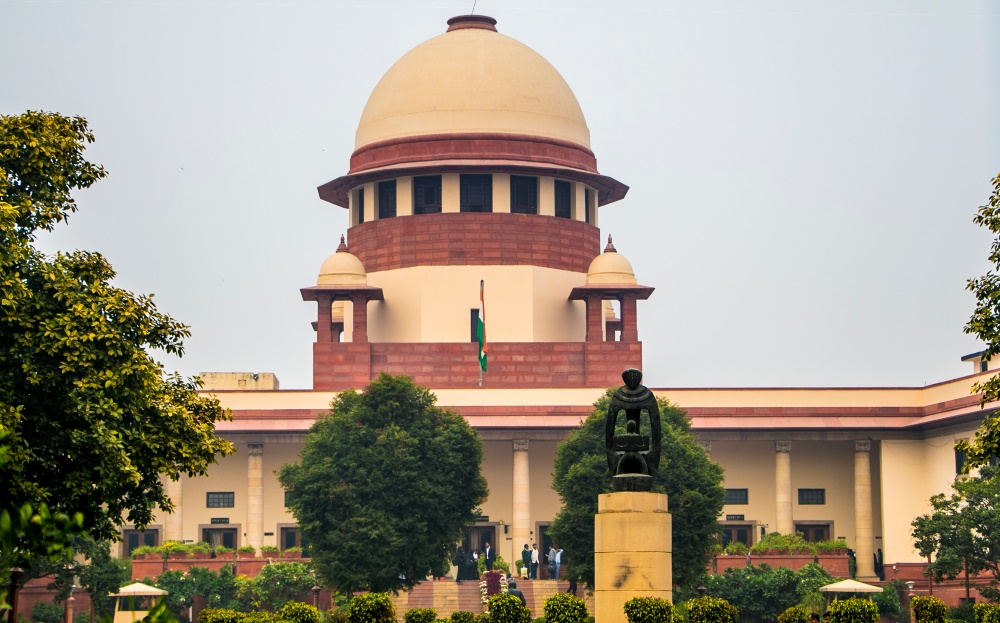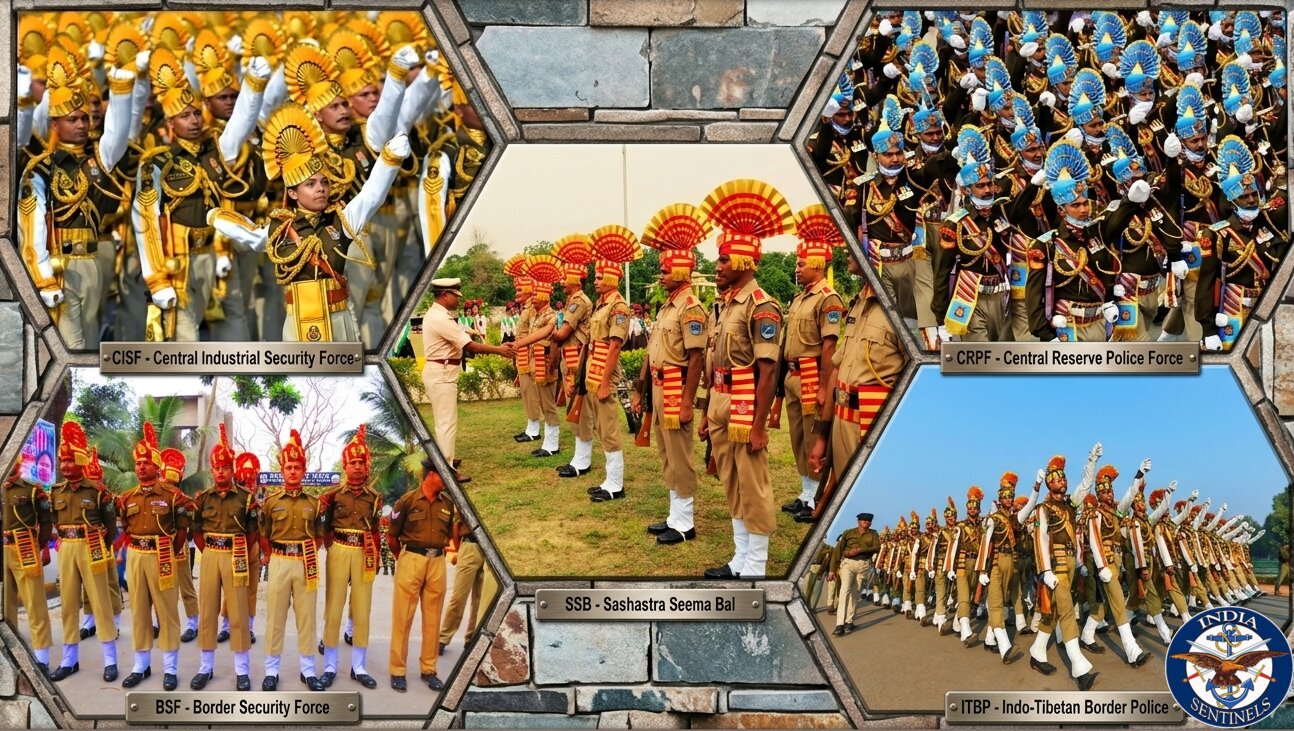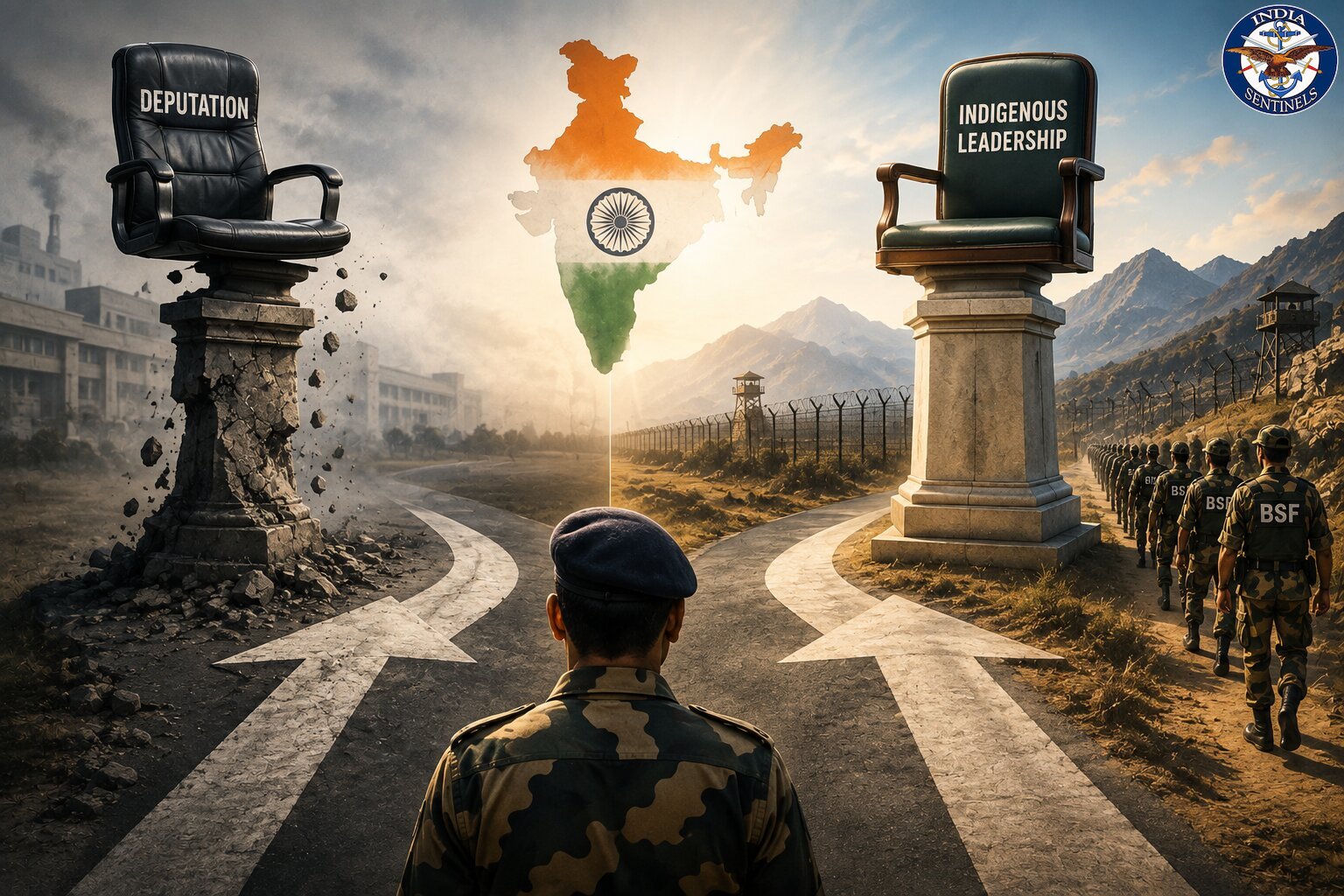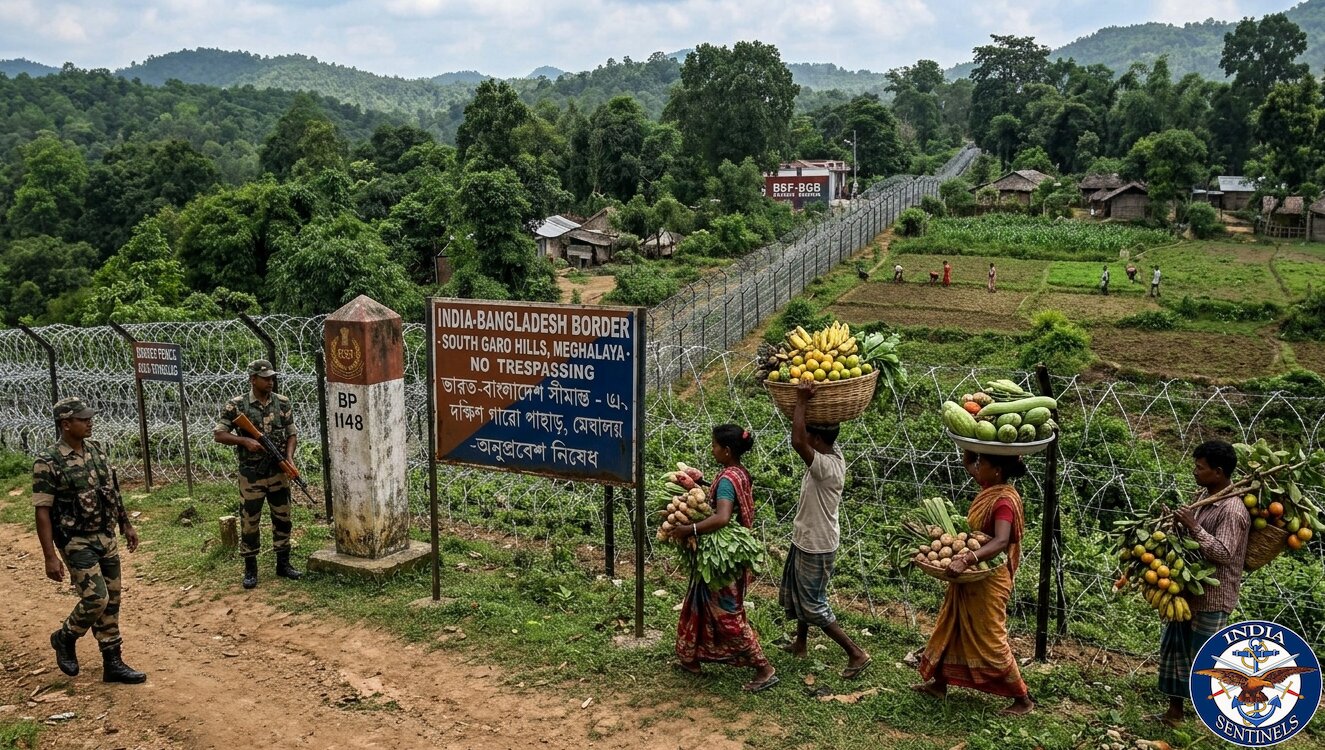
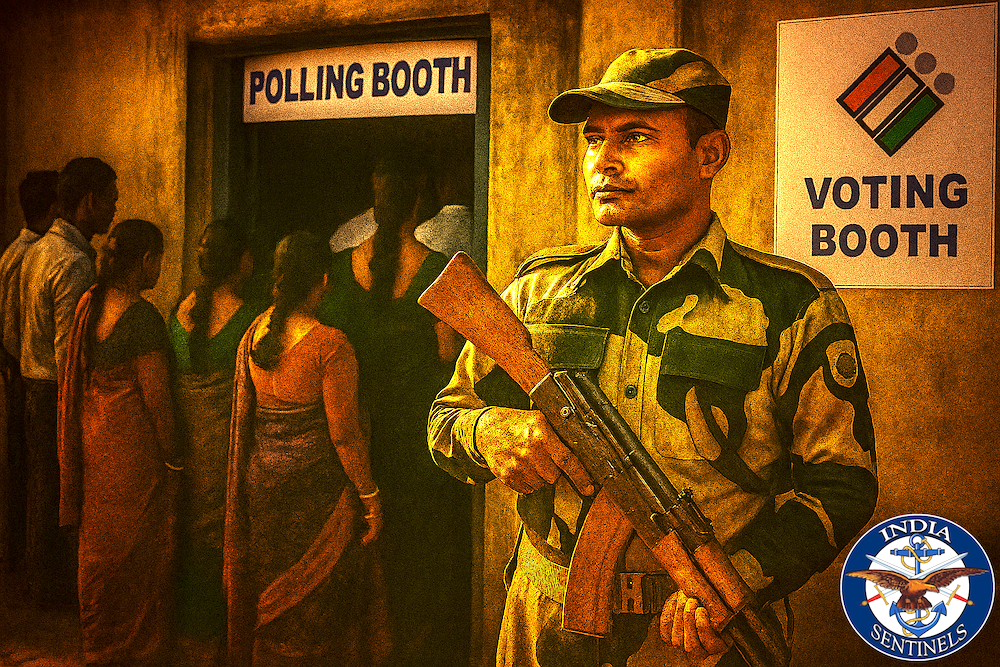
 Illustration for representation. (© India Sentinels 2026–27)
India’s elections are celebrated as the great festival of democracy – a spectacle unmatched in scale and spirit anywhere in the world. Yet, beneath the pageantry of ballot boxes and campaign rallies lies a quietly festering crisis that very few in power are willing to acknowledge: the systematic and reckless diversion of border-guarding forces for election duties, at a grave cost to national security.
This is not a peripheral concern but a structural failure – one that exposes thousands of kilometres of India’s most volatile frontiers to smugglers, infiltrators, illegal immigrants, and, in the worst case, terrorists and insurgents. And yet, election after election, the Ministry of Home Affairs continues to treat this as an acceptable inconvenience rather than the strategic blunder it truly is.
On March 15, the Election Commission of India announced assembly elections and byelections to five states: Assam, Kerala, Puducherry, Tamil Nadu, and West Bengal. As per the commission’s media release, a staggering 8.5 lakh security personnel would be deployed to ensure free and fair polling. The sheer scale of this mobilization should have prompted careful deliberation. Instead, it triggered what has now become a disturbing routine – the mass pull-out of Border Security Force (BSF) companies from their primary duties along India’s frontiers.
Read also: BSF is an armed force, not police, nation must know
The logic behind this practice is as familiar as it is flawed. State police forces are rarely trusted – by the Election Commission or by political parties – to remain neutral in high-stakes state elections. That distrust, often well-founded, places an enormous and disproportionate burden on the central armed police forces (CAPFs), and especially on the BSF, to fill the vacuum. The result: gaping holes along some of the most sensitive and contested stretches of India’s borders.
The BSF is India’s first line of defence. It guards approximately 7,419.7 kilometres of land borders – nearly 49.11 per cent of India’s total land frontier – running along two of the country’s most sensitive flanks. The India-Pakistan border, spanning Jammu & Kashmir, Punjab, Rajasthan, and Gujarat, is a perennial flashpoint for arms and narcotics smuggling, drone-based infiltration, and cross-border terrorism. The India-Bangladesh border, stretching across West Bengal, Assam, Meghalaya, Tripura, and Mizoram, is the primary corridor for illegal immigration and human trafficking.
When BSF companies are pulled out for election duty, the physical domination of these borders – achieved through round-the-clock patrolling, surveillance, and deployment of troops at forward posts – collapses. The resulting vulnerabilities are not theoretical. They are operational realities that adversaries – state and non-state alike – are well aware of and keenly exploit. Drug cartels, cross-border smugglers, and jihadist networks do not observe election schedules. In fact, they count on them.
Read also: Democratic Dilemma – How elections compromise border security
India’s neighbours have developed a sophisticated understanding of India’s electoral calendar. The withdrawal of BSF companies from their forward positions is not lost on Pakistani intelligence or Bangladeshi criminal networks. These gaps, however temporary they may seem on paper, are windows of opportunity that are routinely exploited. Narcotics worth hundreds of crores have historically been seized in post-election periods – a tell-tale sign of what transits through during the electoral churn.
This is not a new problem, and India has been warned before. The Kargil Review Committee (KRC), set up in the aftermath of the 1999 Kargil war – one of the most painful intelligence and strategic failures in independent India’s history – explicitly recommended that border-guarding forces should be minimally deployed for internal security needs. The committee was categorical: there must be no “cannibalization” of border security forces for secondary roles.
Every government since then has ignored this directive. It has been quietly buried under the weight of political expediency and bureaucratic inertia. The warning from Kargil was not merely procedural – it was born of blood and hard experience. To disregard it, repeatedly and brazenly, is not just a policy failure; it is a dereliction of duty.
Read also: Debunking the myth of IPS superiority over CAPF cadres
There is another dimension to this crisis that is rarely discussed: the fundamental incompatibility between the BSF’s training and the demands of election duty.
The BSF is an armed force. Its soldiers are trained, equipped, and mentally conditioned for combat along borders – for soldiering, not policing. Its mandate is enshrined in the BSF Act and its rules, enacted by Parliament. Its training curriculum is designed to prepare troops for confrontations with armed adversaries, not for crowd management at polling booths.
What makes this worse is a deeply troubling directive that has emerged in recent elections: BSF personnel deployed in West Bengal and Assam were reportedly instructed to carry lathis (batons) during election duty. This instruction is not merely operationally incongruous – it is psychologically damaging. A soldier conditioned to engage with armed threats across a live border cannot, and should not, be re-wired overnight into a baton-wielding crowd-control officer.
Such directives betray a profound ignorance of military psychology and training methodology. In the long run, they risk diluting the combat readiness and operational effectiveness of the very force that stands between India’s borders and its adversaries.
Read also: Commanded Into Crisis – Systematic wrecking of CAPFs’ moral fabric
Responsibility for this state of affairs is diffuse, which is precisely why it persists. The Ministry of Home Affairs (MHA) drives the deployment decisions. The Election Commission sets the demand. The top leadership of the CAPFs, which ought to caution both institutions against the strategic consequences of mass border withdrawals, has – year after year – remained conspicuously silent.
This silence is not neutral. It is complicit. The “wheel-chair administrators” – to borrow a pointed phrase – who sign off on these deployments from air-conditioned offices in Delhi have little appreciation for what happens on a forward border post when one company becomes two platoons, and two platoons become one. The ground reality of border security is not a spreadsheet problem. It is a matter of boots on ground, physical domination of terrain, and the psychological deterrence that comes from visible, sustained presence.
The alternatives are neither radical nor unaffordable. They require political will, institutional honesty, and some degree of imagination – none of which should be in short supply in a nation that prides itself on managing the world’s largest democratic exercise.
Read also: When Leadership Lacks Grounding – The real risk in the CAPF-IPS debate
The Central Reserve Police Force (CRPF), as the nodal force for internal security, has the deepest experience in election duties and internal security management. It should bear the primary burden of electoral deployment, with maximum mobilization ensured well before election schedules are finalized. The Central Industrial Security Force (CISF), whose personnel are trained for security duties in civilian environments, is another underutilized resource that can be deployed to supplement CRPF strength.
State police forces and state armed police battalions – drawn from across India, not just from the election state – represent another significant reserve. The instinctive distrust of local police can be addressed by deploying forces from distant states where political affiliations and local pressures are irrelevant. This is not an untested idea; it has been used effectively in the past and can be systematized further.
Crucially, the planning must begin far earlier. The Election Commission and the MHA must initiate the force-requirement assessment months before elections are announced – not weeks after. State police and local election authorities invariably project inflated force requirements. These projections must be independently vetted by security experts with operational credibility, not rubber-stamped by bureaucrats with no experience of ground realities.
Read also: Stagnant Ranks, Broken Morale – The cost of CAPF’s skewed HR policies
If this exercise were conducted with professional rigour, the need to cannibalize border security forces would reduce dramatically, if not disappear entirely.
The frequency with which the BSF is withdrawn for internal security and election duties is also a damning indictment of India’s failure to build adequate institutional capacity for internal security. Expanding and professionalizing the CAPFs, strengthening state police forces, and upgrading state armed police battalions should have been sustained national priorities. Instead, they have been neglected, leaving the BSF – a border-guarding force – to serve as the de facto reserve army for every domestic emergency.
This failure belongs equally to successive governments and to the Indian Police Service, which has historically resisted structural reforms that might dilute its administrative dominance over the police apparatus. The cost of that resistance is being borne, silently and invisibly, along India’s frontiers.
Exposing nearly half of India’s land borders – borders that are contested, infiltrated, and under constant adversarial pressure – for the sake of electoral management is not a compromise. It is a gamble with national security, and it is a gamble India has been taking for far too long.
Read also: Chanakya’s Warning and India’s Shame – How the state fails its CAPFs
The festival of democracy must not become a festival of vulnerability. It is not too late to reform. The modalities for deploying security forces without compromising border duties can – and must – be worked out. What is required is not ingenuity so much as integrity: the willingness of policymakers, security advisors, and the CAPF leadership to speak the truth to power, even when that truth is inconvenient.
Cut-and-paste electoral deployments, recycled from one election to the next without analysis or accountability, are no longer acceptable. India’s borders, and the men and women who guard them, deserve better.
Disclaimer: The views expressed in the article are the author’s own and don’t necessarily reflect the views of India Sentinels.
Follow us on social media for quick updates, new photos, videos, and more.
X: https://x.com/indiasentinels
Facebook: https://facebook.com/indiasentinels
Instagram: https://instagram.com/indiasentinels
YouTube: https://youtube.com/indiasentinels
© India Sentinels 2026-27